



What Is a Ductless AC and How Does It Work? (Quick Answer)
How does a ductless AC work is a question more and more Seattle-area homeowners are asking — and for good reason. If you’ve ever dealt with rooms that stay stuffy no matter how high you crank the thermostat, or you’re adding a new space to your home without existing ductwork, a ductless mini-split system might be exactly what you need.
Here’s the short answer before we dive deeper:
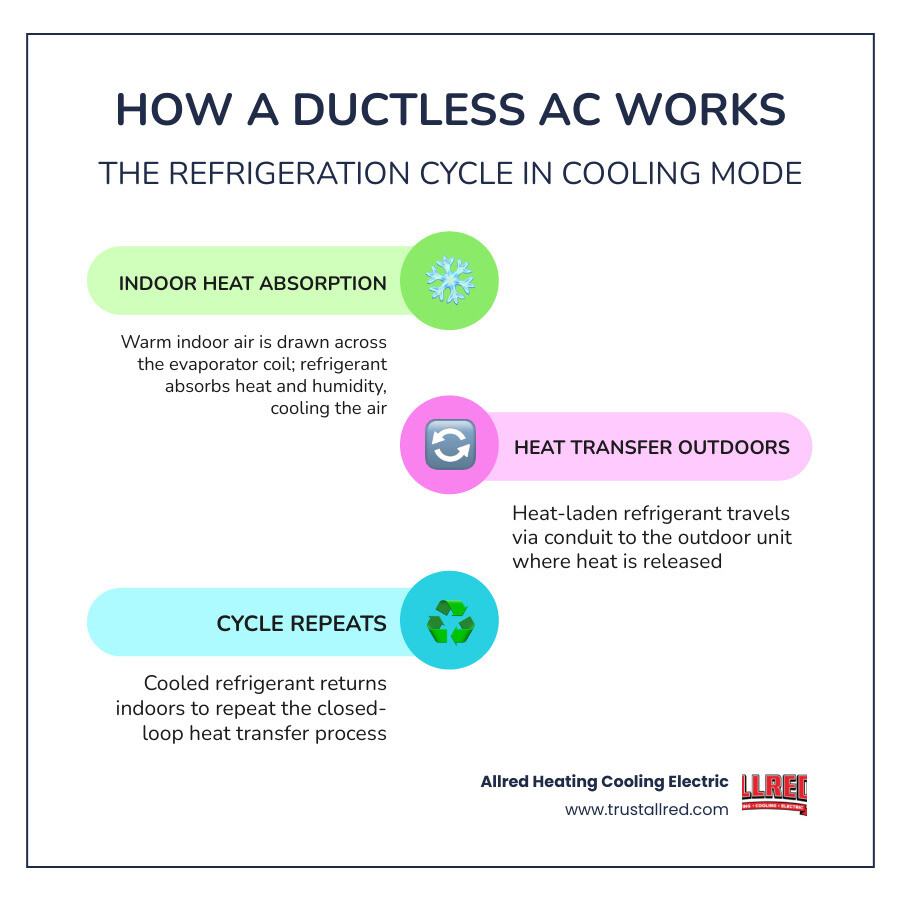
How a ductless AC works — at a glance:
- Warm indoor air is drawn across a refrigerant-filled coil inside the indoor air handler
- The refrigerant absorbs heat from that air, cooling it down and removing humidity
- The cooled air is blown back into the room directly — no ducts needed
- The heat-laden refrigerant travels through a small conduit to the outdoor unit
- The outdoor unit releases the heat outside and sends the refrigerant back indoors to repeat the cycle
In heating mode, the process simply runs in reverse — pulling heat from outdoor air and delivering it inside.
Unlike central AC, which pushes conditioned air through a network of ducts, a ductless system delivers comfort directly where you need it. That means no energy lost through leaky ductwork, which can account for 20–30% of cooling energy in a typical home.
My name is Daniel Allred, and as an HVAC professional and co-founder of Allred Heating, Cooling & Electric serving the Puget Sound region, I’ve helped countless homeowners understand how does a ductless AC work and whether it’s the right fit for their home. In the sections below, I’ll walk you through everything — from the refrigeration cycle to sizing, installation, and maintenance — so you can make a confident, informed decision.
Important how does a ductless ac work terms:
What is a Ductless Mini-Split and How Does It Differ From Central AC?
To understand how a ductless system operates, it helps to compare it to the system most Americans grew up with: central air conditioning.
A traditional central air system relies on a single, large indoor unit (often located in a basement, attic, or utility closet) that cools air and distributes it throughout the home via a massive network of sheet metal or flexible ducts.
A ductless mini-split system, on the other hand, completely eliminates the middleman. Instead of pushing air through hundreds of feet of dusty, hidden ductwork, it uses small, individual indoor air handlers mounted directly on the walls, ceilings, or floors of the rooms you actually use. These indoor units are connected directly to an outdoor compressor by a small, three-inch conduit containing electrical wiring and refrigerant lines.
This structural difference changes everything when it comes to efficiency, air distribution, and installation. If you are debating which setup fits your home, you can read our detailed breakdown on Is a Ductless System Better Than Central Air for Your Home?.
| Feature | Ductless Mini-Split System | Traditional Central AC |
|---|---|---|
| Ductwork Required | No | Yes |
| Energy Loss | Virtually 0% (No duct leakage) | 20% to 30% due to leaks and unconditioned spaces |
| Zoned Control | Yes (Every room has its own thermostat) | No (One thermostat controls the whole house) |
| Noise Levels | Extremely quiet (20–32 dB indoors) | Moderate to loud (Air rushing through vents) |
| Aesthetic Impact | Visible indoor wall/ceiling units | Hidden behind registers and grilles |
| Lifespan | 15 to 20 years | 12 to 15 years |
The Core Differences in Air Distribution
In a central air system, the central blower has to work incredibly hard to create enough static pressure to push conditioned air to the furthest corners of your home. Along the way, that cold air travels through unconditioned spaces like your attic or crawlspace. If there are any cracks, loose tape, or holes in those ducts — which is incredibly common in Puget Sound homes — you lose a massive chunk of your cooling capacity before the air ever reaches your living spaces.
Ductless systems offer localized cooling. Because each indoor head contains its own quiet blower fan, it delivers conditioned air directly into the room where it is installed. This bypasses the friction, static pressure issues, and thermal loss associated with ductwork. We break down these differences further in our Northwest HVAC Showdown: Ductless Mini Splits vs Central Air.
Why Homeowners Choose Ductless Systems
In our experience serving communities from Bellevue and Redmond down to Tacoma and Puyallup, we find that homeowners typically choose ductless systems for a few key reasons:
- Older Homes: Many historic homes in neighborhoods like Tacoma, Snoqualmie, or North Bend were built with radiant heat or baseboards and have no existing ductwork. Retrofitting these homes with central air requires tearing open walls and lowering ceilings to build bulkheads, which ruins the home’s historic charm. Ductless systems bypass this issue entirely.
- Home Additions & Renovations: If you are converting a garage in Auburn, finishing a basement in Kent, or building an accessory dwelling unit (ADU) in Kirkland, extending your existing central HVAC system is often impractical or outright impossible. A ductless system provides independent, localized climate control.
- Sunrooms and Bonus Rooms: Rooms with lots of glass or those situated above garages often get incredibly hot in the summer. A single-zone mini-split can target these specific trouble spots without forcing your main HVAC system to run constantly.
Determining which system is right for your unique layout is a critical step in home comfort. For a comprehensive guide on making this decision, check out our resource on Choosing Right HVAC System.
How Does a Ductless AC Work? The Refrigeration Cycle Explained
No matter how modern or sleek they look, ductless systems still rely on the fundamental laws of thermodynamics. They do not actually “create” cold air; instead, they act as heat transporters, moving thermal energy from one location to another using a closed-loop refrigerant cycle.
The system uses a chemical refrigerant that easily transitions between liquid and gas states at various temperatures and pressures. By manipulating these states, the system can absorb heat from inside your home and dump it outdoors. If you want to explore the basics of this technology, you can read more about Mini Split Air Conditioning.

How Does a Ductless AC Work in Cooling Mode?
When you set your ductless thermostat to “Cool” on a warm summer day in Federal Way or Sammamish, a continuous four-phase vapor-compression cycle begins:
- Evaporation (Inside the Room): The indoor unit’s blower fan draws warm room air across the cold evaporator coil. Liquid refrigerant flowing through the coil absorbs the heat from the air. As the refrigerant absorbs this heat, it warms up and evaporates into a low-pressure gas. Meanwhile, the cooled air is blown back into your room.
- Compression (Outside the House): This low-pressure gas travels through the insulated copper lines in the wall conduit to the outdoor compressor. The compressor squeezes the refrigerant gas, packed with indoor heat, raising both its pressure and temperature.
- Condensation (Outside the House): The high-pressure, hot gas enters the outdoor condenser coil. A large fan blows outdoor air across this coil, transferring the heat from the refrigerant into the outdoor air. As it cools down, the refrigerant condenses back into a high-pressure liquid.
- Expansion (Inside the Conduit): Before returning to the indoor unit, the liquid refrigerant passes through an expansion valve. This valve rapidly drops the pressure of the refrigerant, cooling it down dramatically. It is now a cold, low-pressure liquid, ready to enter the indoor unit and start the cycle all over again.
During this process, moisture from your indoor air naturally condenses on the cold indoor coils. This water is collected in a small pan and carried safely outside through a gravity-fed or pump-assisted condensate drain line, lowering the humidity levels in your home and keeping you feeling much cooler.
How Does a Ductless AC Work in Heating Mode?
One of the most incredible aspects of a ductless mini-split is that it is almost always a heat pump. This means it can reverse its entire operation to keep you warm and cozy during our damp, chilly Pacific Northwest winters.
Inside the outdoor unit sits a clever component called a reversing valve. When you switch your system to heat mode:
- The reversing valve changes the direction of the refrigerant flow.
- The outdoor coil now acts as the evaporator, extracting ambient heat from the outdoor air (yes, even when it is freezing outside, there is still usable heat energy in the air!).
- The compressor pressurizes this extracted heat, turning it into a hot gas.
- The hot refrigerant travels indoors to the wall-mounted air handler, which now acts as the condenser.
- The indoor fan blows air across the hot coils, warming your room, while the refrigerant condenses and returns outside to harvest more heat.
Modern cold-climate ductless heat pumps are incredibly advanced. Many systems can operate at high heating capacities even when outdoor temperatures drop well below freezing, making them a highly reliable primary heat source for homes in Snoqualmie, North Bend, and across Western Washington.
Key Components of a Ductless Mini-Split System
A ductless system is elegant in its simplicity. Instead of a massive furnace, extensive duct runs, and a loud outdoor unit, a mini-split consists of just a few key components designed to blend seamlessly into your home.
If you are curious about how these systems integrate into older or historic properties, check out our detailed guide on The Ins and Outs of Ductless AC Pros and Cons for Older Homes.
The Indoor Air Handler
The indoor air handler is the visible portion of the system installed inside your living space. While high wall-mounted units are the most common, they also come in floor-mounted consoles, ceiling cassettes (which sit flush with your ceiling), and slim duct options that can be hidden in closets or joist spaces.
Inside this unit, you will find:
- The Evaporator Coil: Where the heat transfer takes place.
- A Multi-Speed Blower Fan: Which uses a quiet, brushless motor to gently circulate air.
- Air Filtration: Built-in mesh filters trap dust, pollen, and pet dander.
Because the air is filtered right at the point of delivery rather than traveling through dusty duct channels, these systems can dramatically improve your home’s air quality. You can read more about this benefit in our article on how Ductless AC Services Improve Air Quality.
The Outdoor Condenser and Compressor
The outdoor unit houses the compressor, condenser coil, fan, and control board. In a high-quality ductless system, this unit utilizes advanced inverter technology.
Traditional central AC systems operate like a single-speed light switch: they are either 100% on or completely off. This leads to temperature swings, loud startup noises, and high energy usage.
Inverter compressors, however, operate more like cruise control on a car. They can continuously modulate their speed up and down in tiny increments to match the exact cooling or heating load of your home. If a room only needs a tiny bit of cooling to stay at its setpoint, the compressor will run at a whisper-quiet 10% capacity, saving you a massive amount of energy and keeping indoor noise levels down to an unnoticeable hum.
Single-Zone vs. Multi-Zone Ductless Systems
Ductless systems are highly modular, which gives you incredible flexibility when designing a comfort solution for your home. Depending on your goals, you can choose between single-zone and multi-zone configurations.
To understand how these configurations translate to daily comfort and energy savings, take a look at our article on the Benefits Ductless AC Systems Home.
Single-Zone Configurations
A single-zone system consists of one outdoor compressor connected to exactly one indoor air handler. This is the ideal option if you have a single “problem room” that your central system can’t quite keep comfortable, or if you are adding a standalone space like a home office in Redmond, a garage workshop in Puyallup, or a primary suite addition in Issaquah.
Single-zone systems are incredibly efficient, quick to install, and offer pinpointed comfort for individual spaces.
Multi-Zone Configurations
A multi-zone system allows you to connect multiple indoor air handlers (often up to five or more) to a single, robust outdoor compressor. Each indoor unit is controlled by its own wireless remote or wall-mounted thermostat.
This setup allows you to create completely independent temperature zones throughout your home. For example, you can keep your upstairs bedrooms cool and comfortable for sleeping at night while turning off the indoor units in your downstairs living room or kitchen to save energy. It also resolves classic household arguments over the thermostat; one family member can keep their home office warm while another enjoys a cool, breezy bedroom.
Sizing, Installation, and Maintenance Essentials
While understanding how does a ductless ac work is helpful, ensuring the system is correctly sized, professionally installed, and properly maintained is what guarantees decades of reliable comfort.
If you want to know what to expect during the setup process, we have compiled an excellent overview in our guide on Efficient Ductless Mini Split Installation.
Determining the Right BTU Capacity
Air conditioning capacity is measured in British Thermal Units (BTUs). One BTU is the amount of heat energy required to raise the temperature of one pound of water by one degree Fahrenheit.
Sizing a ductless system is not as simple as matching square footage to a generic chart. If a unit is too small, it will run constantly without ever making the room comfortable. If it is oversized, it will rapidly cool the space and shut off — a process known as short-cycling. Short-cycling prevents the system from running long enough to pull humidity out of the air, leaving your home feeling clammy, and it puts unnecessary wear and tear on the compressor.
To size a system correctly, our expert technicians perform an ACCA Manual J load calculation. This calculation takes into account:
- Total square footage and ceiling height.
- The insulation values of your walls and attic.
- The number, size, and orientation of your windows (west-facing windows in Western Washington catch intense afternoon sun!).
- Local climate patterns in your specific city (e.g., Snoqualmie vs. Tacoma).
- Heat-generating appliances in the room (like kitchens or home theaters).
Proper Maintenance for Longevity
Ductless mini-splits are incredibly durable, often lasting up to 20 years with proper care. However, because they recirculate indoor air directly, they do require a bit of simple, regular maintenance:
- Clean the Filters (Every 2–4 Weeks): This is the most important step! Most indoor units have pop-open front panels with washable mesh filters. Simply slide them out, vacuum away any dust, rinse them under warm water, let them dry completely, and slide them back in. Clean filters keep airflow high and protect the indoor coil from getting clogged with dust.
- Keep the Outdoor Unit Clear: Ensure that leaves, dirt, weeds, or snow do not accumulate around your outdoor unit. It needs plenty of open space to draw in and exhaust air efficiently.
- Professional Annual Service: We recommend scheduling a professional maintenance visit once a year. Our technicians will deep-clean the indoor evaporator coils, flush the condensate drain lines to prevent clogs and water leaks, test electrical connections, and verify that the refrigerant levels are perfectly balanced.
Frequently Asked Questions About Ductless AC
Do ductless air conditioners pull fresh air from the outside?
No, ductless air conditioners do not pull air from the outside. This is a very common myth! The conduit connecting the indoor and outdoor units only carries copper refrigerant lines, electrical wiring, and a drain tube. No air is exchanged between the inside and outside.
Instead, the indoor unit continuously recirculates and filters the air already inside your room, cooling or heating it as it passes across the internal coils.
How long do ductless mini-split systems typically last?
With regular homeowner maintenance (like cleaning the filters) and annual professional tune-ups, a high-quality ductless mini-split system can easily last 15 to 20 years. This is notably longer than the average 12-to-15-year lifespan of a traditional central air conditioner, largely due to the gentle, variable-speed operation of inverter compressors which reduces wear and tear on the system.
Are ductless AC systems highly energy efficient?
Yes, ductless systems are among the most energy-efficient heating and cooling options on the market today. Because they do not use ducts, they completely eliminate duct leakage, which is responsible for up to 30% of energy loss in traditional homes.
Furthermore, because they utilize inverter-driven compressors that run at low, steady speeds rather than turning on and off constantly, they use a fraction of the electricity required by standard HVAC systems or noisy window units.
Conclusion
Understanding how does a ductless ac work reveals why these systems have become the preferred comfort solution for so many homeowners across the Puget Sound region. By delivering targeted, energy-efficient heating and cooling directly to individual rooms, ductless mini-splits bypass the energy losses, structural headaches, and uneven temperatures associated with traditional central systems.
Whether you are looking to cool a single room addition in Bellevue, solve temperature imbalances in your Puyallup home, or transition your historic Tacoma property to highly efficient heat pump technology, our family-oriented team at Allred Heating, Cooling & Electric is here to help. Our highly rated, expert technicians are dedicated to ensuring your year-round comfort with honest, professional service.
