



Is a Ductless System Better Than Central Air for Your Seattle Home?
A central ac vs ductless mini split comparison comes down to a few key differences that matter most for your home’s layout, existing infrastructure, and how you use your space day to day:
| Factor | Central AC | Ductless Mini-Split |
|---|---|---|
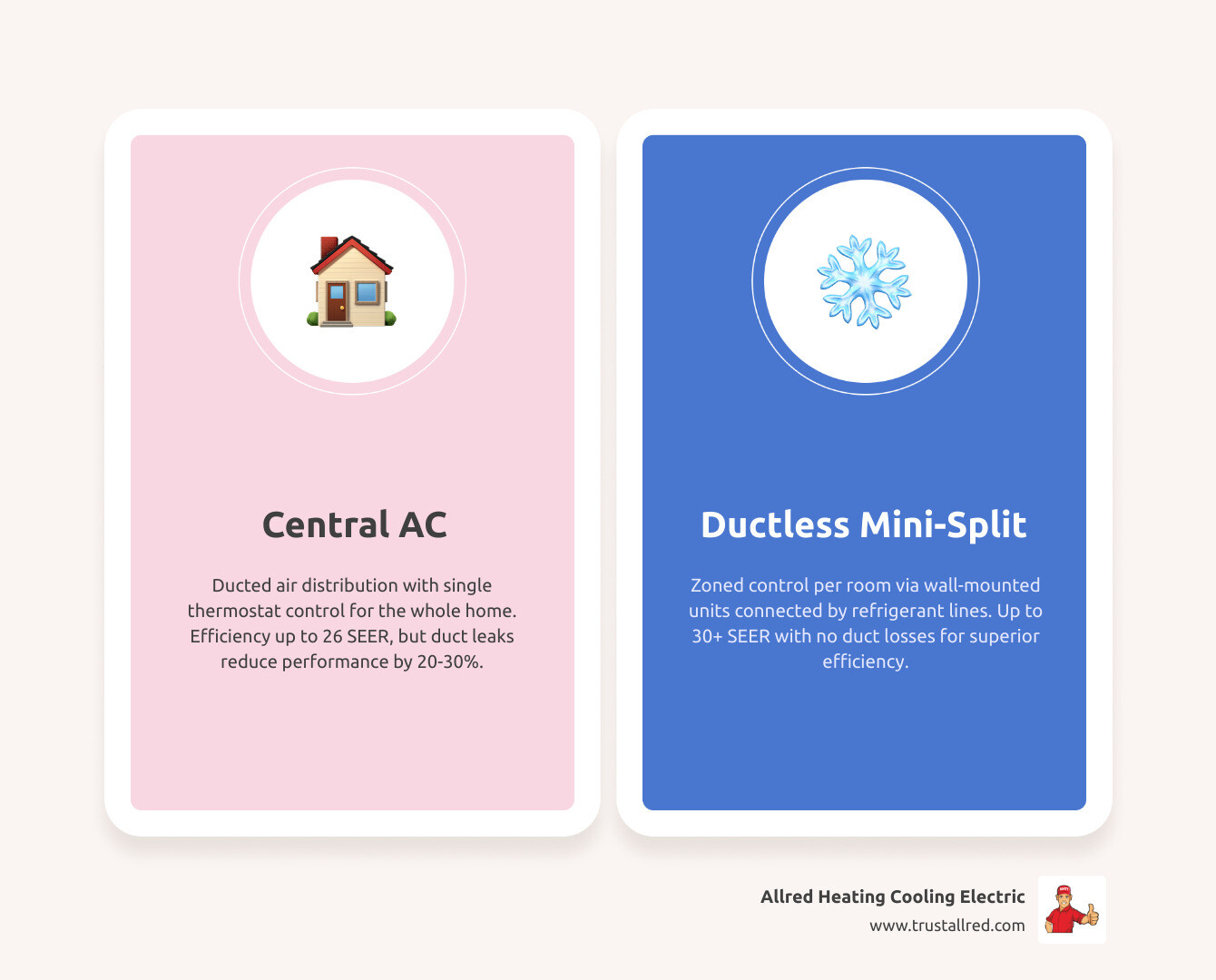
| Air Distribution | Uses ductwork throughout the home | Refrigerant lines connect to wall-mounted indoor units |
| Temperature Control | Single thermostat for whole home | Independent zone control per room |
| Best For | Homes with existing, well-sealed ductwork | Homes without ducts, additions, or rooms needing zoned comfort |
| Energy Efficiency | Up to 26 SEER; duct leaks can reduce real-world efficiency by 20-30% | Up to 30+ SEER; no duct losses |
| Installation | Less disruptive if ducts already exist | Minimal construction required; typically 1-2 days |
| Aesthetics | Hidden components; only vents visible | Wall-mounted units are visible in each room |
| Heating | Typically cooling only; needs separate furnace | Most units are heat pumps that handle both heating and cooling |
Neither system is the clear winner for every home. The right choice depends on your ductwork, how many rooms you need to cool, and your energy priorities. In Seattle’s climate, where summers are warming and energy costs are a real concern, both options deserve a careful look before you decide.
I’m Daniel Allred, co-founder of Allred Heating, Cooling & Electric, and I’ve spent years helping Puget Sound homeowners navigate exactly this central ac vs ductless mini split comparison — from older craftsman homes with no ductwork to newer builds where central systems make perfect sense. Let’s walk through everything you need to know to make the right call for your home.
Understanding the Core Technology Differences in 2026
As we move through 2026, the technology behind home cooling has become more sophisticated than ever. To make an informed central ac vs ductless mini split comparison, we first have to look under the hood at how these systems actually move heat out of your home.
How Central AC Works
Traditional central air conditioning is a “whole-house” solution. It relies on a large outdoor condenser unit paired with an indoor air handler and evaporator coil (often sitting on top of your furnace). The system cools a large volume of air at once and uses a powerful blower motor to push that air through a network of metal or flexible ducts hidden in your walls, attic, or crawl space. It is controlled by a single thermostat, meaning the temperature you set in the hallway is the temperature the system tries to achieve everywhere.
How Ductless Mini-Splits Work
A Mini-Split Air Conditioning system takes a different approach. Instead of one giant indoor unit, it uses several smaller indoor air handlers mounted directly on the walls or ceilings of specific rooms. These units are connected to an outdoor compressor via small refrigerant lines, suction lines, and power cables that pass through a tiny 3-inch hole in your exterior wall. Because there are no ducts, there is no need for a massive blower to move air across the house. Each indoor unit operates independently, allowing you to cool the kitchen while leaving the guest bedroom off.
Key Factors in Your Central AC vs Ductless Mini Split Comparison
When we sit down with homeowners in Auburn or Bellevue to discuss their options, we look at several “make-or-break” factors. In 2026, the standards for efficiency (SEER2) have shifted, making it even more important to choose a system that fits your specific lifestyle.
| Feature | Central AC | Ductless Mini-Split |
|---|---|---|
| Zoning | Possible with expensive dampers | Built-in; every room is a zone |
| Noise (Indoor) | Moderate (whoosh of air) | Whisper quiet (19-26 dB) |
| Maintenance | Duct cleaning + filter changes | Frequent filter washing per unit |
| Resale Value | Standard expectation in modern homes | High value in older or high-end homes |
If you are looking at Air Conditioning Replacement, the first question is always: How is your current ductwork? If your ducts are in great shape, central AC is often the most straightforward path. If you live in an older home in Tacoma or Issaquah that was built with baseboard heat and no ducts, mini-splits are almost always the superior choice.
Energy Efficiency: A Central AC vs Ductless Mini Split Comparison
Efficiency is where the central ac vs ductless mini split comparison gets really interesting. On paper, mini-splits win the SEER2 (Seasonal Energy Efficiency Ratio) race. While high-end central systems can reach about 21 to 26 SEER, top-tier ductless systems are now pushing past 30 SEER.
But the real-world difference is even larger. In a central system, the Department of Energy estimates that ductwork can waste 10% to 30% of cooled air through leaks or poor insulation in attics. Essentially, you are paying to cool your crawl space. Ductless systems eliminate this loss entirely. Furthermore, mini-splits use inverter technology—think of it like a dimmer switch rather than an on/off switch—allowing the compressor to scale its energy use up or down precisely. This precision is why Ductless AC Services Improve Air Quality and efficiency simultaneously, as they don’t over-cool and then shut off abruptly.
Installation Requirements: Central AC vs Ductless Mini Split Comparison
The “invasiveness” of the installation is a major factor for many of our neighbors in Puyallup and Redmond.
- Central AC: If you have existing ducts, we can often swap out your old unit in a day. However, if you need to install new ductwork in an existing home, it can be a massive project involving cutting into drywall, losing closet space for “chases,” and weeks of construction.
- Ductless Mini-Split: These are remarkably flexible. We can install a single-zone unit in a day or a multi-zone system for the whole house in about 48 hours. Since they only require a small hole for refrigerant lines, the structural impact on your home is minimal. This is one of the most important things What You Should Know About Mini-Split Heat Pumps—they go where ducts can’t, like finished basements, sunrooms, or historic homes.
Performance, Climate, and Maintenance Needs
In the Pacific Northwest, we don’t just deal with heat; we deal with damp winters and occasional cold snaps. This is where the “heat pump” aspect of these systems shines. Most modern mini-splits are actually heat pumps, meaning they provide both cooling in July and highly efficient heating in January.
There are Five Reasons You Need to Get a Heat Pump, including the fact that they are significantly more efficient than electric baseboards or old furnaces. Some “hyper-heat” mini-split models can even keep your home warm when outside temperatures drop to -5°F, which is more than enough for our typical Western Washington winters.
Maintenance Comparison
Maintenance is non-negotiable for both systems if you want them to last.
- Central AC: You need to change the main air filter every 1 to 3 months. You also have to consider the Importance of Regular Ductwork Maintenance. Over time, ducts collect dust, pet dander, and can even develop leaks that need sealing.
- Ductless Mini-Split: Each indoor unit has its own filter. Because these filters are smaller, they need to be popped out and rinsed under a tap every 2 to 4 weeks. It’s a simple 5-minute DIY task, but it’s more frequent than central air.
Regardless of which you choose, we highly recommend Annual HVAC Maintenance Plans to ensure your refrigerant levels are correct and your condensate lines are clear. A well-maintained system can last 15 to 20 years, whereas a neglected one might fail in 10.
Frequently Asked Questions
Can a mini-split cool an entire home?
Yes, absolutely! While many people think of mini-splits as “one-room solutions,” modern multi-zone compressors can support up to eight indoor units. This allows you to create a “whole-home” ductless system where every bedroom, the living room, and even the kitchen has its own independent climate control. Many of our customers in Kent and Maple Valley find this “zoned” approach much more comfortable than central air because it solves the “hot upstairs bedroom” problem common in two-story homes. You can find more answers to common queries in our HVAC System FAQ.
Which system has a longer lifespan?
Both systems typically last between 15 and 20 years. However, mini-splits often have a slight edge in longevity (sometimes reaching 20-25 years) because they don’t have to work as hard to push air through restrictive ductwork. The key to durability isn’t just the brand; it’s the quality of the installation and following HVAC Maintenance Tips for Long-Lasting Systems.
Is central air better for air quality?
Central air systems have a slight advantage in air filtration because they can accommodate thick, high-MERV (Minimum Efficiency Reporting Value) filters that trap very fine particles. They also allow for the easy addition of whole-home humidifiers or UV air purifiers. However, mini-splits can actually provide cleaner air in some cases because they don’t have ducts where dust and mold can accumulate over decades. To keep either system running cleanly, you should Enhance Air Quality with New Filter Services regularly.
Conclusion
Choosing between central AC and a ductless mini-split isn’t about finding the “best” technology—it’s about finding the best fit for your specific Seattle-area home. If you have a newer home with great ducts, a central system is a reliable, invisible workhorse. If you’re looking to upgrade an older home, cool a new addition, or finally stop the “thermostat wars” in your household, a ductless system offers efficiency and control that is hard to beat.
At Allred Heating Cooling Electric, we take a family-oriented approach to HVAC. We aren’t here to sell you the most expensive system; we’re here to ensure your family stays comfortable in Auburn, Tacoma, Bellevue, and beyond. Our expert technicians are available 24/7 for emergencies, but we’d much rather help you plan the perfect cooling upgrade before the next heatwave hits.
Ready to see which system wins in your home? Schedule your central AC or ductless consultation today with the Allred team. We’ll perform a full assessment of your layout and help you choose the system that will keep you cool for the next two decades.
