



Are Ductless AC Pros and Cons for Older Homes Worth Knowing Before You Buy?
Ductless AC pros and cons for older homes come down to a clear trade-off that every Seattle-area homeowner should understand before making a decision:
Pros:
- No ductwork required — ideal for homes built without it
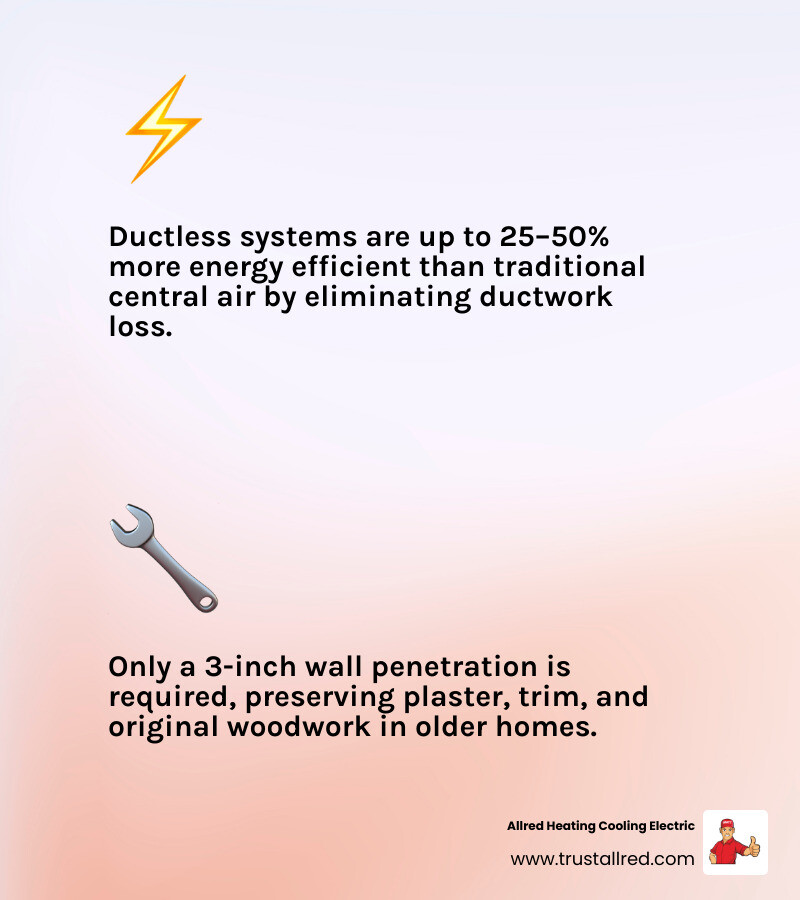
- Up to 25–50% more energy efficient than traditional central air
- Zoned control lets you heat or cool individual rooms independently
- Installation requires only a 3-inch wall hole, preserving plaster, trim, and original woodwork
- Operates as quietly as 24 decibels — quieter than a whisper
- Works as a heat pump for year-round comfort
- Modern cold-climate models maintain heating capacity even at 5°F
Cons:
- Higher upfront cost than some alternatives
- Indoor wall-mounted units are visible and may not suit every aesthetic
- Older homes may need electrical panel upgrades before installation
- Requires more frequent filter cleaning than central air (every 2–4 weeks)
- Placement errors can create uneven temperatures in larger open spaces
If your older home lacks ductwork — or if retrofitting ducts would mean tearing through plaster walls and original woodwork — a ductless mini-split is almost always the smarter path forward. If your home already has well-sealed, properly insulated ducts in good condition, central air may still be worth considering.
Older homes in the Pacific Northwest are full of charm, but they come with real comfort challenges. Drafty windows, poor insulation, and no existing ductwork can leave some rooms roasting in summer and freezing in winter — all while driving energy bills through the roof. That’s exactly why so many homeowners in Seattle and the surrounding area are asking whether ductless mini-splits are the right answer.
I’m Daniel Allred, co-founder of Allred Heating, Cooling & Electric, and I’ve spent years helping Pacific Northwest homeowners navigate the ductless AC pros and cons for older homes — from century-old Craftsman bungalows in Seattle to vintage farmhouses throughout the Puget Sound region. In the sections below, I’ll walk you through everything you need to know to make a confident, informed decision for your home.
The Major Ductless AC Pros and Cons for Older Homes
When we talk about ductless ac pros and cons for older homes, the conversation usually starts with energy efficiency. Traditional HVAC systems can lose between 20% and 30% of their conditioned air through leaky or poorly connected ducts. In an older home where ducts might be original or run through uninsulated crawlspaces, that loss can be even higher. Ductless systems deliver air directly into the room, eliminating duct loss entirely.
Efficiency and Inverter Technology
Most modern ductless systems utilize inverter technology. Think of it like a dimmer switch for your cooling. Traditional systems are either “on” at 100% power or “off,” which leads to inefficient temperature swings. Inverter-driven compressors adjust their speed continuously to maintain a steady temperature. This precision can reduce energy bills by as much as 30% to 50% compared to traditional systems.
Zoned Comfort vs. Aesthetic Impact
One of the biggest “pros” is zoned comfort. If you have a classic two-story home in Auburn or Kent, you know the struggle of the upstairs being 10 degrees warmer than the downstairs. Ductless units allow you to set the temperature for each room individually.
The “con” most homeowners mention is the aesthetic impact. These units sit on your wall or ceiling. While modern designs are sleek and project only about 8 to 10 inches, they are visible. However, for many, the trade-off for whisper-quiet operation (as low as 24 decibels) and perfect comfort is well worth it. To keep these systems running at peak levels, you can learn more about how a Ductless Mini Split for Optimal Performance makes a difference.
Why Ductless Systems Outshine Central Air in Vintage Properties
For many vintage properties in the Puget Sound, central air isn’t just difficult—it’s invasive. Most homes built before the mid-20th century weren’t designed with bulky ductwork in mind. Retrofitting central AC often requires lowering ceilings, cutting into original plaster, and sacrificing precious closet space to hide the “tin.”
Structural Integrity and Plaster Walls
Older homes often feature lath and plaster walls. These are beautiful but notoriously difficult to work with. Cutting large holes for vents can cause plaster to crack and crumble. Ductless systems bypass this headache. We only need to drill a small 3-inch hole to connect the indoor unit to the outdoor condenser. This preserves the structural integrity of your home while providing modern climate control.
| Feature | Ductless Mini-Split | Traditional Central AC |
|---|---|---|
| Installation Impact | Minimal (3-inch hole) | Major (Wall/ceiling demolition) |
| Energy Loss | 0% (No ducts) | 20-30% (Duct leaks) |
| Zoning | Standard (Room by room) | Rare/Expensive (Add-on) |
| Noise Level | 24–30 dB (Whisper) | 40–60 dB (Noticeable) |
| SEER Rating | 18–30+ | 14–22 |
If you are looking for specific solutions for your neighborhood, our team handles HVAC Seattle Ductless AC installations regularly, ensuring that even the most historic homes stay cool without losing their soul.
Preserving Architectural Integrity with Ductless AC Pros and Cons for Older Homes
The primary concern for owners of historic homes in Browns Point or Tacoma is often preservation. You’ve likely spent years maintaining original crown molding, built-in bookshelves, and hand-carved woodwork. The last thing you want is a generic metal vent slapped in the middle of a Victorian ceiling.
Ductless systems are the “Gold Star Standard” for preservation. Because they require so little space, we can often mount them in discreet locations that don’t distract from the home’s character. Whether you choose wall-mounted units, floor-mounted models, or ceiling cassettes, the impact on your architecture is negligible. For those living in specific coastal or historic areas, we offer tailored advice on Everything You Need for Ductless Mini Split Installation in Browns Point.
Key Installation Considerations for Older Residences
While the benefits are numerous, the ductless ac pros and cons for older homes include some technical hurdles. The most common is the electrical system. Many vintage homes in Puyallup or Sumner still have 60-amp or 100-amp electrical panels. Modern multi-zone ductless systems typically require a 200-amp panel to operate safely alongside your other appliances.
Electrical and Structural Prep
Before installation, we evaluate your home’s infrastructure. You may need:
- An electrical panel upgrade (from 60/100 to 200 amps).
- Dedicated 240V circuits for the outdoor compressor.
- Strategic mounting on plaster and lath using specialized brackets to ensure the unit stays secure without damaging the wall.
Placement is also key. The outdoor unit should ideally be in a shaded area with 2 to 3 feet of clearance to breathe. If you’re in a community like Gem Heights, we take extra care to ensure the installation meets all local standards. You can read our guide on Everything You Need for Ductless Mini Split Installation in Gem Heights WA for more details.
Overcoming Uneven Temperatures: Ductless AC Pros and Cons for Older Homes
One of the most persistent issues in older, multi-story homes is “hot upstairs syndrome.” Heat rises, and in homes with poor attic insulation, the second floor can become an oven. Traditional central AC often struggles here because the thermostat is usually located downstairs. By the time the living room is cool, the upstairs is still sweltering.
Ductless systems solve this through multi-zone control. Each indoor air handler has its own thermostat. You can keep the bedrooms at a crisp 68 degrees for sleeping while letting the downstairs kitchen stay at 72. This targeted approach is much more effective than trying to “force” air through a single-zone system. We specialize in Efficient Ductless Mini Split Installation to ensure these zones are balanced perfectly for your specific layout.
Long-Term Performance and Maintenance in the Pacific Northwest

Maintenance is where the “cons” of ductless systems occasionally pop up if you’re used to a “set it and forget it” furnace. Because ductless units don’t have large, heavy-duty filters like a central air handler, the smaller mesh filters inside the units need more frequent attention.
Maintenance and Lifespan
In the Seattle area, we recommend:
- Filter Cleaning: Every 2 to 4 weeks. You simply pop the cover, rinse the mesh filter in the sink, let it dry, and put it back.
- Outdoor Coil Care: Keeping the outdoor unit clear of leaves, snow, and debris.
- Annual Professional Service: Once a year, a technician should check refrigerant levels and deep-clean the coils.
With proper care, a high-quality mini-split has an expected lifespan of 15 to 20 years. If you notice your unit isn’t cooling as it should, it might be time for a professional look. We’ve detailed the signs in our post on why your Ductless Mini Split Needs Tune Up.
Maximizing Efficiency with Ductless AC Pros and Cons for Older Homes
In 2026, the technology behind these systems has reached incredible heights. Modern mini-splits achieve SEER ratings as high as 30, whereas standard central air units typically hover around 14 to 16. For homeowners in Kent or Covington, this translates to monthly operating costs that are significantly lower—often saving $30 to $60 per month on cooling alone.
By eliminating the 20-30% energy loss associated with ductwork, every dollar you spend on electricity goes directly into the air you breathe. For those looking for year-round solutions, our HVAC Kent Mini Split Heat Pumps provide an excellent example of how these systems handle our unique climate.
Frequently Asked Questions about Ductless AC for Older Homes
Can ductless systems handle both heating and cooling in Seattle’s climate?
Yes! Modern ductless systems are actually air-source heat pumps. They don’t “create” heat; they move it. Even when it’s cold outside, there is thermal energy in the air. Modern “hyper-heat” models can maintain up to 70% of their heating capacity even when temperatures drop to 5°F. For the vast majority of winters in Federal Way or Tacoma, a ductless system is more than enough to keep you cozy. Learn more about our HVAC Federal Way Ductless AC services for year-round comfort.
Will a mini-split system devalue my historic home?
Actually, the opposite is usually true. While a few purists might dislike the look of a wall unit, most modern homebuyers in 2026 prioritize energy efficiency and comfort. Replacing noisy, window-rattling AC units with a sleek, quiet, and efficient ductless system is considered a major upgrade. It adds conditioned square footage to areas like finished attics or basements that were previously unusable during summer months.
How often do ductless units require maintenance compared to central air?
Central air typically requires a filter change every 1 to 3 months and a professional inspection once a year. Ductless units require you to rinse the indoor filters every few weeks. While it’s more frequent, it’s also easier and doesn’t require buying expensive replacement filters. To keep things running smoothly, check out our guide on Ductless Mini Split for Optimal Performance.
Conclusion
Navigating the ductless ac pros and cons for older homes doesn’t have to be a solo journey. At Allred Heating Cooling Electric, we understand the unique architectural landscape of the Pacific Northwest. We’re a family-oriented business, and we treat your home like it’s our own—whether that means preserving the plaster walls of a 1920s bungalow or ensuring your new addition is perfectly zoned.
Our expert technicians are available 24/7 for emergencies and are highly rated for their professionalism and skill. From Auburn to Redmond, we’re here to ensure your family stays comfortable all year long.
Ready to bring modern comfort to your vintage home? Schedule your consultation with our Tacoma ductless experts today and discover why ductless is the preferred choice for older homes across the Puget Sound.
