



Is a Ductless Mini Split or Central AC Right for Your Northwest Home?
Ductless mini split vs central AC for northwest homes is one of the most common questions we hear from Seattle-area homeowners — and the honest answer is: it depends on your home’s infrastructure, how you use your space, and your long-term comfort goals.
Here is a quick breakdown to help you decide:
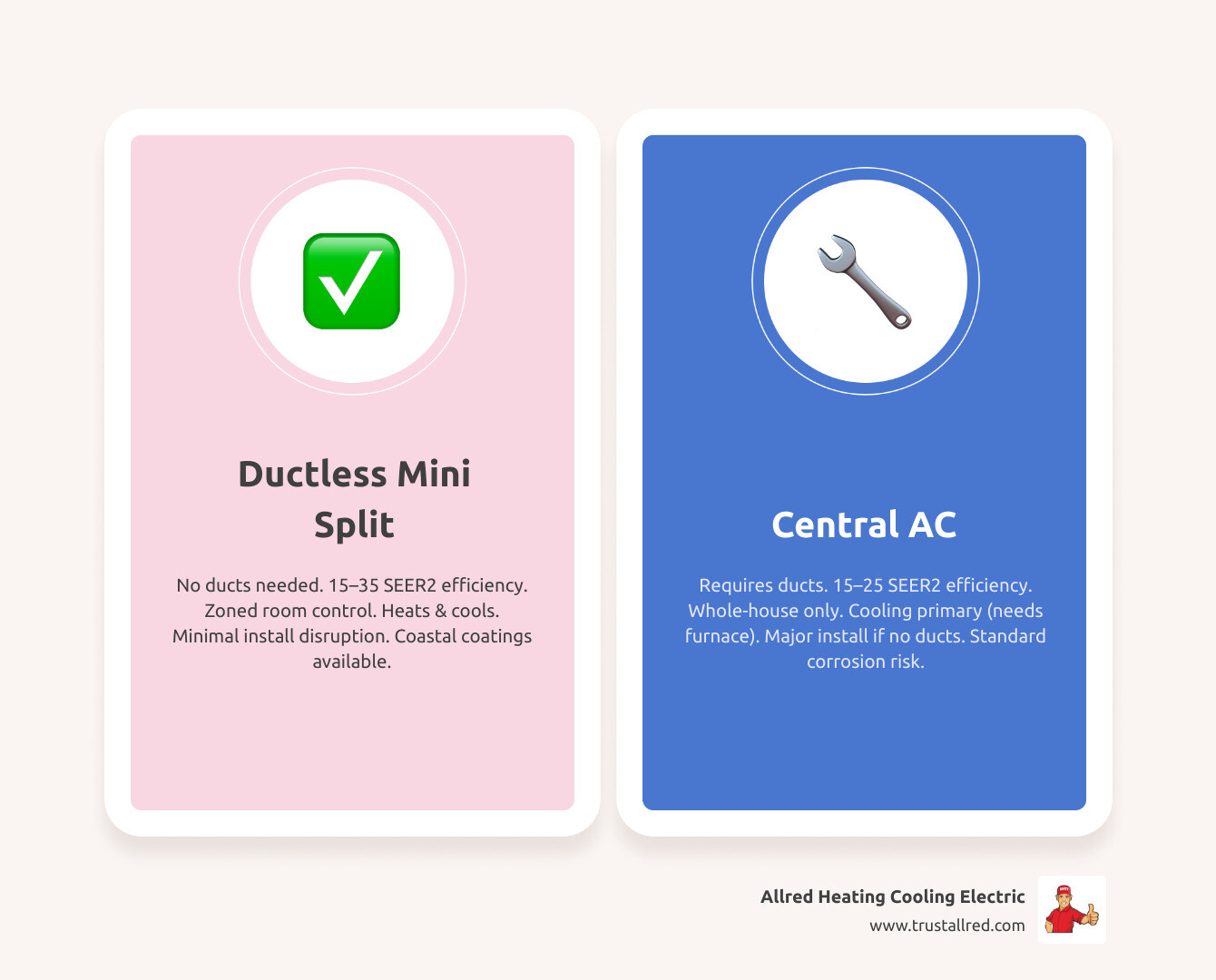
| Factor | Ductless Mini Split | Central AC |
|---|---|---|
| Existing ductwork needed | No | Yes (preferred) |
| Energy efficiency | Higher (15–35 SEER2) | Moderate (15–25 SEER2) |
| Zoned temperature control | Built-in, room by room | Limited without add-ons |
| Best for older PNW homes | Yes | Only if ducts already exist |
| Heats and cools | Yes (heat pump) | Cooling only (needs furnace) |
| Coastal corrosion resistance | Available with coatings | Standard units may corrode |
| Installation disruption | Minimal | Significant if adding ducts |
For most Pacific Northwest homes — especially older properties without existing ductwork — a ductless mini split offers superior energy efficiency, year-round heating and cooling, and flexible zoned comfort. Central AC tends to make more sense when your home already has well-maintained ductwork and you prefer a fully hidden system.
Keep reading for a full breakdown of how each system performs in the PNW’s mild summers, damp winters, and coastal conditions.
I’m Daniel Allred, co-founder of Allred Heating, Cooling & Electric, and I’ve spent years installing and servicing both ductless mini splits and central AC systems across the Puget Sound region. My hands-on experience comparing ductless mini split vs central AC for northwest homes gives me a clear picture of what actually works in our unique climate — and what doesn’t. Let’s walk through everything you need to know so you can make a confident choice for your home.
Choosing Between a Ductless Mini Split vs Central AC for Northwest Homes
When we talk about ductless mini split vs central ac for northwest homes, we are comparing two fundamentally different ways of moving heat. Central AC is the traditional “whole-house” approach. It uses a large outdoor condenser and an indoor evaporator coil (usually sitting on top of your furnace) to cool air in one central spot. That air is then pushed through a network of ducts and out through floor or ceiling vents.
A ductless mini split, on the other hand, is a Ductless AC system that skips the ducts entirely. It uses an outdoor unit connected to one or more indoor air handlers by small copper refrigerant lines and electrical wiring. These lines only require a small three-inch hole in your wall, making the installation far less invasive than tearing up drywall to add ducts.
One of the “secret weapons” of the mini split is inverter technology. While traditional central AC systems often operate like a light switch—either 100% on or 100% off—inverter-driven compressors work more like cruise control. They ramp up and down to meet the exact cooling or heating demand of the room, which prevents those annoying temperature swings and saves a massive amount of energy.
| Feature | Central AC | Ductless Mini Split |
|---|---|---|
| Air Distribution | Centralized via large ducts | Localized via indoor units |
| Infrastructure | Requires extensive ductwork | Requires small refrigerant lines |
| Control | Single thermostat (standard) | Individual remote/app for each unit |
| Visual Impact | Hidden vents | Visible wall or ceiling units |
Energy Efficiency: Ductless Mini Split vs Central AC for Northwest Homes
In the Pacific Northwest, where we are increasingly conscious of our carbon footprint and utility bills, efficiency is a top priority. When comparing a mini split system to central air, the efficiency gap is significant.
Central AC systems are prone to “duct loss.” According to the Department of Energy, duct leaks can account for up to 30% of energy consumption. If your ducts run through a hot attic or a crawlspace, you are losing cooling power before it ever reaches your living room. Ductless systems eliminate this waste entirely.
Furthermore, mini splits often boast SEER2 (Seasonal Energy Efficiency Ratio) ratings between 15.2 and 35, while ducted heat pumps usually cap out around 25 SEER2. By using variable-speed compressors, these systems use up to 60% less energy than standard electric baseboard heaters and significantly less than traditional central units. For a 2,000-square-foot home in the Puget Sound area, this can mean the difference between a high summer cooling bill and one that feels much more manageable.
Zoned Comfort: Ductless Mini Split vs Central AC for Northwest Homes
Have you ever had a “thermostat war” in your house? Maybe the upstairs bedrooms are sweltering while the basement feels like a meat locker. This is where a Ductless AC in Bellevue truly shines.
Mini splits provide inherent zoned comfort. Each indoor unit has its own thermostat. This means:
- The Home Office: Keep it at a crisp 68°F while you work during the day.
- The Master Suite: Set it to 65°F for perfect sleeping conditions at night.
- The Guest Room: Turn the unit off entirely when nobody is staying there.
Some modern units even feature occupancy sensors that detect when a room is empty and switch to an eco-mode to save even more power. While you can add zones to a central AC system, it involves expensive motorized dampers and complex bypass ductwork that still doesn’t offer the surgical precision of a ductless setup.
Performance in the Unique Pacific Northwest Climate
Our climate in the Northwest is unique. We don’t usually deal with the 110°F humidity of the South, but our summers are getting warmer, and our winters remain damp and chilly.
Central AC is strictly a cooling machine; it relies on your furnace to provide heat. However, ductless systems are actually Mini Split Heat Pumps, meaning they move heat out of your house in the summer and into your house in the winter. This dual-functionality is perfect for the mild PNW. Because they also act as dehumidifiers, they are excellent at pulling that “damp” feeling out of the air during our long rainy seasons.
Heating Capabilities in Washington and Oregon Winters
A common myth is that ductless systems can’t handle a “real” winter. That might have been true twenty years ago, but 2026 technology has changed the game. Modern Mini Split Heat Pumps in Federal Way are designed for cold climates.
Many high-end models can provide 80–85% of their heating capacity at temperatures as low as 5°F. Since it rarely drops below that in areas like Auburn or Kent, a mini split can often serve as the primary heat source for a home. They are incredibly efficient at transferring heat rather than generating it through combustion, which can drastically lower your reliance on expensive electric baseboard heat or older gas furnaces.
Protecting Systems from Coastal Corrosion
For our neighbors in coastal areas or near the Puget Sound, salty air is a real threat. Salt spray is highly corrosive and can eat through standard aluminum HVAC coils in just a few years. When choosing between ductless mini split vs central ac for northwest homes in these areas, durability is key.
Many Ductless AC units in Auburn are available with specialized “Blue Fin” or “Gold Fin” anti-corrosion coatings. These are protective layers applied to the outdoor heat exchanger to prevent salt and moisture from degrading the metal. Because mini splits are often engineered for global markets (including coastal Japan and Europe), they frequently offer better protection against marine environments than standard American central AC units.
Installation and Aesthetic Considerations for PNW Properties
The Pacific Northwest is full of beautiful historic homes—think of the Craftsman homes in Tacoma or the mid-century gems in Seattle. Many of these houses were built long before air conditioning was a standard feature, which means they lack the space for bulky ductwork.
If you try to force a central AC system into a home without ducts, you’re looking at a major renovation. You might have to drop ceilings, build “soffits” (bulkheads) to hide the pipes, and lose precious closet space. A Ductless AC installation in Bonney Lake is much less invasive. We only need to run a small conduit through an exterior wall, preserving the structural integrity and original beauty of your home.
Solutions for Older Homes Without Existing Ductwork
For homeowners who are worried about the “box on the wall” look of a standard mini split, there are more options than ever in 2026. If you want the efficiency of a Ductless AC in Auburn without the visible wall unit, consider these styles:
- Ceiling Cassettes: These sit flush with your ceiling, showing only a decorative grille.
- Floor Mounts: These look similar to a traditional radiator and sit low on the wall, often fitting perfectly under a window.
- Slim-Duct Units: These are hidden behind a wall or in a crawlspace, with only a small, discreet vent visible.
These options are perfect for attic conversions, basement ADUs, or garage workshops where you want climate control without the headache of a full construction project.
Maintenance and Long-Term Reliability
Regardless of which system you choose, maintenance is the key to longevity. Central AC systems require you to change a large furnace filter every 1–3 months and have your ducts professionally cleaned every few years to prevent dust and allergen buildup.
Ductless systems require a different approach. Because each indoor unit has its own small filter, you should pop them out and rinse them under a tap about once a month. This keeps the airflow high and the air clean. If you ever need a South Hill Mini Split Repair, you’ll find that because the systems are modular, it’s often easier to diagnose issues than in a complex ducted system.
Both systems generally last 15–20 years if you schedule annual tune-ups. However, mini splits often have a slight edge in reliability because they don’t suffer from the wear and tear caused by leaky, dirty ducts or the constant on/off cycling of older central units.
Frequently Asked Questions
Can a mini-split effectively heat a whole house in a Washington winter?
Yes! By using a multi-zone setup, you can place indoor units in every major living area. Modern Mini Split Heat Pumps in Federal Way are specifically engineered to extract heat from outside air even when it’s freezing. For 95% of the days we experience in the Puget Sound, a properly sized mini split will keep your home perfectly toasty.
Which system is better for indoor air quality in the PNW?
Ductless systems often provide better air quality because they don’t have ducts where dust, pet dander, and mold can accumulate over decades. Each mini split system unit filters the air locally in the room it’s in. Many units also include advanced multi-stage filtration that can trap allergens and even neutralize certain odors.
Are there rebates or incentives for these systems in 2026?
Absolutely. Because they are so energy-efficient, many ductless heat pumps are ENERGY STAR certified. In 2026, homeowners can often take advantage of federal tax credits through the Inflation Reduction Act, which can cover a significant portion of the installation. Many local utility companies in Washington also offer “instant rebates” to encourage people to switch from inefficient electric baseboard or oil heat to high-efficiency heat pumps.
Conclusion
Choosing between ductless mini split vs central ac for northwest homes really comes down to your lifestyle. If you have a newer home with great ductwork and you want a “set it and forget it” invisible system, central AC is a solid choice. But if you live in an older home, want to slash your utility bills, or crave the ability to keep your bedroom cooler than your living room, the ductless mini split is the clear winner.
At Allred Heating Cooling Electric, we’re a family-oriented team that treats your home like our own. Whether you’re in Puyallup, Bellevue, or Tacoma, our expert technicians are ready to help you find the perfect fit.
Ready to upgrade your comfort? Contact us for an Expert HVAC Consultation in Seattle and let’s get your home ready for whatever the Northwest weather throws our way!
