



How Many Ductless Heads Do I Need? Here’s the Short Answer
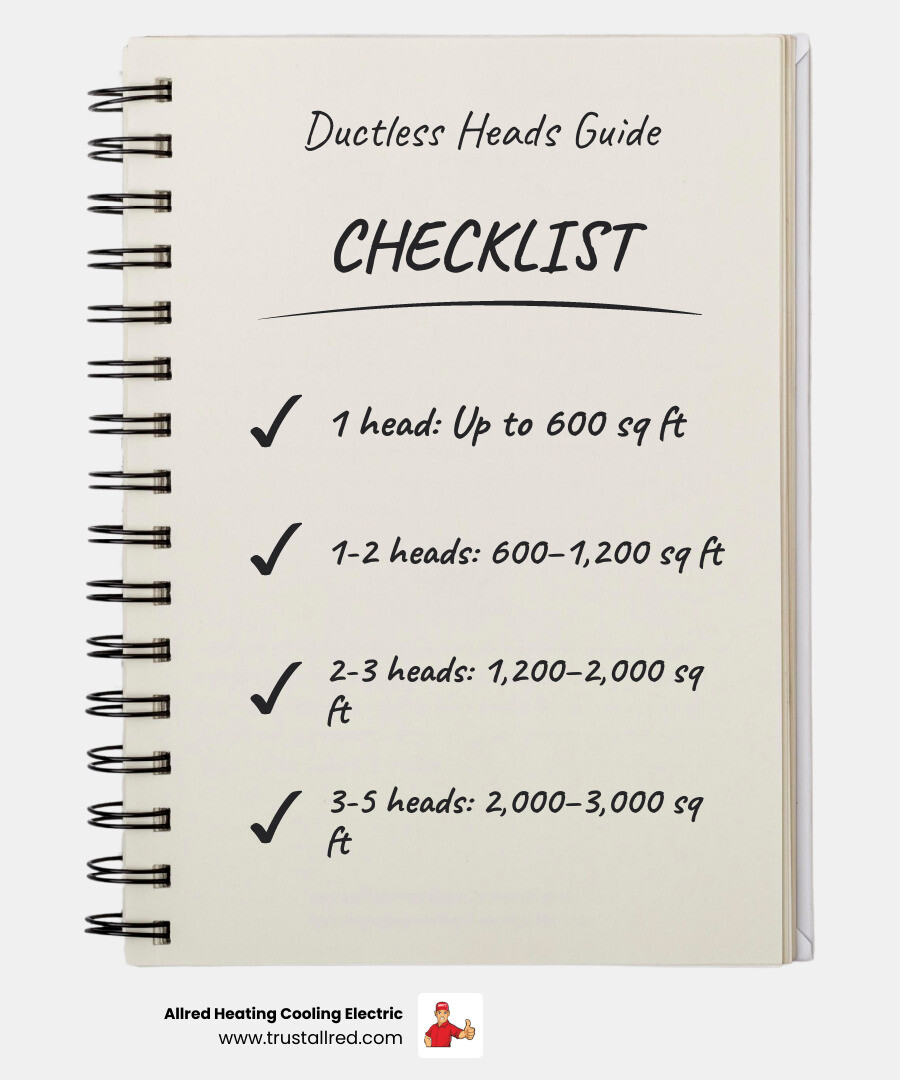
If you’re wondering how many ductless heads do i need, here’s a quick guide based on home size and layout:
| Home Size | Estimated Number of Heads |
|---|---|
| Up to 600 sq ft | 1 head |
| 600 – 1,200 sq ft | 1 – 2 heads |
| 1,200 – 2,000 sq ft | 2 – 3 heads |
| 2,000 – 3,000 sq ft | 3 – 5 heads |
| 3,000+ sq ft | 5 – 8 heads |
The general rule: Plan for one head per room that has a door separating it from the rest of the house — think bedrooms, home offices, and finished basements. Open-concept spaces like a combined kitchen, dining, and living area can often be handled by a single head. Bathrooms typically don’t need one at all.
These are starting-point estimates. Your actual number depends on your floor plan, insulation, ceiling height, sun exposure, and how your family uses each space. Getting it right matters — too few heads leaves some rooms uncomfortable, while too many can actually hurt system performance and efficiency.
Seattle’s climate adds another layer to the equation. Our famously mild summers can turn into unexpected heat waves, and our wet winters demand reliable heating performance. A ductless system sized and zoned correctly for your specific home is one of the smartest investments you can make for year-round comfort in the Pacific Northwest.
I’m Daniel Allred, co-founder of Allred Heating, Cooling & Electric, and I’ve spent years helping Puget Sound homeowners figure out exactly how many ductless heads do i need for their unique homes — from compact condos to sprawling multi-story houses. In this guide, I’ll walk you through everything you need to know to plan your ductless system with confidence.
How Many Ductless Heads Do I Need for My Home?

When we talk about “heads,” we are referring to the indoor air handlers that deliver warm or cool air directly into your living space. Unlike traditional central air that uses a single massive unit to push air through dusty ducts, a ductless system allows for “zoning.” This means you only condition the rooms you actually use.
To determine how many ductless heads do i need, we start with the layout. In the HVAC world, we often use the “Door Rule.” If a room is separated by a door—like a bedroom, a home office, or a nursery—it usually needs its own head. Airflow struggles to turn corners or move through narrow doorways. If you close the door to sleep or work, that room becomes its own isolated thermal island. Without a dedicated head, that room will likely be several degrees warmer in the summer and colder in the winter than the rest of the house.
However, if you have an open-concept floor plan where the kitchen, dining room, and living room flow together without walls, a single high-capacity head can often handle the entire space. We’ve performed many Parkland Mini Split Installation/ projects where a single well-placed unit transformed an entire first floor.
Another major factor is multi-story heat stratification. As we all remember from science class, heat rises. In a two-story home in Kent or Federal Way, the upstairs bedrooms will naturally be warmer than the living room downstairs. To maintain comfort, you’ll almost always need at least one head per floor, even if the square footage is small.
Finally, consider your occupancy patterns. Do you have a guest room that stays empty 300 days a year? You might choose to skip a head there to save on equipment, or install one but keep it turned off until visitors arrive. This flexibility is exactly why ductless systems are so efficient.
Calculating BTU Capacity and Sizing Each Zone
Once you know which rooms need a head, we have to figure out how powerful those heads should be. This is measured in BTUs (British Thermal Units). A common “rule of thumb” is 20 to 25 BTUs per square foot for cooling, but in our April 2026 climate standards, we also have to look closely at heating. In colder climates or during our damp Washington winters, you might need 30 to 40 BTUs per square foot to keep things cozy.
At Allred, we don’t guess. We use a Manual J load calculation. This is the gold standard of HVAC sizing. It takes into account:
- Square Footage: The base of our math.
- Ceiling Height: If you have vaulted ceilings, there is more air volume to treat. We typically add 10% capacity for every two feet over a standard 8-foot ceiling.
- Insulation Quality: A 1920s craftsman in Tacoma needs more power than a modern, airtight home in Sammamish.
- Sun Exposure: South-facing rooms with large windows act like greenhouses. They require significantly more cooling capacity than a shaded room on the north side.
If you are looking at Hvac/Seattle Wa/Mini Split Heat Pumps/, these variables are the difference between a system that hums along perfectly and one that struggles to keep up.
Determining how many ductless heads do i need for large spaces
For very large spaces, like a 1,200-square-foot open basement or a massive great room, one head might not be enough—not because of power, but because of distribution. Even an 18,000 BTU head might struggle to push air to the far corners of a long, rectangular room.
In these cases, we might recommend two smaller heads (say, two 9,000 BTU units) placed at opposite ends of the room. This ensures even airflow and prevents “hot spots” near the kitchen or “cold pockets” by the windows. We recently completed a Factoria Mini Split Installation/ where this two-head strategy provided much better comfort than a single, larger unit would have.
Single-Zone vs. Multi-Zone System Configurations
A common question we get in Bellevue and Redmond is whether to use one outdoor unit for everything or multiple smaller ones.
- Single-Zone: One outdoor condenser connects to one indoor head. These are incredibly efficient and are perfect for adding AC to a single “problem room,” like a sunroom or a primary bedroom.
- Multi-Zone: One outdoor condenser can power up to eight indoor heads. This is the standard for whole-home conversions.
When planning a multi-zone system, we look at the “load diversity.” It is rare that every single room in your house will need maximum heating or cooling at the exact same moment. Because of this, the total BTU capacity of your indoor heads can actually be higher (usually 100% to 130%) than the capacity of the outdoor unit.
| Feature | Single-Zone System | Multi-Zone System |
|---|---|---|
| Best For | Single rooms, additions, garages | Whole-home comfort, multiple rooms |
| Control | Dedicated thermostat | Independent control for every room |
| Efficiency | Maximum efficiency per unit | High efficiency with shared load |
| Space | Requires more outdoor space for multiple units | Saves outdoor space with one condenser |
For many Bellevue Mini Split Installation/ projects, homeowners prefer the multi-zone approach to keep their outdoor landscaping tidy while enjoying independent temperature control in every bedroom.
Factors that influence how many ductless heads do i need in a multi-zone setup
When we design a multi-zone layout, we also have to consider the physical limitations of the home.
- Refrigerant Line Length: The “veins” of your system carry refrigerant between the indoor and outdoor units. If these lines are too long (typically over 100-150 feet total), the system loses efficiency.
- Condensate Drainage: Every indoor head creates moisture (condensation) as it cools. This water needs to drain away via gravity or a small pump. Sometimes, the layout of a room makes it difficult to run a drain line, which might influence where—or if—we can put a head.
- Future Expansion: If you’re planning an attic conversion next year, we can install a multi-zone outdoor unit with extra “ports.” This allows us to perform your Tahleh Mini Split Installation/ today and simply plug in an additional head later.
Strategic Placement for Optimal Comfort and Efficiency
Placement is just as important as the number of heads. A poorly placed unit will blow air directly onto your face while you’re trying to sleep, or it will get “tricked” by a nearby lamp into thinking the room is hotter than it actually is.
Our best practices for placement include:
- High on the Wall: Heads should be mounted about 7 feet up. This allows the cool air to sink naturally and mix with the warmer air in the room.
- Clear Airflow Paths: Don’t hide a head behind a decorative soffit or above a tall bookshelf. It needs at least 5-6 inches of clearance on all sides to “breathe.”
- Interior vs. Exterior Walls: Mounting on an exterior wall is often easier for drainage, but mounting on an interior wall can sometimes provide better air distribution for the whole room.
- Avoid Heat Sources: Keep heads away from ovens, big-screen TVs, or sunny windows. If the unit’s sensor gets too hot, it will work overtime, wasting energy.
If your system isn’t hitting the right temperature, it might not be a sizing issue—it could be a placement or maintenance issue. In those cases, a quick Sammamish Mini Split Repair/ visit can often recalibrate the sensors and get things back on track.
Common Sizing Mistakes to Avoid
In the HVAC world, “bigger is better” is a dangerous myth. If you install a head that is too powerful for a small room, you’ll run into oversizing risks. An oversized unit will reach the target temperature in five minutes and then shut off. This is called “short-cycling.”
Short-cycling is bad for two reasons. First, it puts massive wear and tear on the compressor, leading to an early Carbonado Mini Split Repair/ call. Second, it doesn’t run long enough to remove humidity. You’ll end up with a room that is cold but “clammy.”
On the flip side, undersizing is just as frustrating. An undersized unit will run 24/7, struggling to reach the setpoint. This leads to high energy bills and a system that wears out years before its time. This is why we always emphasize that your Blog/Ductless Mini Split Needs Tune Up/ is easier to manage when the system was sized correctly from day one.
Frequently Asked Questions About Ductless Sizing
Do I need a mini split head in every room?
Not necessarily. While the “Door Rule” is a great guide, you don’t need a head in every single square inch of your home. Bathrooms are the primary exception; they are usually small enough that the airflow from an adjacent hallway or bedroom is sufficient. Also, utility rooms or walk-in closets rarely need dedicated climate control. Understanding your Blog/Mini Split System/ means knowing where to prioritize comfort.
How many ductless heads do i need for a 2,000 square foot home?
For a typical 2,000-square-foot home in Pierce County, you are usually looking at 3 to 5 heads. A common configuration is one large head for the main living area/kitchen and one smaller head for each of the 3 bedrooms. However, if your home is a wide-open ranch style, you might get away with 2 high-capacity units. We often customize Pierce County Mini Split Installation/ plans to match these exact floor plan nuances.
Can I add more heads to my system later?
Yes, provided your outdoor unit has the capacity and available ports. When we do a Des Moines Mini Split Installation/, we often talk to homeowners about their 5-year plan. If you think you’ll want AC in the garage later, we can install a larger outdoor unit now so that adding the extra head later is a simple afternoon job rather than a full system replacement.
Conclusion
Determining how many ductless heads do i need isn’t just about counting rooms; it’s about understanding how air moves through your home and how your family lives in it. From the rainy winters in Puyallup to the sunny July afternoons in Issaquah, your comfort depends on a system that is sized with precision.
At Allred Heating Cooling Electric, we take a family-oriented approach to every job. We aren’t just looking to sell you the most expensive system; we want to design the right system for your needs and your budget. Our expert technicians are ready to perform a detailed Manual J load calculation and walk you through every option, ensuring your home stays perfectly comfortable all year long.
Ready to stop guessing and start living in comfort? Schedule your professional ductless consultation today and let our family take care of yours.
