



Ductless Heating and Cooling for Homes Without Ductwork: What You Need to Know
Ductless heating and cooling for homes without ductwork is one of the most practical and energy-efficient comfort solutions available to Seattle-area homeowners today. If your home has no existing duct system — or if you’re dealing with hot and cold spots, a new addition, or sky-high energy bills — a ductless mini-split system may be exactly what you’re looking for.
Here’s a quick answer to what ductless heating and cooling offers homes without ductwork:
- No ductwork required — installation needs only a small 3-inch hole through an exterior wall
- Both heating and cooling — one system handles year-round comfort using heat pump technology
- Zoned control — each room or area gets its own temperature setting
- High energy efficiency — avoids the up to 30% energy loss that occurs in traditional ducted systems
- Flexible placement — indoor units can be wall-mounted, ceiling-mounted, or floor-mounted
- Works in cold climates — modern systems operate in temperatures as low as -13°F
- Faster installation — a single zone can often be up and running in just a few hours
A typical household spends nearly half of its annual energy bill on heating and cooling. For homes without ducts, the cost and disruption of retrofitting a traditional central system can be enormous — and often unnecessary. Ductless mini-splits offer a smarter path forward: efficient, flexible, and far less invasive.
I’m Daniel Allred, co-founder of Allred Heating, Cooling & Electric, and I’ve spent years helping Puget Sound homeowners find the right ductless heating and cooling solutions for homes without ductwork — from older craftsman bungalows to modern additions. In the sections below, I’ll walk you through everything you need to know to make a confident, informed decision.
Basic ductless heating and cooling for homes without ductwork terms:
- ductless ac pros and cons for older homes
- how does a ductless ac work
- how many ductless heads do i need
Why Ductless Heating and Cooling for Homes Without Ductwork is the Best Choice
For homes built without existing ductwork — such as historic properties in Tacoma, mid-century homes in Bellevue, or classic Seattle craftsman houses — retrofitting a central forced-air system is a major headache. It requires tearing open walls, sacrificing precious closet space to run bulky metal ducts, and enduring days of noisy, dusty construction.
Aside from the physical disruption, traditional ductwork is surprisingly inefficient. According to the U.S. Department of Energy, duct losses can reduce the efficiency of central air conditioning systems by up to 30 percent. In poorly maintained systems, that efficiency loss can even climb to 40 percent. When conditioned air travels through dusty, leaky ducts in unconditioned spaces like attics or crawlspaces, you are paying to heat or cool areas of your home you do not even use.
This is where choosing ductless heating and cooling for homes without ductwork becomes the ultimate game-changer. By delivering conditioned air directly into individual rooms, these systems completely bypass the need for ductwork, saving you money on your monthly energy bills and protecting your home’s structural integrity.
For historic and older homes throughout the Puget Sound region, preserving original plasterwork, hand-carved moldings, and high ceilings is incredibly important. If you want to dive deeper into how these systems preserve historic charm while upgrading your comfort, take a look at our guide on The Ins and Outs of Ductless AC Pros and Cons for Older Homes.

Choosing Ductless Heating and Cooling for Homes Without Ductwork
Every home has a unique layout, which is why ductless systems are designed with incredible flexibility in mind. Rather than relying on a single, massive central unit to heat or cool the entire house, you can customize your setup using different zones and indoor unit styles.
To start, you will need to choose between a single-zone and a multi-zone configuration:
- Single-Zone Systems: These consist of one outdoor compressor connected to a single indoor air handler. They are perfect for cooling or heating a specific room, such as a newly added sunroom, a converted garage, a detached home office, or a stubborn “hot spot” upstairs.
- Multi-Zone Systems: These feature a single, high-capacity outdoor compressor connected to multiple indoor air handlers (typically between two and five, depending on the system). This allows you to create independent climate zones throughout your entire home.
You also have several stylish options for the indoor air-handling units themselves:
- Wall-Mounted Units: The most common and cost-effective style. These are mounted high on a wall near the ceiling, taking up zero floor space and maximizing air circulation.
- Ceiling Cassettes: These units are recessed directly into the ceiling, leaving only a sleek grille visible. They distribute air in four directions, making them excellent for large, open-concept living spaces.
- Floor-Mounted Units: Perfect for rooms with low ceilings, attic conversions, or homes where wall space is limited by large windows or artwork. They sit low on the wall, similar to a traditional radiator.
No matter which style fits your aesthetic, we can help you design a customized setup. Learn more about the options available by checking out our dedicated page on Mini Split Air Conditioning.
Installing Ductless Heating and Cooling for Homes Without Ductwork
One of the greatest advantages of a ductless mini-split system is how quickly and cleanly it can be installed. Unlike a central HVAC retrofit that can take a week of invasive construction, a single-zone ductless installation can often be completed in as little as a single day.
The installation process is incredibly straightforward:
- The Wall Penetration: We drill a small, discreet 3-inch hole through an exterior wall.
- Connecting the Units: Through this single hole, we run a conduit containing the power cable, refrigerant lines, and a condensate drain line.
- Mounting the Equipment: The indoor air handler is mounted securely on your chosen wall or ceiling, while the outdoor compressor is placed on a concrete pad or a sturdy wall bracket.
- Electrical and Startup: We connect the wiring to your electrical panel (typically requiring a 208-230V connection) and thoroughly test the system.
Because the connection between the indoor and outdoor units is so flexible, the outdoor unit can be placed up to 50 feet away from the indoor air handler. This allows us to keep the outdoor compressor tucked out of sight, preserving your home’s curb appeal.
While some systems are marketed as DIY projects, professional installation is highly recommended. Handling chemical refrigerants, running high-voltage electrical lines, and properly vacuuming and sealing the lines require specialized tools and training. In fact, DIY installation almost always voids the manufacturer’s warranty. For a seamless setup that ensures peak efficiency, explore our professional services for Efficient Ductless Mini Split Installation.
How Ductless Mini-Splits Work for Heating and Cooling
To understand why ductless mini-splits are so efficient, it helps to know how they work. Unlike traditional combustion furnaces or electric baseboards, a ductless system does not actually generate heat. Instead, it uses advanced heat pump technology to transfer heat from one place to another.
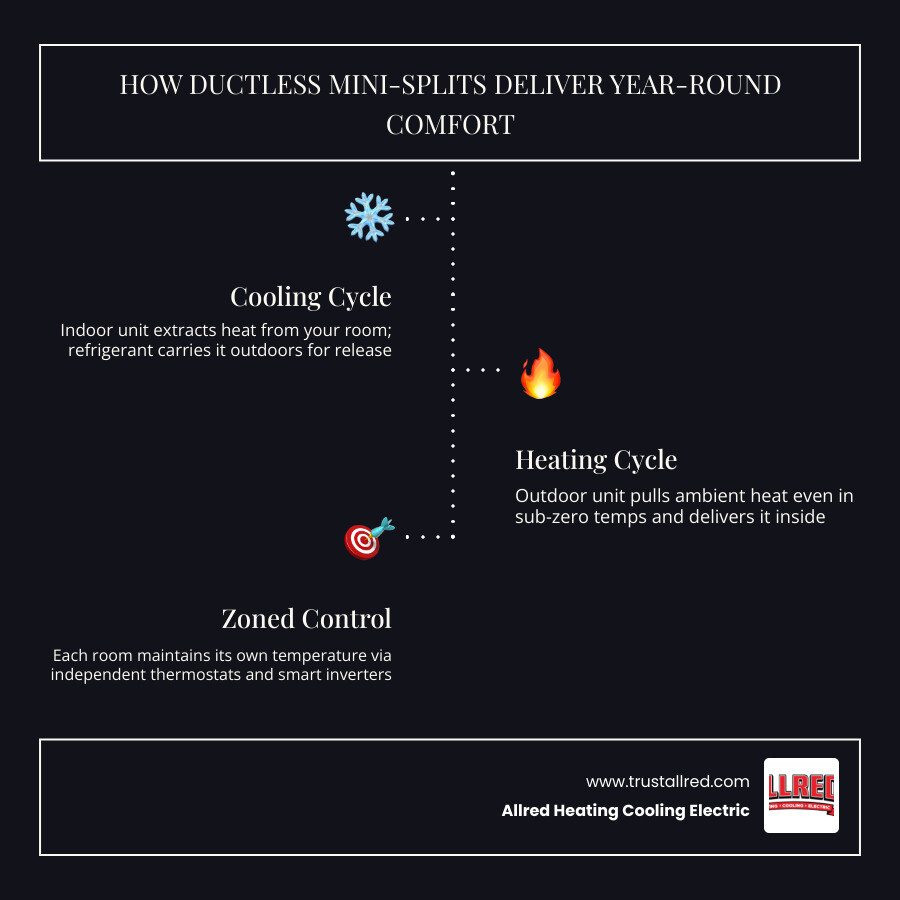
Inside a ductless system, a chemical refrigerant continuously circulates between the indoor air handler and the outdoor compressor. A clever component called a reversing valve allows the system to reverse the direction of this refrigerant flow. This means the exact same system can provide powerful cooling in the hot summer months and cozy warmth during our damp Pacific Northwest winters.
If you are curious about how this compares to traditional home heating methods, you can read more in our detailed comparison of Furnace vs Heat Pump.
The Cooling Cycle
In the summer, a ductless mini-split operates just like a highly efficient air conditioner:
- Heat Absorption: The indoor air handler draws warm air from the room across a cold evaporator coil containing liquid refrigerant. The refrigerant absorbs the heat from your indoor air, cooling the room down.
- Refrigerant Transport: As the refrigerant absorbs heat, it evaporates into a gas and travels through the copper tubing in the wall conduit out to the outdoor compressor.
- Heat Release: The outdoor compressor squeezes the refrigerant gas, increasing its temperature and pressure. The heat is then blown outside into the ambient air through the outdoor coil.
- The Cycle Repeats: The refrigerant cools back down, turns back into a liquid, and flows back indoors to absorb more heat.
This closed-loop process is incredibly efficient and provides whisper-quiet cooling. To learn more about how this system operates, read our guide on the mechanics of a Mini Split System.
The Heating Cycle
When winter arrives in Western Washington, the reversing valve flips, and the entire process runs in reverse:
- Extracting Ambient Heat: Even when it feels freezing outside, there is still a significant amount of ambient heat energy in the outdoor air. The outdoor unit extracts this heat and transfers it to the cold refrigerant.
- Compression: The outdoor compressor squeezes the refrigerant, raising its temperature significantly.
- Indoor Delivery: The hot refrigerant travels indoors to the air handler. The indoor fan blows air across the hot coil, distributing warm, comfortable air directly into your living space.
Modern cold-climate ductless heat pumps are engineered to perform exceptionally well even in extreme winter weather, with some systems providing reliable heating in temperatures as low as -13°F. If you live in Bellevue, Kirkland, or Redmond and want to know how these systems hold up during our winter cold snaps, check out our page on HVAC Bellevue WA Mini Split Heat Pumps.
Key Benefits of Going Ductless
Investing in a ductless mini-split system brings a wide range of benefits that go far beyond simply keeping your home at a comfortable temperature.
First, ductless systems are renowned for their whisper-quiet operation. Because the loudest components — the compressor and the condenser fan — are located outside, the indoor air handlers operate at sound levels as low as 19 to 30 decibels. For context, that is quieter than a soft whisper or a library reading room. Compare that to a noisy window AC unit rattling in your window frame, and the difference is night and day.
Additionally, ductless systems are incredible for your home’s indoor air quality. Traditional ductwork is a notorious hiding place for dust, pollen, pet dander, mold spores, and other allergens. Every time a central furnace or AC kicks on, these particles are blown into your breathing air. Ductless systems bypass this issue entirely. Each indoor unit features its own washable, multi-stage filtration system to capture airborne particles right at the source. To learn more about how you can breathe easier, read about how Ductless AC Services Improve Air Quality.
To see how ductless mini-splits stack up against other common heating and cooling options, take a look at the comparison table below:
| Feature | Ductless Mini-Split | Central HVAC | Window / Portable Units |
|---|---|---|---|
| Ductwork Required? | No | Yes | No |
| Energy Efficiency | Extremely High (Up to 60% savings) | Moderate (Subject to duct losses) | Low |
| Zoned Comfort | Yes (Room-by-room control) | No (Single thermostat for whole house) | No (Single room only) |
| Noise Level | Whisper Quiet (Indoor unit is very quiet) | Moderate (Air rushing through vents) | Very Loud (Compressor inside the room) |
| Structural Impact | Minimal (Only a 3-inch wall hole) | High (Requires extensive remodeling) | Moderate (Blocks window views & security) |
| Lifespan | 15 to 30 Years | 15 to 20 Years | 3 to 8 Years |
Zoned Temperature Control
Have you ever had a domestic dispute over the thermostat? Maybe someone in your household likes the bedroom cool for sleeping, while someone else wants the living room warm and cozy.
With a multi-zone ductless system, those arguments are a thing of the past. Because each indoor air handler is controlled by its own independent thermostat, you can customize the temperature in each individual room.
This zoning capability is also a massive energy saver. If you have guest bedrooms, a formal dining room, or a basement that you rarely use, you can simply turn down the heating or cooling in those zones while keeping your active living spaces perfectly comfortable. There is no need to pay to condition empty rooms.
Enhanced Energy Efficiency
When it comes to lowering your carbon footprint and saving money on utility bills, ductless systems are second to none.
Because they do not suffer from the thermal losses associated with ductwork, mini-splits are inherently more efficient than central systems. Furthermore, ENERGY STAR certified mini-split heat pumps use up to 60% less energy than standard home electric radiators or baseboard heaters.
Most modern ductless systems utilize advanced variable-speed inverter compressors. Unlike traditional HVAC systems that constantly turn fully “on” and “off” (which wastes a massive amount of energy), inverter technology allows the compressor to continuously adjust its speed to match the exact heating or cooling demand of the room. It keeps the temperature perfectly steady while sipping electricity.
Over its lifespan, an ENERGY STAR certified system used in a whole-house setting avoids an average of more than 4,500 pounds of greenhouse gas emissions compared to standard heating and cooling systems. That is a win for your wallet and a win for our beautiful Pacific Northwest environment.
Maintenance and Lifespan of Ductless Systems
To keep your ductless mini-split running at peak efficiency, regular maintenance is essential. Fortunately, the day-to-day upkeep is incredibly simple and can be done by any homeowner:
- Clean the Dust Filters: Every two to four weeks, open the front panel of your indoor air handler, slide out the reusable plastic mesh filters, and rinse them under warm water. Let them air dry completely before sliding them back in. Keeping these filters clean ensures optimal airflow and protects the system’s internal coils.
- Keep the Outdoor Unit Clear: Periodically check your outdoor compressor to ensure that leaves, grass clippings, snow, or weeds are not blocking the airflow. We recommend keeping a two-foot clear perimeter around the outdoor unit.
While cleaning the filters is a great DIY task, your system also requires professional preventative maintenance. An annual tune-up by a certified technician ensures that your refrigerant levels are correct, electrical connections are tight, and the condensate drain lines are clear of algae and debris.
If you notice your system is not heating or cooling as well as it used to, or if it is making strange noises, it is likely time for a professional checkup. Learn more about the warning signs by reading Ductless Mini Split Needs Tune Up.
With proper care and regular professional servicing, a high-quality ductless mini-split system boasts an impressive average lifespan of 15 to 30 years. This easily outlasts traditional heat pumps and central air conditioners, which typically need replacement after 15 to 20 years. For expert tips on maximizing your system’s longevity, check out our guide on maintaining a Ductless Mini Split for Optimal Performance.
Frequently Asked Questions About Ductless HVAC
As Seattle’s local HVAC experts, we get a lot of questions about ductless systems. Here are some of the most common things homeowners ask us:
Do ductless systems work well in cold climates?
Yes, absolutely! While older heat pumps struggled when temperatures dropped below freezing, modern cold-climate ductless systems are engineered to handle freezing temperatures with ease. Many ENERGY STAR certified systems are tested to maintain high heating capacities down to 5°F, and some advanced units continue to operate efficiently in temperatures as low as -13°F. For homeowners in Western Washington, a quality ductless system is more than capable of keeping your home warm and cozy all winter long without needing a backup furnace.
How long do ductless mini-split systems last?
The average lifespan of a ductless heat pump is between 15 and 30 years. The exact lifespan depends heavily on the quality of the installation, how hard the system has to work, and whether it receives regular maintenance. Cleaning your indoor filters every month and scheduling an annual professional tune-up are the best ways to ensure your system lasts for decades.
Are there tax credits or rebates available for ductless systems?
Yes! Because ductless systems are incredibly eco-friendly, there are fantastic financial incentives available to help offset the initial installation cost. Under the federal Energy Efficient Home Improvement Credit (Section 25C), homeowners can claim a tax credit of up to $2,000 for installing qualified ENERGY STAR certified heat pumps.
Additionally, local utility providers throughout the Puget Sound region — including Puget Sound Energy (PSE), Tacoma Power, and Seattle City Light — frequently offer lucrative rebates for homeowners upgrading from inefficient electric baseboards or oil furnaces to ductless systems.
Conclusion
If you are tired of dealing with bulky, noisy window AC units, dusty baseboard heaters, or inconsistent temperatures, ductless heating and cooling for homes without ductwork is the perfect solution. It delivers whisper-quiet comfort, unmatched energy savings, and independent room-by-room control, all without the invasive construction of traditional ductwork.
At Allred Heating, Cooling & Electric, we are proud to be a local, family-owned business. Founded by twin brothers, our company is built on a foundation of superior customer service, expert craftsmanship, and a warm, family-oriented approach. Our highly rated, expert technicians are available 24/7 for emergencies, ensuring that your home remains comfortable no matter what the weather brings.
Whether you live in Auburn, Federal Way, Puyallup, Bellevue, Redmond, or right here in Seattle, we are here to help you design the perfect comfort system for your home.
Ready to make the switch to efficient, customized comfort? Check out our HVAC Seattle WA Ductless AC services, or take the next step and Schedule your professional ductless installation with Allred Heating Cooling Electric today!
