



Why Understanding How Moisture and Mold Spores Affect Filter Replacement Can Protect Your Home’s Air Quality
How moisture and mold spores affect filter replacement is something every Seattle-area homeowner should understand — because in the Pacific Northwest’s damp climate, your HVAC filter faces challenges far beyond ordinary dust.
Here is a quick summary of the key effects:
- Moisture saturates filter media, causing fibers to swell and airflow to drop — sometimes by 10–15% — even before the filter looks dirty
- Mold spores (1–30 microns) are readily captured by high-efficiency filters, but a damp filter can itself become a surface where mold colonies grow
- Viable mold and bacteria can reach concentrations of 10³ to 10⁵ colony-forming units per gram of filter material
- Filters in high-humidity homes (above 60% relative humidity) need replacement every 30–45 days rather than the standard 60–90 days
- A contaminated filter circulates spores rather than capturing them, worsening indoor air quality and triggering respiratory symptoms
- Moisture control and filtration work together — neither alone is enough to prevent mold from spreading through your home
The short answer: moisture shortens filter life, turns filters into mold breeding grounds, and forces more frequent replacements. Pairing the right filter rating with proper humidity control is the most effective defense.
Americans spend roughly 90% of their time indoors, where pollutant concentrations can run two to five times higher than outside. When a filter becomes saturated or mold-laden, those numbers get worse — not better. For homeowners in the Seattle area, where humidity swings are a year-round reality, understanding this relationship is not optional. It is the difference between clean air and a home quietly circulating mold spores through every room.
I’m Daniel Allred, co-founder of Allred Heating, Cooling & Electric, and after years of serving Puget Sound homeowners in the HVAC field, I’ve seen how moisture and mold spores affect filter replacement schedules, system performance, and family health — especially during our region’s wet seasons. In the sections ahead, I’ll walk you through everything you need to know to stay ahead of the problem.
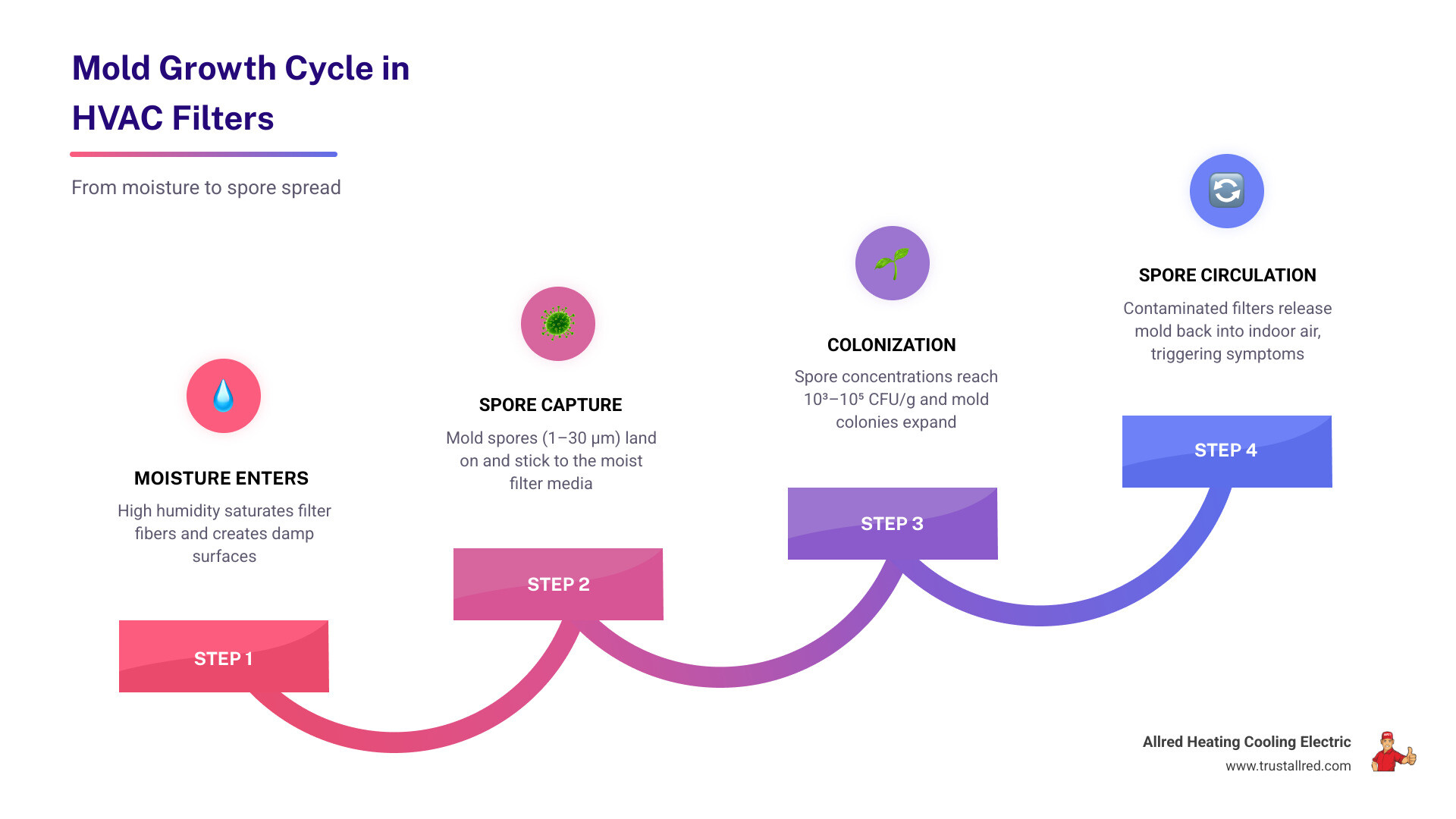
Explore more about how moisture and mold spores affect filter replacement:
How Moisture and Mold Spores Affect Filter Replacement and HVAC Performance
When we talk about how moisture and mold spores affect filter replacement, we have to start with the physical integrity of the filter itself. Most residential filters are made of paper, cotton, or synthetic fibers. These materials are designed to be porous, allowing air to move through while trapping particles. However, moisture acts like a silent saboteur.
The Science of Fiber Swelling and Airflow
In the high-humidity environments common in places like Auburn and Federal Way, water vapor in the air doesn’t just pass through the filter. If the relative humidity (RH) exceeds 60%, the filter fibers can absorb moisture and swell. This physical change reduces the space between the fibers, leading to a significant increase in static pressure.
Research indicates that high humidity can increase the pressure drop across a filter by 10–15%. This means your blower motor has to work much harder to pull air through a damp filter than a dry one. Even if the filter isn’t “dirty” in the traditional sense, the moisture-driven swelling can choke your system, leading to higher energy bills and potential mechanical failure.
Microbial Survival and Particle Capture
Mold spores are incredibly resilient. They typically range from 1 to 30 microns in size, which makes them much larger than smoke particles but small enough to remain airborne for long periods. When these spores hit your filter, they get trapped. Under normal, dry conditions, this is exactly what you want.
The problem arises when you combine these trapped spores with moisture. Scientific studies have shown that in static conditions where RH is above 98%, abundant mold growth occurs in filter media. Even at lower levels (70–80% RH), atmospheric dust trapped in the filter provides the necessary nutrients for mold to thrive. This turns your air filter from a protective barrier into a “bio-factory” that can harbor 10³ to 10⁵ colony-forming units (cfu) per gram of material.
Understanding the Types of HVAC Filters available is the first step in choosing a defense that won’t crumble the moment the Puget Sound rain starts falling.
Choosing the Right MERV Rating for Mold Spore Capture
Not all filters are created equal when it comes to mold. The Minimum Efficiency Reporting Value (MERV) tells you how well a filter traps specific particle sizes. To effectively manage mold spores, you need to be strategic about your choice.
MERV 13: The Gold Standard for Mold
For homeowners concerned about mold, we typically recommend MERV 13 filters. According to ASHRAE standard 52.2 with Appendix J, MERV 13/13A filters are constructed to capture 90% of particles 1 micron and larger. Since most mold spores fall into the 1–30 micron range, a MERV 13 filter is exceptionally efficient at stripping these contaminants from your air.
MERV 11: The Practical Minimum
If a MERV 13 filter creates too much airflow resistance for your specific HVAC unit, MERV 11 is the minimum we suggest for moisture-prone homes. It still captures a significant portion of mold spores and provides a much better defense than standard fiberglass filters, which may only capture 20% of spores.
Synthetic Media and Hydrophobic Properties
In our local climate, the material of the filter is just as important as the rating. Synthetic pleated media generally outperforms fiberglass or cotton-based filters in humid conditions. Synthetic fibers are often hydrophobic (water-repelling), meaning they are less likely to swell or provide a hospitable environment for mold growth compared to natural fibers.
| Filter Type | Mold Spore Capture Efficiency | Best Use Case |
|---|---|---|
| Fiberglass (MERV 1-4) | < 20% | Large debris only; not recommended for mold. |
| Pleated (MERV 8) | 50% – 70% | Basic dust and pollen control. |
| High-Efficiency (MERV 11) | 70% – 85% | Homes with pets or mild humidity concerns. |
| Premium (MERV 13) | > 90% | Best for mold, bacteria, and respiratory health. |
| HEPA | 99.97% | Specialized air purifiers or hospital settings. |
To learn more about how these ratings impact your daily life, check out our guide on Clear the Air: Improving Indoor Air Quality.
How moisture and mold spores affect filter replacement efficiency
It is important to note that as particles swell from moisture, they become easier to trap but harder to move air around. This creates a “false efficiency.” While the filter might be trapping more particles, it is doing so at the cost of your system’s health. This is why how moisture and mold spores affect filter replacement is a delicate balance of air quality and mechanical performance.
The Risks of Saturated Filters and Mold Breeding Grounds
A saturated filter is more than just an airflow bottleneck; it’s a health hazard. When a filter stays damp for more than 24 to 48 hours, it provides the perfect trifecta for mold colonization: moisture, a food source (trapped dust), and the right temperature.
The “Bio-Aerosol” Effect
Once mold begins to grow on the filter media, it produces Volatile Organic Compounds (VOCs). These are the gases responsible for that “musty” or “sour” smell you might notice when your furnace or AC kicks on. Worse, as the mold matures, it releases new spores directly into the supply air. Instead of cleaning the air, your HVAC system begins “seeding” every room in your house with fresh mold spores.
This can lead to immediate respiratory irritation, itchy eyes, sneezing, and in some cases, full-blown asthma attacks. If you suspect your system has already been compromised, you may need to look into The Importance of Duct Cleaning to ensure you aren’t circulating old contaminants.
System Longevity
Neglecting a moldy, saturated filter doesn’t just hurt your lungs; it hurts your wallet. A clogged filter increases the load on your blower motor, potentially shortening its lifespan by years. We always tell our customers to Keep Your HVAC From Retiring Early With These Maintenance Tips to avoid the high cost of premature system replacement.
Signs that moisture and mold spores affect filter replacement timing
You shouldn’t always wait for the calendar to tell you when to change your filter. In humid months, watch for these “red flags”:
- Visible Staining: Dark, fuzzy, or speckled spots on the filter media.
- Musty Odors: A damp or earthy smell coming from your vents.
- Reduced Airflow: Rooms taking longer to reach the set temperature.
- Increased Allergy Symptoms: Sneezing or coughing that only happens when you’re at home.
For most homes in Puyallup or Tacoma during the rainy season, we recommend a 30–45 day replacement schedule if humidity is a concern. Consistent Regular HVAC Maintenance for Optimal Performance ensures these issues are caught before they become expensive repairs.
Integrated Strategies for Humidity Control and Filtration
Filtration is only half the battle. To truly master how moisture and mold spores affect filter replacement, you must address the root cause: humidity.
The 35-50% Rule
The EPA and leading HVAC experts agree that indoor relative humidity should be kept between 35% and 50%. Once you cross the 60% threshold, mold growth becomes exponentially more likely.
Actionable Steps for Homeowners
- Use a Hygrometer: These inexpensive digital devices allow you to monitor your home’s humidity in real-time.
- Run Exhaust Fans: Always use bathroom and kitchen fans to vent moisture directly outside.
- Check the Condensate Drain: During the cooling season, ensure your HVAC’s drain line is clear. A backup can send moisture right back into the air handler.
- Consider a Whole-Home Dehumidifier: For homes in particularly damp areas like Snoqualmie or North Bend, a whole-home solution can maintain the perfect RH level year-round.
- Schedule Tune-Ups: An improperly charged AC or a dirty evaporator coil can’t dehumidify effectively. This is why we emphasize the Importance of Regular Furnace Tune-Ups and AC maintenance.
Frequently Asked Questions about Mold and Air Filters
We get a lot of questions from our neighbors in Kent and Covington regarding mold safety. Here are some of the most common ones we hear, along with answers from our HVAC System FAQ.
Can a damp air filter cause mold to grow in my ductwork?
Yes. If a filter becomes a breeding ground, it can release spores that settle in the dust inside your ducts. If those ducts also have condensation issues, you can end up with a widespread mold problem that requires professional remediation.
How often should I change my filter if my home has high humidity?
While the standard advice is every 90 days, high-humidity homes should aim for every 30 to 45 days. In the Pacific Northwest, this often means changing your filter more frequently in the winter (when it’s damp outside) and the height of summer (if your AC is running constantly).
Do HEPA filters kill mold spores or just trap them?
HEPA filters are incredibly effective at trapping spores through mechanical processes like impaction and diffusion, but they do not typically “kill” them. Without a secondary treatment (like UV light), the spores remain viable on the filter. If the filter gets damp, those trapped spores can still grow.
Conclusion: Breathe Easier with Allred Heating Cooling Electric
Understanding how moisture and mold spores affect filter replacement is a key part of being a responsible homeowner in the Greater Puget Sound area. From Auburn to Issaquah, our local climate demands a proactive approach to indoor air quality.
At Allred Heating Cooling Electric, we aren’t just HVAC technicians; we’re your neighbors. As a family-oriented company founded by twin brothers, we take your home’s comfort and safety personally. Whether you need a 24/7 emergency repair or a simple seasonal check-up, our expert technicians are here to ensure your system is running efficiently and your air is clean.
Don’t let moisture and mold take over your home’s air supply. Schedule your HVAC maintenance in Auburn, WA or any of our surrounding service areas today, and let us help you breathe easy.
