


What Happens If You Don’t Change Your Air Filter — And Why It Costs You More Than You Think
What happens if you dont change your air filter is a question every homeowner should know the answer to — because the consequences show up fast and get expensive quickly. Here’s a quick summary:
- Higher energy bills — A clogged filter forces your system to work harder, increasing utility costs by 20–30%
- Poor indoor air quality — Dust, pollen, pet dander, and bacteria recirculate through your home
- Uneven heating and cooling — Restricted airflow means some rooms never reach the right temperature
- HVAC system damage — Overheated blower motors, frozen evaporator coils, and compressor failure
- Engine and car problems — Reduced horsepower, lower fuel economy, and potential engine wear
- Health risks — Worsened allergies, asthma flare-ups, and respiratory irritation
The short version: skipping filter changes turns a small, inexpensive task into a big, costly problem.
Most homeowners don’t think about their air filter until something goes wrong — a system breakdown, a spike in the energy bill, or a family member sneezing more than usual. By then, the damage is often already underway. A clean filter costs a few dollars and takes minutes to swap out. The repairs it prevents can run into the thousands.
I’m Daniel Allred, co-founder of Allred Heating, Cooling & Electric, and after years of HVAC service across the Puget Sound region, I’ve seen what happens if you dont change your air filter — from frozen coils in the middle of summer to blower motors that burned out well before their time. In the sections below, I’ll walk you through exactly what’s at stake and what you can do about it.
The Primary Role of Air Filters in Your Home and Vehicle
Think of your air filter as the first line of defense for your mechanical systems. Whether it’s the furnace in your basement in Puyallup or the engine under the hood of your car as you commute to Seattle, the air filter serves one primary master: the equipment itself.
In a home HVAC system, the filter’s main job is to trap airborne pollutants like dust, pollen, pet dander, and lint before they can enter the sensitive inner workings of your furnace or air conditioner. Without a filter, these particles would coat the blower motor, the electrical components, and the heating/cooling coils, causing them to fail prematurely.
For vehicles, the engine air filter ensures that the air used for combustion is clean. If grit and debris get into the engine, they can act like sandpaper on the cylinders. Similarly, the cabin air filter protects you and your passengers by scrubbing the air that comes through your vents.
When choosing a filter, you’ll often see a MERV rating (Minimum Efficiency Reporting Value). In our Guide to HVAC Services, we explain that residential filters usually range from MERV 5 to 8 for standard use, while higher ratings capture even smaller particles like mold spores and bacteria. However, the higher the MERV rating, the more “tightly woven” the filter is, meaning you must stay on top of changes to prevent the filter itself from becoming a brick wall that air can’t pass through.
What Happens If You Don’t Change Your Air Filter: Immediate Performance Issues
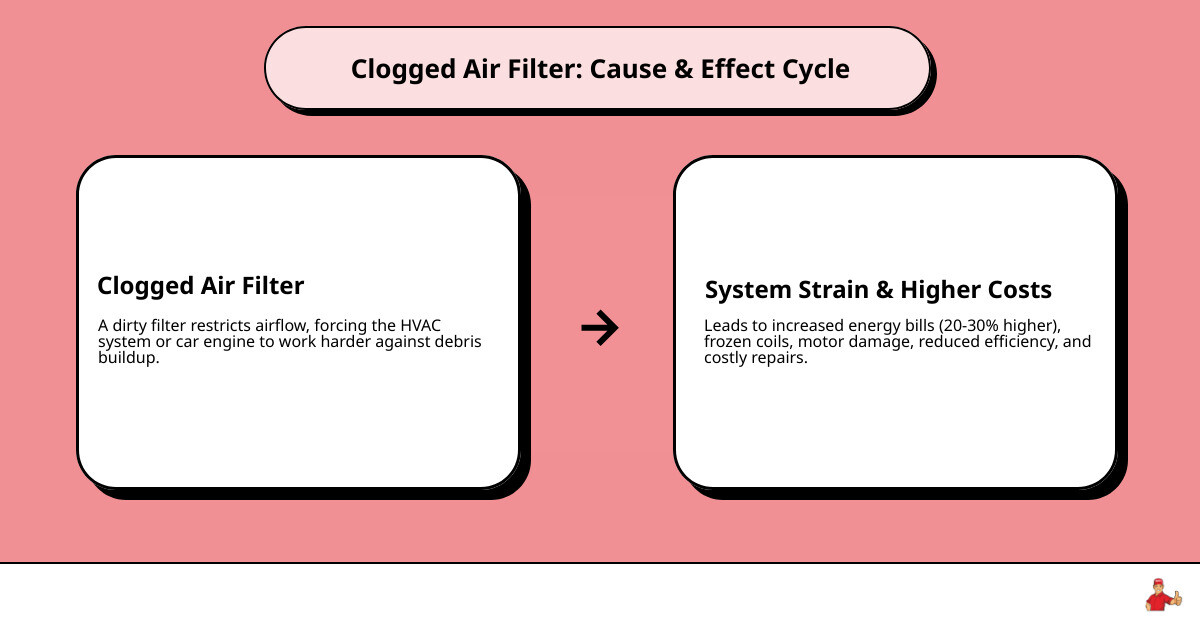
The moment an air filter becomes “full,” it transitions from a helpful cleaner to a harmful barrier. This leads to restricted airflow, which is the root cause of almost every HVAC and automotive issue.
When airflow is restricted, your system has to run longer to achieve the same results. This is why Why Annual HVAC Maintenance is Important; it ensures your system isn’t “suffocating.” A system that runs longer uses more electricity or gas, leading to utility bills that can be 20% to 30% higher than normal.
You might also notice temperature imbalances. Have you ever noticed that your bedroom in Issaquah is freezing while the living room is stuffy? That’s often because a dirty filter is preventing the conditioned air from reaching the furthest points of your ductwork.
What happens if you dont change your air filter in your car
In your vehicle, a clogged engine air filter is like trying to run a marathon while breathing through a straw. You’ll experience a noticeable drop in engine horsepower and sluggish acceleration. If you’ve ever felt your car “jerk” when you step on the gas, a lack of oxygen caused by a dirty filter could be the culprit.
Furthermore, a dirty filter can foul your MAF (Mass Air Flow) sensor. This sensor tells your car’s computer how much air is coming in. If it gets dirty or receives incorrect readings because of a clogged filter, your car might trigger a “Check Engine” light or suffer from poor fuel economy—sometimes as much as a 5-15% loss in MPG.
What happens if you dont change your air filter in your furnace
Inside your home, what happens if you dont change your air filter can lead to a frustrating phenomenon called “short cycling.” This is when your furnace turns on and off rapidly. Because the air can’t move through the filter, the heat builds up inside the furnace until it hits a safety limit and shuts down to prevent a fire.
This constant on-and-off cycle puts massive strain on the blower motor and can eventually lead to your Furnace Blowing Cold. Over time, the heat exchanger—the most expensive part of your furnace—can crack due to the repeated overheating and cooling.
Long-Term Mechanical Damage to HVAC Systems and Engines
If you ignore the immediate signs of a dirty filter, you move into the territory of catastrophic failure. For an air conditioning system, the most common “death sentence” is a frozen evaporator coil.
When the air filter is clogged, there isn’t enough warm air passing over the cold AC coils. Without that warmth, the condensation on the coils turns to ice. Once a layer of ice forms, it acts as an insulator, making the coil even colder until the entire unit is a block of ice. This can lead to liquid refrigerant flowing back into the compressor—the “heart” of your AC—which is not designed to handle liquids. A failed compressor often means you’re looking at an Air Conditioning Replacement rather than a simple repair.
In our experience with AC Repair: Trusting Our Technicians, we find that a significant percentage of system failures in places like Kent and Bellevue could have been avoided with a $20 filter. The Proven Benefits of Timely HVAC Repair Services include extending your system’s lifespan from a premature 10 years to a healthy 15 or 20 years.
In cars, the long-term damage is equally grim. A severely neglected filter can eventually deform or tear, allowing raw dirt and debris to enter the engine. This can score cylinder walls, damage turbochargers, and lead to engine repairs that cost thousands of dollars.
Health Risks and Indoor Air Quality Degradation
We spend about 90% of our lives indoors, and the EPA has noted that indoor air is often 2 to 5 times more polluted than outdoor air. When your filter is clogged, it stops trapping new contaminants. Instead, the air blowing past the dirty filter can actually “pick up” old dust, mold spores, and bacteria and distribute them throughout your home.
This is a major concern for anyone in the household with allergies or asthma. You might notice increased coughing, sneezing, headaches, or watery eyes. If the filter gets damp from high humidity—a common issue in the Pacific Northwest—it can become a breeding ground for mold and bacteria, including Legionella, which can cause serious respiratory infections.
To protect your family, you can Enhance Air Quality with New Filter Services. If you live in an area prone to high pollen or dust, like Auburn or Sumner, focusing on Indoor Air Quality Ashburn WA (and surrounding areas) is essential for long-term health.
How to Maintain Your Filters for Peak Efficiency
Maintaining your filters doesn’t have to be a chore. It’s one of the highest-ROI maintenance tasks you can perform. For most homes in the Seattle area, we recommend checking your filter once a month and replacing it at least every 90 days. However, your specific situation might require more frequent changes.
| Household Factor | Recommended Replacement Frequency |
|---|---|
| Single occupant / No pets | Every 90 days |
| Family with 1 pet | Every 60 days |
| Multiple pets / Allergy sufferers | Every 20–45 days |
| During home renovations | Every 30 days or less |
| Vacation home / Low usage | Every 6–12 months |
When you replace your filter, always look for the arrow on the frame. This indicates the direction of airflow. The arrow should always point toward the furnace or blower unit, not away from it. Installing it backward reduces the filter’s efficiency and can actually damage the filter media.
For those looking for even better protection, consider upgrading to a 4-inch pleated media filter. These have a much larger surface area, allowing them to trap more dirt without restricting airflow as quickly as a 1-inch filter. Following these Must-Know Maintenance Tips can save you a world of trouble.
And remember, while the filter cleans the air entering the system, it doesn’t clean the air already in your ducts. If you’ve gone a long time without changing your filter, you may want to check out our Duct Cleaning Blog to see if a professional cleaning is needed to remove the buildup that bypassed your old filter.
Frequently Asked Questions
How often should I change my air filter in 2026?
As we move through 2026, the standard advice remains every 3 months for a typical home. However, with more people working from home and HVAC systems running more frequently, we are seeing many households in Bellevue and Kirkland benefit from a 60-day schedule. If you have pets or live near a construction site, stick to a 30-day check.
What are the first signs of a clogged air filter?
The most common “early warning” signs are:
- Dust buildup: You notice you’re dusting your furniture more often than usual.
- Higher bills: Your utility bill spikes even though the weather hasn’t changed much.
- Odors: A musty or “dusty” smell when the heat or AC kicks on.
- Long runtimes: The system seems to stay on forever without reaching the set temperature.
Can a dirty filter cause my AC to stop blowing cold air?
Yes! As mentioned earlier, a dirty filter restricts airflow, which can cause the evaporator coils to freeze. Once the coils are encased in ice, the air can’t pass through them to be cooled, and you’ll eventually feel warm air—or no air at all—coming out of your vents. If this happens, turn the system off immediately to let it thaw and call for AC Repair Everett WA or your local technician.
Conclusion
At Allred Heating Cooling Electric, we’ve built our reputation on being the “twin brothers” you can trust for honest, family-oriented service. We know that life gets busy in Puyallup, Tacoma, and Redmond, and it’s easy to forget a small thing like an air filter. But as we’ve seen, what happens if you dont change your air filter can range from a slightly higher bill to a total system collapse.
Whether you need a quick filter check, a seasonal tune-up, or 24/7 emergency service, our expert technicians are ready to ensure your home stays comfortable year-round. Don’t wait for your furnace to stop or your AC to freeze up. Take a moment today to check that filter—your wallet and your lungs will thank you.
If you’re unsure which filter is right for your home or if your system needs a professional eye, reach out to us for HVAC Maintenance Services. We’re proud to serve our neighbors across the Puget Sound, from Federal Way to Snoqualmie and everywhere in between.
