


Why the Right HVAC Settings That Help Prevent Mold in Your Home Matter More Than You Think
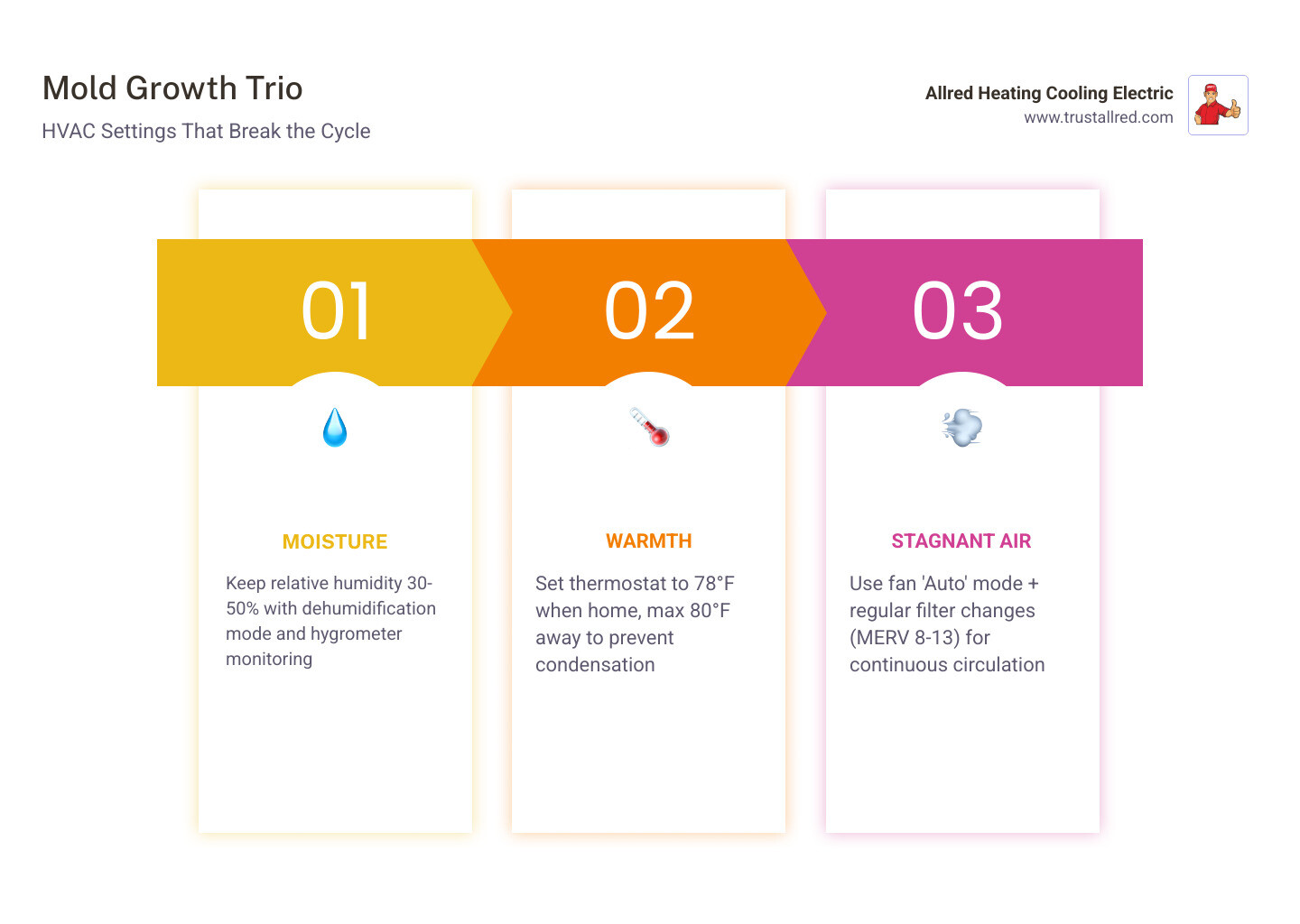
The best HVAC settings that help prevent mold in your home come down to one core principle: controlling moisture. Here is a quick-reference summary of the most important settings to keep mold at bay:
- Thermostat temperature: Set to 78°F when home, no higher than 80°F when away
- Indoor humidity target: Keep between 30% and 50% (never above 60%)
- Fan mode: Use “Auto” — not “On” — to prevent moisture from re-evaporating into your home
- Filter replacement: Every 1 to 3 months, using a MERV 8–13 rated filter
- Dehumidification mode: Activate when humidity climbs above 50% to stay safely below the 60% mold threshold
- Windows and doors: Keep closed while the AC is running to prevent humid outdoor air from entering
Mold spores are always in the air around us — they only become a problem when they land on a damp surface and find the warmth and stagnation they need to grow. Your HVAC system is your most powerful tool for breaking up that combination before it becomes a health hazard or a costly remediation bill. And in the Pacific Northwest, where damp, overcast weather is a year-round reality, getting your settings right is not optional — it is essential.
I’m Daniel Allred, co-founder of Allred Heating, Cooling & Electric, and after years of servicing homes across the Puget Sound region I’ve seen how the wrong HVAC settings that help prevent mold in your home can quietly turn a comfortable house into a breeding ground for moisture damage. In this guide, I’ll walk you through exactly what to adjust, and why each setting matters for keeping your family’s air clean and your home protected.
The Most Effective HVAC Settings That Help Prevent Mold in Your Home
If you remember only one number, make it this: keep indoor relative humidity between 30% and 50%. That range is widely considered ideal for comfort and mold prevention. Once humidity rises above 60%, mold risk increases fast.
A simple digital hygrometer can help you track this, and many are inexpensive and easy to place near your thermostat or in damp-prone rooms. In our area, that little monitor can tell you a lot before your walls or vents do.

Here is a quick way to think about humidity levels:
| Indoor humidity | Mold risk | What to do |
|---|---|---|
| Below 30% | Low mold risk, but air may feel dry | Monitor comfort, avoid over-drying |
| 30% to 50% | Ideal range | Maintain current settings |
| 50% to 60% | Elevated risk | Use dehumidification and check airflow |
| Above 60% | High risk | Act quickly and inspect for moisture issues |
If you want more basics on how your equipment works, our HVAC FAQs are a helpful place to start.
Thermostat Adjustments: HVAC Settings That Help Prevent Mold in Your Home
Your thermostat affects mold risk more than many homeowners realize. Cooling is only part of the job. Your AC also removes moisture as warm indoor air passes over the cold evaporator coil and water drains away.
For many homes, 78°F is a solid setting when you are home during cooling season. It supports comfort, energy efficiency, and steady moisture removal. If you are away, avoid shutting the system off entirely or setting it too high. In humid conditions, we recommend staying at or below 80°F. Letting the house get too warm can allow humidity to rise and condensation to form on cooler surfaces.
That matters because condensation is mold’s favorite welcome mat.
A few practical thermostat tips:
- Use 78°F as your normal occupied cooling setting
- When away, set the thermostat no higher than 80°F
- Do not turn the AC completely off during damp weather
- If your thermostat has humidity readouts or dehumidify settings, use them
If your system struggles to hold temperature or humidity, it may be time for Residential HVAC Service.
Fan and Airflow: HVAC Settings That Help Prevent Mold in Your Home
Mold loves stagnant air. Even when a room does not feel wet, poor circulation can create little pockets of dampness behind furniture, inside closets, or near exterior walls.
That is why airflow matters just as much as temperature.
To help your HVAC system move air the way it should:
- Keep supply vents open and unobstructed
- Do not block return grilles with rugs, furniture, or storage bins
- Keep interior doors open when possible to support balanced circulation
- Use bathroom and kitchen exhaust fans during and after moisture-producing activities
- Let exhaust fans run for 15 to 20 minutes after showers or cooking
If you use a ductless system, airflow direction and routine cleaning matter too. Our article on How to Keep Your Klahanie Home Cool with Ductless Magic covers more on that.
Managing Humidity with Dehumidification and Fan Modes
Some homes need more than standard cooling to stay dry, especially during Seattle-area shoulder seasons when it is damp outside but not hot enough for long AC cycles.
That is where dehumidification settings help.
Many modern systems include a dry mode, dehumidification mode, or humidity control through a smart thermostat. These settings tell the system to focus more on moisture removal and less on aggressive temperature drops. That can be especially useful when your house feels cool but still clammy, which is never a sentence homeowners enjoy hearing.
If your system has variable-speed equipment, even better. These systems can run longer at lower speeds, which usually removes more moisture than short bursts of very cold air. Consistent runtime is good for humidity control. Short-cycling is not.
Routine maintenance also plays a huge role here. A neglected system cannot manage moisture well, no matter how fancy the controls are. For more on that, see Stop Throwing Money Out the Window with Regular Maintenance.
Choosing Between Fan “Auto” and “On”
For mold prevention, “Auto” is usually the better choice.
Here is why: when your fan is set to “On,” it keeps blowing air even after the cooling cycle stops. That can pull moisture sitting on the evaporator coil back into your home before it drains away. In other words, your system just did the work of dehumidifying, and the fan may undo part of it.
“Auto” avoids that problem because the fan runs only when the system is actively cooling or heating.
Choose fan settings like this:
- Use “Auto” for normal mold prevention and better humidity control
- Use “On” only temporarily if a room has major airflow issues and your humidity is already under control
- Switch back to “Auto” if indoor humidity starts creeping up
This is one of the simplest changes homeowners can make, and it often helps right away. For more upkeep tips that support airflow and humidity control, visit Must-Know Maintenance Tips.
The Role of Whole-Home Dehumidifiers
In some Pacific Northwest homes, AC alone is not enough to manage moisture. That is especially true in basements, tightly sealed newer homes, or homes that feel damp during spring and fall.
A whole-home dehumidifier works with your HVAC system to remove moisture directly from the air, even when cooling demand is low. Many include a humidistat so you can set a target, often around 50%.
These systems can help when:
- Indoor humidity regularly stays above 50%
- You notice condensation on windows
- The house feels cool but sticky
- Musty odors return even after cleaning
- Certain rooms stay damp year-round
If your system needs help holding proper humidity, regular service is the first step. Learn more in Regular HVAC Maintenance Optimal Performance.
Essential Maintenance to Support Your Mold-Prevention Settings
Settings matter, but settings alone cannot overcome standing water, clogged drains, or dirty components. Mold prevention is part control strategy and part maintenance routine.
A well-set thermostat is great. A well-set thermostat above a full drain pan is not.
Your highest-risk HVAC moisture points are usually:
- Evaporator coils
- Condensate drain pans
- Condensate drain lines
- Wet or dirty filters
- Leaky or sweating ductwork
Drain pans and condensate lines deserve special attention. During cooling season, check for standing water, visible slime, or slow drainage. A periodic vinegar flush is a common maintenance step to reduce buildup in the line, but deeper clogs or recurring moisture issues should be handled professionally.
If you want better indoor air support from your system overall, read Ductless AC Services Improve Air Quality.
Filter Selection and Replacement Schedules
Dirty filters do two bad things at once: they restrict airflow and collect dust that can become food for mold if moisture is present.
For most homes, a MERV 8 to MERV 13 filter offers a practical balance between good particle capture and healthy airflow. The right replacement schedule is usually every 30 to 90 days, depending on pets, allergies, occupancy, smoke exposure, and system use.
A good rule of thumb:
- Check filters monthly
- Replace every 1 to 3 months
- Replace sooner if the filter looks dirty or humidity has been high
- Replace immediately if you suspect mold contamination
Research shows that two-thirds of people find it hard to remember filter changes, so set a phone reminder. Your future self will appreciate it.
More filter guidance is available in Enhance Air Quality with New Filter Services.
UV Lights and Advanced Mold Guard Technology
Some HVAC systems can be upgraded with UV-C lights installed near the evaporator coil. These lights are designed to disrupt microorganisms on damp surfaces where mold often starts. They can be especially useful for reducing biofilm on coils and slowing microbial growth in high-moisture parts of the system.
That said, UV technology is a supplement, not a substitute for cleaning and maintenance. If the coil is already dirty, a light alone will not solve the underlying issue.
Advanced indoor air quality options may help if you have recurring mold concerns, but they work best when combined with:
- Humidity control
- Proper drainage
- Regular coil cleaning
- Good filtration
- Correct fan settings
For long-term system care, see HVAC Maintenance Tips Long-Lasting Systems.
Seasonal Adjustments for the Seattle Climate
In the Puget Sound area, mold prevention is not just a summer issue. Our damp weather means spring and fall are often the sneaky seasons.
Here is how we recommend adjusting through the year:
- Spring:
- Monitor humidity closely as outdoor moisture rises
- Replace filters before cooling season
- Check condensate lines before first heavy AC use
- Summer:
- Keep cooling settings steady around 78°F
- Use fan “Auto”
- Keep windows and doors closed when AC is running
- Fall:
- Run bathroom and kitchen exhaust fans consistently
- Watch for musty smells during mild, damp weather when AC runs less
- Schedule maintenance before heating season
- Winter:
- Manage indoor moisture from showers, cooking, and drying clothes
- Use mechanical ventilation as needed
- Watch cooler surfaces for condensation in rooms with poor airflow
In our region, mechanical ventilation can also help in tighter homes. Depending on the house, an ERV or similar ventilation strategy may improve fresh-air exchange without inviting unnecessary moisture problems. Seasonal care tips are also covered in Fall HVAC Tips.
Frequently Asked Questions about HVAC Mold Prevention
Should I keep windows and doors closed when the AC is running?
Yes. Keeping windows and doors closed helps prevent humid outdoor air from entering your home while the AC is trying to remove moisture. Open windows can also create pressure imbalances and force your system to work harder for worse results.
In short, running the AC with the windows open is a little like brushing your teeth while eating cookies. Effort is happening, but progress is limited.
For broader system care, visit HVAC Service.
What are the signs of mold in my HVAC system?
Common warning signs include:
- Musty or earthy smells when the system starts
- A “dirty sock” odor from vents
- Visible black, green, or dark spotting on vent covers
- Increased allergy or asthma symptoms at home
- Excess condensation near the indoor unit
- Reduced airflow or unusual system performance
If you notice these signs, make a few immediate changes:
- Set fan mode to “Auto”
- Replace the air filter
- Lower indoor humidity below 50% if possible
- Use exhaust fans to reduce moisture at the source
- Call for a professional inspection if odors or symptoms continue
If you need a better understanding of how your system components work together, read Understanding Your Homes Heating Cooling System.
How does proper AC sizing impact mold growth?
Proper sizing is a big deal for mold prevention.
An oversized AC cools the house too quickly and shuts off before it removes enough moisture from the air. That short-cycling leaves the home feeling cold but damp. An undersized system can also struggle if it never catches up with heat and humidity loads.
The goal is a correctly sized system based on the home itself, ideally using a load calculation rather than guesswork. When sizing is right, the system runs long enough to dehumidify effectively without wasting energy or leaving clammy conditions behind.
If your home never seems dry even though the AC runs, sizing could be part of the problem. You can learn more at HVAC Services to Keep Home Comfortable.
Conclusion
The most effective HVAC settings that help prevent mold in your home are not complicated, but they do need to be consistent. Keep humidity between 30% and 50%, use a thermostat setting around 78°F when home and no higher than 80°F when away, leave the fan on “Auto,” replace filters every 1 to 3 months, and stay on top of drains, coils, and airflow.
If you are dealing with musty smells, high humidity, or a system that never seems to dry the house out, we are here to help. At Allred Heating, Cooling & Electric, we bring a family-oriented approach, expert technicians, and 24/7 availability to homeowners throughout our Puget Sound service area. For year-round comfort and smarter mold prevention, schedule your next HVAC Maintenance with our team.
