


Why the Benefits of Regular HVAC Maintenance Matter for Seattle Homeowners
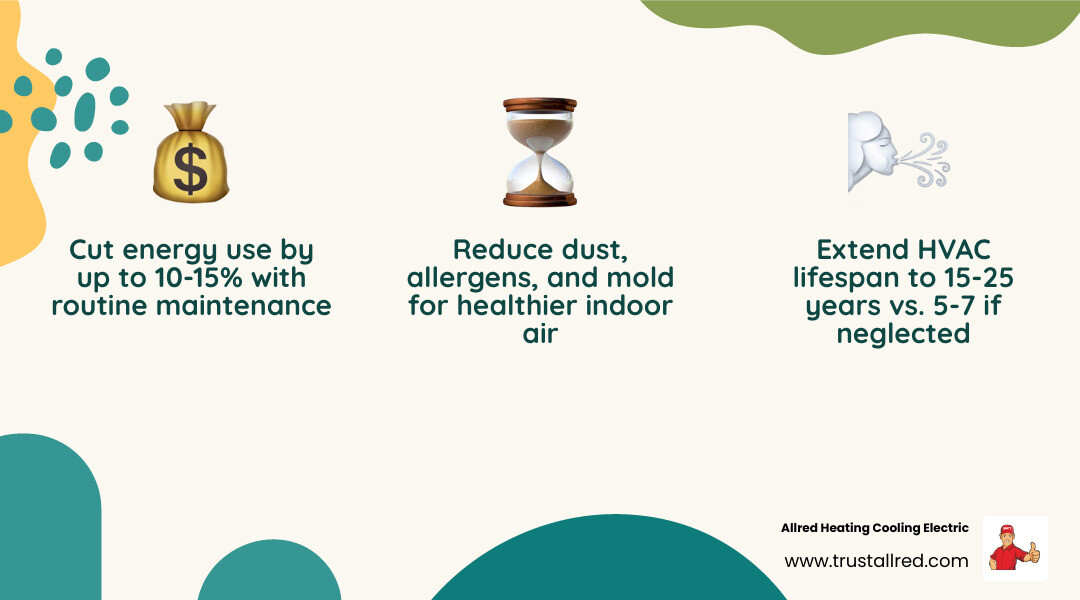
The benefits of regular HVAC maintenance are real, measurable, and felt every month on your energy bill, every breath of air inside your home, and every year your system keeps running instead of needing replacement. Here’s a quick look at what routine upkeep actually delivers:
| Benefit | What It Means for You |
|---|---|
| Lower energy bills | A well-maintained system can cut energy use by up to 10-15% |
| Longer system lifespan | Maintained systems last 10-25 years vs. 5-7 years if neglected |
| Better indoor air quality | Cleaner filters mean less dust, allergens, and mold in your air |
| Fewer surprise breakdowns | Small problems get caught before they become expensive failures |
| Safer home environment | Reduces risks of carbon monoxide leaks, electrical faults, and fire hazards |
Your HVAC system runs quietly in the background every single day — heating your home through Seattle’s wet winters, cooling it on those increasingly warm summer days, and filtering the air your family breathes around the clock. Like a car engine, it builds up wear and tear over time. Without regular attention, that wear turns into reduced efficiency, poor air quality, and eventually a breakdown at the worst possible moment.
In April 2026, with energy costs continuing to climb and Seattle homeowners expecting more from their home comfort systems, the case for routine maintenance has never been stronger.
I’m Daniel Allred, co-founder of Allred Heating, Cooling & Electric, and with years of hands-on HVAC experience serving the Puget Sound region, I’ve seen how the benefits of regular HVAC maintenance translate into real savings and comfort for homeowners. Let’s walk through exactly what those benefits look like — and how to make sure your system is working as hard for you as you are for it.
The Top Financial and Performance Benefits of Regular HVAC Maintenance
When we talk about the benefits of regular HVAC maintenance, we aren’t just talking about keeping the air blowing. We are talking about the financial health of your household. In a climate like ours—stretching from the humid summers in Kent to the chilly winters in North Bend—your system is the hardest-working appliance you own.
Neglecting your system is essentially like driving your car for 50,000 miles without an oil change. Eventually, the friction wins. By scheduling Residential HVAC Service, you ensure that every moving part is lubricated, every connection is tight, and every sensor is calibrated. This leads to consistent comfort throughout your home, eliminating those annoying “hot spots” in the upstairs bedrooms or “cold zones” in the living room.
Furthermore, maintenance is the primary way to manage humidity. In the Pacific Northwest, dampness can lead to a host of structural and health issues. A well-tuned system balances moisture levels effectively, providing the proven benefits of timely HVAC repair services before a small moisture problem turns into a major mold restoration project.
Improving Energy Efficiency: One of the Best Benefits of Regular HVAC Maintenance
Efficiency is where you see the most immediate return on your investment. According to the U.S. Department of Energy, a well-maintained HVAC system can operate up to 15% more efficiently than one that is neglected. In fact, studies show that professional maintenance alone can save you as much as 10% on your monthly utility bills.
When dust and debris accumulate on your coils or in your blowers, your system has to work twice as hard to move the same amount of air. This increased workload doesn’t just raise your bill; it overheats the components. Our HVAC Service Blog often highlights how something as simple as a clean evaporator coil can prevent the system from drawing excessive power. Whether you have a traditional furnace or you’ve invested in efficient ductless mini-split installation, keeping the pathways clear is the secret to peak performance.
Extending Equipment Lifespan: Long-Term Benefits of Regular HVAC Maintenance
The average HVAC system is designed to last between 10 and 15 years. However, “designed to last” and “actually lasting” are two different things. Neglected units often begin to fail efficiently around year 5 or 7, leading to a premature and expensive replacement.
One of the most significant benefits of regular HVAC maintenance is that it can push that lifespan toward the 20 or even 25-year mark. By catching minor wear—like a frayed fan belt or a loose electrical connection—we prevent the “domino effect” where one failing part destroys the compressor or the motor. If you are worried about how much furnace replacement costs, the best way to delay that expense is through routine care. Even specialized systems like those requiring Summit mini-split repair benefit from annual check-ups that keep the sophisticated electronics and refrigerant lines in top shape.
Enhancing Indoor Air Quality and Health
Your HVAC system is the lungs of your home. Every day, it circulates the air you breathe, along with whatever else is floating in it. Over time, ducts and filters become magnets for dust, pet dander, pollen, and even mold spores.
Regular maintenance involves deep-cleaning these components. This is especially vital for residents in areas like Federal Way, where high humidity can encourage biological growth inside dark, damp ductwork. Utilizing Federal Way furnace duct cleaning as part of your maintenance routine can significantly reduce respiratory symptoms for allergy and asthma sufferers.
Beyond just changing a filter, a professional technician can identify if your system is pulling in “unfiltered” air from crawlspaces or attics through leaky ducts. Our Duct Cleaning Blog explains how sealing these gaps and keeping the system clean ensures that your home remains a sanctuary of fresh, healthy air.
What a Professional Maintenance Visit Includes
Many homeowners ask us what actually happens during a service call. It’s much more than a quick “look-see.” A professional tune-up is a comprehensive technical inspection designed to restore the system to its factory-spec performance.
When we perform an Auburn heat pump tune-up, or a furnace check in Tacoma, our technicians follow a rigorous checklist. This includes:
- Coil Cleaning: We clean the evaporator and condenser coils. Dirt on these coils reduces the system’s ability to cool or heat your home, making it run longer and hotter.
- Electrical Inspection: We tighten all electrical connections and measure voltage and current on motors. Loose connections are a leading cause of part failure and even house fires.
- Refrigerant Levels: We check for the proper refrigerant charge. A system that is even slightly low on refrigerant can see a 20% drop in efficiency and put the compressor at risk of burning out.
- Thermostat Calibration: We ensure your thermostat is communicating correctly with your equipment so you aren’t paying for heat or cooling you don’t need.
- Lubrication: We lubricate all moving parts to reduce friction and noise.
To see a full breakdown of the technical steps, check out our HVAC check during routine maintenance blog.
Essential DIY Maintenance Tasks for Homeowners
While complex mechanical and electrical work should always be left to the pros, there are several things you can do to support the benefits of regular HVAC maintenance between our visits. Think of these as the “daily vitamins” for your heating and cooling system.
- Change Your Filters Monthly: This is the single most important DIY task. A clogged filter restricts airflow, forcing the motor to work harder. Depending on your home—especially if you have pets or live in a dusty area—you should check your filter every 30 days. Our guide on the types of HVAC filters can help you choose the right one for your needs.
- Clear the Outdoor Unit: Keep shrubs, grass, and debris at least two feet away from your outdoor condenser or heat pump. Your system needs to “breathe” to release heat; if it’s choked by weeds or autumn leaves, it will overheat.
- Inspect Vents and Registers: Ensure that furniture, rugs, or curtains aren’t blocking your return or supply vents. Blocking vents creates pressure imbalances that can actually damage your ductwork over time.
- Listen and Smell: You know your home better than anyone. If you hear a new “thumping” sound or smell something “metallic” or “musty,” don’t ignore it.
By understanding your home’s heating and cooling system, you become the first line of defense against major repairs.
Protecting Your Home Safety and Warranty Coverage
Safety is the benefit that matters most, even if it’s the one we think about the least. HVAC systems, particularly furnaces, involve combustion and high-voltage electricity.
A cracked heat exchanger in a furnace can leak Carbon Monoxide (CO) into your living space. Since CO is odorless and colorless, it is a silent killer. During a maintenance visit, we use specialized tools to check for these leaks. We also look for “hot spots” in wiring that could lead to electrical fires. If you have questions about safety protocols, our HVAC FAQs offer a wealth of information.
Additionally, did you know that neglecting maintenance can actually cost you your warranty? Most major manufacturers (like Trane, Lennox, or Carrier) require proof of annual professional maintenance to honor parts warranties. If your compressor fails in year five, but you haven’t had a pro look at it since it was installed, the manufacturer may deny your claim, leaving you with a bill for thousands of dollars. Whether you need Frederickson furnace repair or a simple check-up, keeping those records is vital for your financial protection.
Frequently Asked Questions
How often should I schedule HVAC maintenance?
For the best results, you should schedule maintenance twice a year: once in the spring for your air conditioning and once in the fall for your heating system. If you have a heat pump, which handles both heating and cooling, these bi-annual checks are even more critical because the system never gets an “off-season.” This timing ensures your system is ready for the peak loads of summer and winter before the extreme weather hits.
Are HVAC maintenance plans worth the investment?
Absolutely. Maintenance plans (often called service agreements) typically pay for themselves. They generally include your two annual visits at a discounted rate, but the real value lies in the “extras.” Most plans offer priority scheduling—meaning if your AC goes out during a heatwave in Bellevue, you jump to the front of the line. You also usually get discounts on parts and labor if a repair is needed, along with the peace of mind that your warranty remains valid.
What are the risks of neglecting my HVAC system?
The risks are both financial and physical. Beyond the high energy bills and the risk of a total system failure, you face poor indoor air quality which can exacerbate health issues. You also run the risk of “emergency” repair rates. A small part that costs $50 during a scheduled Tuesday maintenance visit could cost $500 if it fails at 2:00 AM on a Sunday and requires an emergency call-out. If you start seeing signs your air conditioner needs repair, you’ve likely already waited too long.
Conclusion
At Allred Heating Cooling Electric, we aren’t just technicians; we’re your neighbors. As a family-oriented business serving the Puget Sound from Seattle to Puyallup and Issaquah to Tacoma, we understand the unique challenges our local climate puts on your home. We’ve built our reputation on 24/7 availability and a commitment to expert service that keeps your family safe and comfortable.
Don’t wait for your system to send you a distress signal. The benefits of regular HVAC maintenance are waiting for you—lower bills, better air, and the peace of mind that comes with a job well done.
Schedule your professional HVAC maintenance today with Allred Heating Cooling Electric and start saving.
