


Is It Worth Repairing Your Old HVAC — or Time to Buy New?
The cost of repairing old hvac vs buying new system is one of the most stressful financial decisions a homeowner can face — especially when your heat goes out in January or your AC quits in the middle of a Seattle heat wave. Here is a quick answer to help you decide:
Quick Decision Guide: Repair vs. Replace
| Situation | Recommendation |
|---|---|
| System is under 10 years old, minor repair needed | Repair |
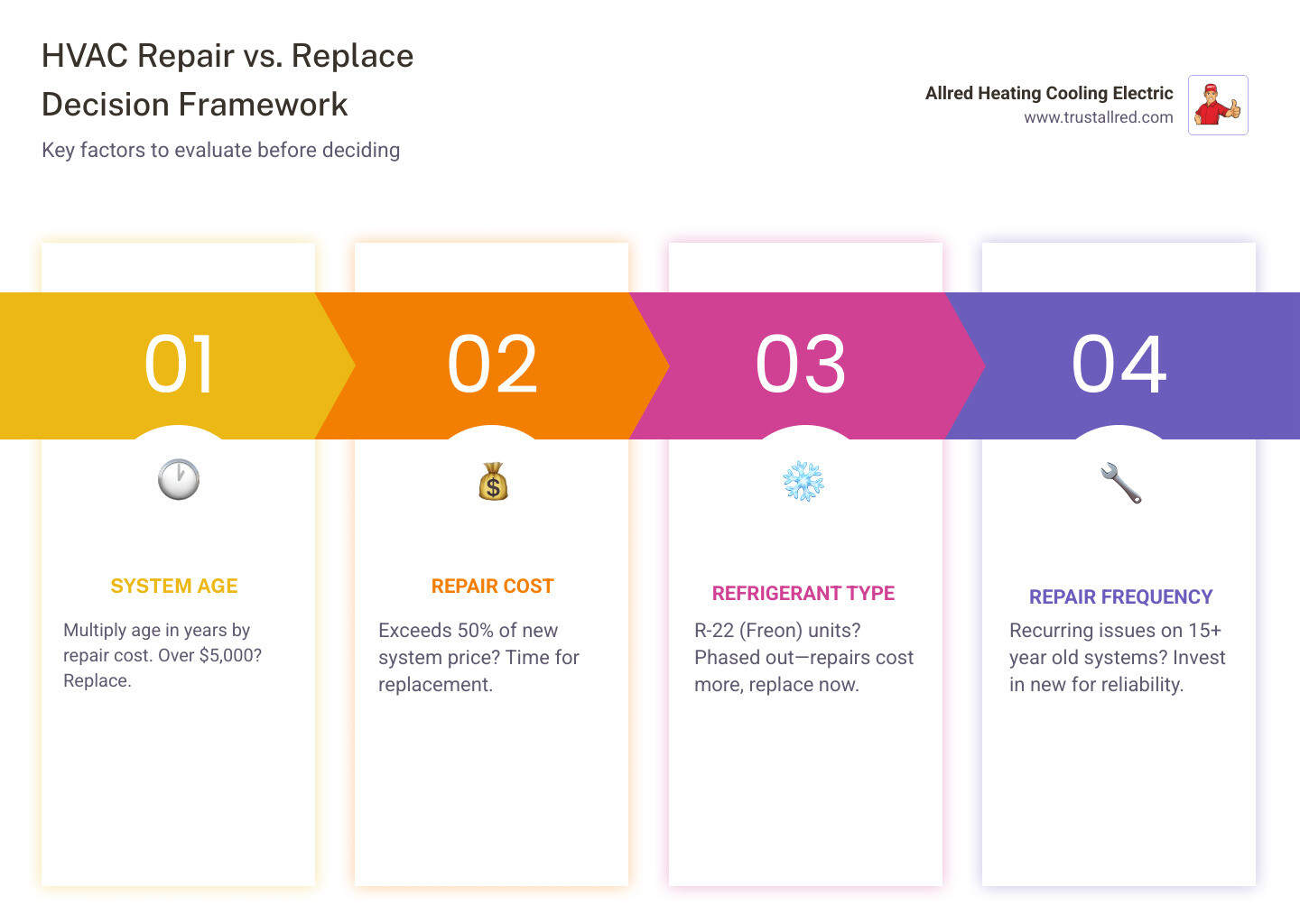
| Repair cost exceeds 50% of a new system’s cost | Replace |
| System age × repair cost exceeds $5,000 | Replace |
| System uses R-22 (Freon) refrigerant | Replace |
| System is 15+ years old with recurring issues | Replace |
| Minor fix on a mid-age system under warranty | Repair |
Most homeowners are surprised to learn that the “cheaper” option in the short term is not always the smarter choice over time. A repair that buys you 12 months of relief on a 16-year-old system may cost you more than a new installation would — once you factor in rising energy bills, refrigerant costs, and the next breakdown that is likely already on its way.
In this guide, we break down exactly how to run the numbers, what warning signs to watch for, and when investing in a new system is the move that actually saves you money.
I’m Dan Allred, co-founder of Allred Heating, Cooling & Electric, and after more than a decade of helping Puget Sound homeowners navigate the cost of repairing old hvac vs buying new system, I know how much the right decision can save a family — or cost them. Let’s walk through the framework we use every day so you can make the call with confidence.
The $5,000 Rule and Decision Frameworks
When we arrive at a home in Bellevue or Tacoma to look at a system that has finally given up the ghost, the first thing we do isn’t reach for a price sheet. We reach for a calculator. Deciding whether to sink money into an old unit or invest in a new one shouldn’t be based on a “gut feeling.” It should be based on data.
The biggest factor in this equation is the system’s age. While some heating systems can push toward 20 years with perfect maintenance, the average lifespan of an HVAC system is typically between 10 and 15 years. As we move into May 2026, many systems installed in the early 2010s are entering their “late-life” stage. At this point, components begin to fail not because of a single fluke, but because of cumulative mechanical fatigue.
Maintenance plays a massive role here. A system that has received annual check-ups will naturally last longer than one that has been ignored. If you are curious about how to keep your current or future system running longer, check out our guide on HVAC Maintenance Tips for Long-Lasting Systems.

Applying the $5,000 Rule to the Cost of Repairing Old HVAC vs Buying New System
The most reliable mathematical formula we use is called the $5,000 Rule. It is a simple way to remove the emotional stress from the decision.
To use it, you multiply the age of your equipment by the estimated repair cost. If the resulting number is more than $5,000, you should seriously consider replacing the unit.
- Scenario A: You have an 8-year-old AC unit that needs a minor electrical repair. 8 (years) x $400 (repair) = $3,200. Since this is under $5,000, repairing it is likely a wise investment.
- Scenario B: You have a 14-year-old furnace that needs a major blower motor replacement. 14 (years) x $600 (repair) = $8,400. Because this exceeds the $5,000 threshold, you are essentially throwing money at a system that is likely to fail again soon.
This rule helps homeowners in places like Puyallup or Issaquah see that a “cheap” repair on an old system is often a “sunk cost fallacy” in action. For more on how regular check-ups influence these numbers, read The Truth About How Often Your HVAC Needs a Tune-Up.
The 50% Rule for Major Component Failure
Another industry standard is the 50% Rule. This is even more straightforward: if the cost of a single repair exceeds 50% of the price of a brand-new system, replacement is almost always the better financial move.
Major component failures — like a cracked heat exchanger or a seized compressor — are the primary culprits here. These aren’t just expensive; they often signal that the rest of the system is under extreme stress. Furthermore, parts availability for older systems is becoming a major hurdle. As manufacturers move toward newer, more efficient standards, finding a specific control board or motor for a 15-year-old unit can lead to long wait times and inflated prices.
Evaluating the Cost of Repairing Old HVAC vs Buying New System
When evaluating the cost of repairing old hvac vs buying new system, we have to look beyond the immediate invoice. We have to look at the health of the entire system. An HVAC system is a “matched system,” meaning the indoor and outdoor units are designed to work together. If you keep repairing an old outdoor unit while the indoor furnace is also aging, you are missing out on the efficiency gains of a modern, synchronized setup.
Impact of Refrigerant Phase-Outs on Repair Viability
One of the most significant “hidden” costs in older systems is the type of refrigerant they use. If your system was installed before 2010, it likely uses R-22 (Freon). The EPA completely phased out the production and importation of R-22 in 2020. By 2026, the remaining supply is extremely limited and incredibly expensive.
Even if the repair itself is simple, such as fixing a small leak, the cost of recharging an R-22 system can be staggering. We often tell our neighbors in Federal Way and Auburn that a single refrigerant recharge on an old unit can cost nearly as much as a significant down payment on a new, high-efficiency system.
Furthermore, we are currently in the middle of new EPA transitions. Starting in 2025 and 2026, the industry is moving toward newer refrigerants like R-454B to meet even stricter environmental standards. This makes repairing older R-410A systems (the standard for the last decade) more complex as those refrigerant prices also begin to climb. Investing in a new system now ensures you are on the right side of these environmental regulations for the next 15 to 20 years.
Hidden Factors in the Cost of Repairing Old HVAC vs Buying New System
There are “soft costs” to keeping an old system that many people overlook.
- Repair History: If you have called us three times in the last two years for different issues, you are in what we call a “Repair Spiral.” The cumulative expenses of those service calls often equal a significant portion of a new system.
- Safety Risks: This is the most critical factor. In older furnaces, the heat exchanger can develop hairline cracks over time. This isn’t just a repair issue; it is a life-safety issue. A cracked heat exchanger can leak carbon monoxide into your home. If we find a crack in a 20-year-old furnace, we will always recommend replacement because the risk to your family is simply too high.
- Comfort and Air Quality: Older systems often struggle with humidity control and air filtration. Modern systems offer advanced filtration that can significantly reduce allergens in your home — a major plus for those of us living in the pollen-heavy Pacific Northwest.
For a deeper dive into what kind of system might be right for your home’s layout, see our breakdown of Types of Home Heating Systems.
When Replacement is the Smarter Long-Term Investment
In our experience serving communities from Bellevue to Spanaway, the most compelling reason to replace isn’t just avoiding a repair bill — it’s the monthly savings. A new system is an investment that pays dividends every time you open your utility bill.
| Feature | 10-15 Year Old System | Modern SEER2 System (2026) |
|---|---|---|
| Efficiency Rating | 10 – 13 SEER | 18 – 25+ SEER2 |
| Energy Consumption | High (Standard Blower) | Low (Variable-Speed) |
| Monthly Bill Impact | Baseline | 20% – 50% Reduction |
| Refrigerant Cost | Very High (R-22/R-410A) | Standard (New EPA Specs) |
| Warranty | Expired | 10 – 12 Years |
Energy Efficiency and Monthly Utility Savings
Modern systems use SEER2 (Seasonal Energy Efficiency Ratio) ratings, which are much more stringent than the old SEER standards. Upgrading from a 10-year-old unit to a high-efficiency SEER2 model can reduce your cooling expenses by up to 50%.
In the Seattle area, where we rely heavily on heating in the winter, the AFUE (Annual Fuel Utilization Efficiency) rating of a new furnace is equally important. Older furnaces might operate at 60% to 70% efficiency, meaning 30 cents of every dollar you spend on gas is literally going up the chimney. A modern high-efficiency furnace can reach up to 98% AFUE.
Variable-speed technology is another game-changer. Unlike old systems that are either “100% on” or “off,” variable-speed blowers adjust their output to the exact needs of your home. This results in more even temperatures, better humidity control, and significantly lower energy usage. You can learn more about these benefits in our post on Maximizing Home Energy Efficiency.
Incentives, Tax Credits, and Financing Options
The upfront cost of repairing old hvac vs buying new system is often the biggest hurdle for homeowners. However, in 2026, there are more financial incentives than ever before to help you upgrade.
- Inflation Reduction Act (IRA): This federal program provides significant tax credits for energy-efficient upgrades. For example, you may be eligible for a tax credit of up to $2,000 for a qualifying heat pump or $600 for a high-efficiency central AC.
- Local Utility Rebates: Many of our local utility providers in King and Pierce counties offer instant rebates for homeowners who switch to high-efficiency electric heat pumps or high-AFUE gas furnaces.
- Flexible Financing: We understand that a new HVAC system is a major investment. That’s why we offer various payment plans that can fit into a monthly budget, often with the energy savings helping to offset the monthly payment.
If you are debating between sticking with gas or moving to an electric heat pump, check out our comparison of Furnace vs Heat Pump.
Signs Your Old HVAC System is Beyond Repair
Sometimes, the system makes the decision for you. If you notice any of the following signs, the “repair” ship has likely sailed.
Performance Decline and Reliability Issues
- Short Cycling: If your unit turns on and off every few minutes, it is struggling to maintain the temperature. This puts immense strain on the compressor and motor, leading to an inevitable (and expensive) blowout.
- Unusual Noises: Screeching, grinding, or loud banging usually indicates a major mechanical failure in the blower or compressor.
- Uneven Temperatures: If your living room is a sauna while your bedroom is an icebox, your old system’s ductwork or blower can no longer handle the load.
- Rising Utility Bills: If your usage hasn’t changed but your bills are climbing every summer and winter, your system is losing its “mechanical “integrity.” It is working harder and harder to produce less and less comfort.
Safety and Infrastructure Compatibility
As we mentioned, safety is paramount. Beyond carbon monoxide risks from cracked heat exchangers, older electrical components can become fire hazards as they degrade.
Infrastructure compatibility is also a factor. If you are planning a home renovation or adding a room to your house in Kent or Renton, your old system likely won’t have the capacity to handle the extra square footage. Upgrading to a properly sized system during a renovation is much more cost-effective than trying to “force” an old unit to do a job it wasn’t designed for.
Furthermore, we always inspect your ductwork. Leaky ducts can waste up to 30% of your conditioned air. When we install a new system, we ensure the “infrastructure” of your home is ready to support the new technology, maximizing your long-term savings.
Frequently Asked Questions
What is the average lifespan of a modern HVAC system?
Most modern central air conditioning and heating systems are designed to last between 15 and 20 years. However, in the humid and variable climate of the Puget Sound, we typically see the “efficiency drop-off” happen around year 12 to 15. After the 15-year mark, the risk of a major component failure increases significantly.
When does it make more sense to repair rather than replace?
Repairing is usually the better option if the system is less than 10 years old, the repair is minor (like a capacitor or a thermostat), and the unit is still under its manufacturer’s warranty. If the system has been well-maintained and this is its first major hiccup, a repair can often buy you several more years of reliable service.
How do new EPA refrigerant regulations affect my older unit?
If your unit uses R-22, repairs involving the refrigerant will be extremely expensive because the gas is no longer produced. If your unit uses R-410A, you are still in good shape for now, but as the industry moves toward R-454B in 2025 and 2026, the cost of R-410A will eventually begin to rise. A new system using the latest refrigerant standards is the best way to “future-proof” your home.
Conclusion
At the end of the day, the cost of repairing old hvac vs buying new system comes down to your long-term goals. If you plan on staying in your home for the next 5 to 10 years, the energy savings and peace of mind provided by a new system almost always outweigh the cost of repeated repairs on an aging unit.
At Allred Heating Cooling Electric, we treat every customer like family. Whether you are in Redmond, Kirkland, or Puyallup, our expert technicians are here to provide an honest, transparent assessment of your system. We won’t sell you something you don’t need, but we will make sure you have all the facts to make the best financial decision for your household.
If you are tired of the “repair spiral” and want to see how much you could save with a modern, high-efficiency system, we are here to help. We offer 24/7 emergency availability and a family-oriented approach that has made us a trusted name across the Puget Sound for years.
Ready for a professional opinion? Learn more about our HVAC replacement services and schedule your assessment today.
