



How Long Your Heat Pump Lasts Depends More on You Than You Think
If you’re wondering how to extend the life of your heat pump, here’s the short answer:
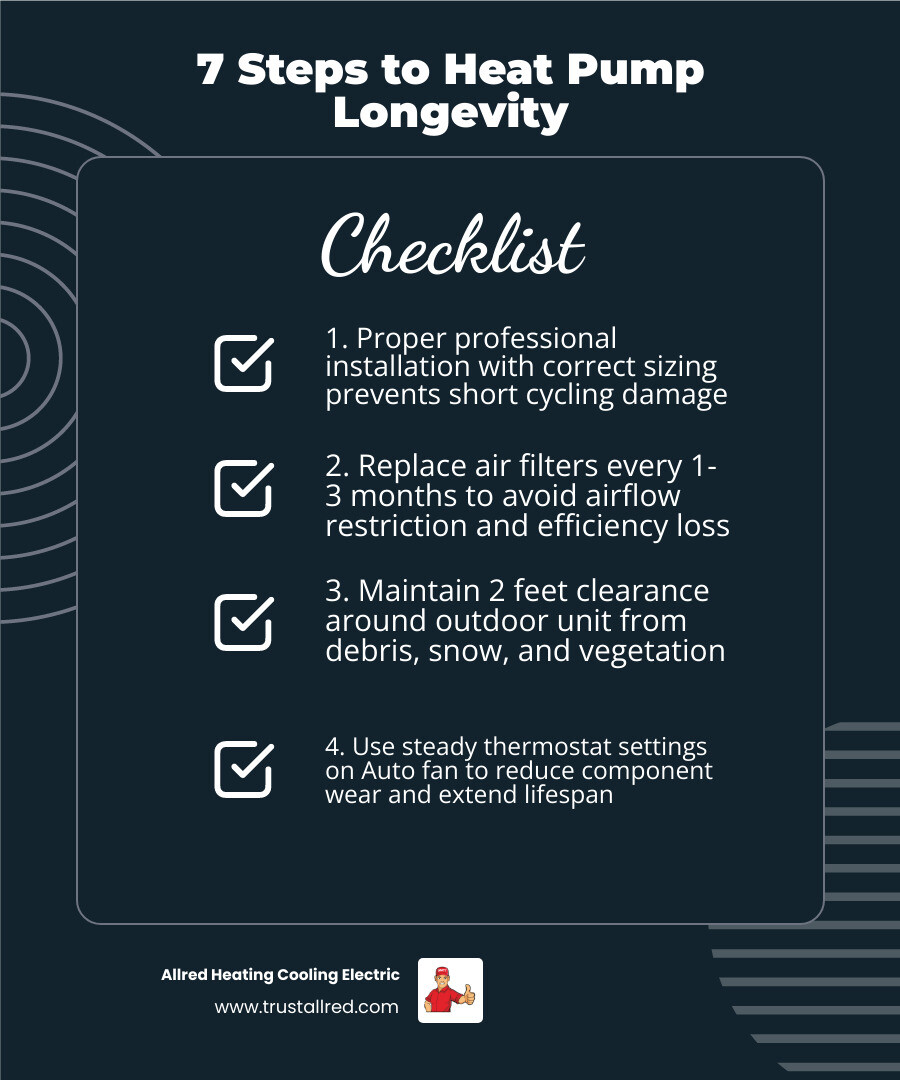
- Start with proper professional installation — correct sizing prevents damaging short cycles
- Change your air filters every 1–3 months — clogged filters force the system to overwork
- Keep the outdoor unit clear — maintain at least 2 feet of clearance from debris, snow, and vegetation
- Use a smart thermostat with steady temperature settings — frequent big adjustments wear components faster
- Run your fan on “Auto” — continuous fan operation adds unnecessary runtime hours
- Schedule professional tune-ups twice a year — spring and fall service catches problems early
- Address unusual noises or performance drops immediately — small issues become expensive failures fast
Most heat pumps last between 10 and 15 years. That’s the average. But here’s what the research consistently shows: a well-maintained system can reach 20 years, while a neglected one can lose 20–30% of its efficiency within just a few years — and fail well before its time. For homeowners in the Seattle area, where your heat pump runs year-round to handle both wet, cool winters and warm summers, the stakes are even higher. Unlike a furnace that rests all summer or an air conditioner that sits idle all winter, your heat pump never really gets a break. That continuous operation puts real stress on components — and that stress compounds quickly without consistent care.
I’m Daniel Allred, co-founder of Allred Heating, Cooling & Electric, and with over a decade of hands-on HVAC experience serving the Puget Sound region, I’ve seen how the right habits around how to extend the life of your heat pump can mean the difference between a system that fails at year 10 and one that’s still running strong at year 20. Let’s walk through exactly what that looks like in practice.
Understanding Heat Pump Longevity and Performance
When we talk about HVAC longevity in May 2026, we have to recognize that heat pumps are the marathon runners of the home comfort world. Because they provide both heating and cooling, they are essentially working double shifts compared to a standalone furnace. This constant activity is exactly why understanding the nuances of Heat Pump Systems is so vital for homeowners in places like Puyallup and Kent.
The typical lifespan of a heat pump is often cited as 10 to 15 years, but that range is heavily influenced by how hard the unit has to work and how well it is cared for. To give you some perspective, here is how heat pumps compare to other common systems:
| System Type | Average Lifespan | Potential with Expert Care |
|---|---|---|
| Standard Heat Pump | 10–15 Years | 20 Years |
| Gas Furnace | 15–20 Years | 25 Years |
| Central Air Conditioner | 12–17 Years | 20 Years |
| Geothermal Heat Pump | 25–30 Years | 35+ Years (50+ for loops) |
| Ductless Mini-Split | 10–30 Years | 30 Years |
As you can see, a standard air-source heat pump generally has a shorter lifespan than a furnace. Why? It’s the “year-round operation stress.” A furnace might only run for five or six months a year in our region. A heat pump is active for twelve. This is why neglecting maintenance is so dangerous; a neglected system doesn’t just lose efficiency—it burns out.
Research indicates that the difference in energy consumption between a well-maintained heat pump and a severely neglected one can range from 10% to 25%. Even worse, a system that hasn’t been serviced can lose up to 30% of its efficiency in just a few short years. When the system struggles to move heat, the compressor—the “heart” of your unit—has to run longer and hotter. Heat is the enemy of mechanical longevity. By keeping the system clean and efficient, you are directly reducing the thermal and mechanical stress on the most expensive parts of the machine.
Steps 1-3: Proper Installation and Airflow Management
The foundation of a long-lasting system is laid before the unit even turns on for the first time. We often tell our customers in Federal Way and Auburn that you can’t “maintain” your way out of a bad installation.
Step 1: Professional Installation and Sizing
If a heat pump is too large for a home, it will engage in “short cycling.” This means it turns on, blasts the house with air, reaches the thermostat setting in minutes, and shuts off. Then, ten minutes later, it does it again. This constant starting and stopping is like driving a car in stop-and-go city traffic; it wears out the starter and the compressor significantly faster than “highway miles” (long, steady run cycles).
To avoid this, we perform a Manual J load calculation. This isn’t just a guess based on square footage. It accounts for your home’s insulation, window types, orientation to the sun, and local climate. Getting the sizing right is the single most important thing you can do to ensure your Daikin Heat Pumps or other high-quality units live to see their 20th birthday.
Step 2: Air Filter Management
This is the most common DIY task, yet it’s the one most frequently forgotten. Your heat pump needs to “breathe” to move heat effectively. When a filter is clogged with dust, pet dander, and Seattle pollen, the blower motor has to work twice as hard to pull air through the restriction.
We recommend checking your filters every month and replacing them at least every 1 to 3 months. If you have pets or live near a dusty construction site in Maple Valley, you’ll likely be on the 1-month schedule.
Step 3: Understanding MERV Ratings
While it’s tempting to buy the highest MERV-rated filter available to “clean the air,” be careful. High-efficiency filters are denser. If your system isn’t designed for a high-MERV filter, it can actually restrict airflow as much as a dirty filter would. Always check your manufacturer’s recommendations or ask us during a visit. For more deep dives into this, check out our HVAC Maintenance Tips Long Lasting Systems guide.

Steps 4-5: Outdoor Unit Protection and Smart Operation
Your outdoor unit is the part of the system that actually interacts with the environment to “find” heat (even in the cold) or dump heat (in the summer). Because it sits outside in the elements, it requires specific protection.
Step 4: Outdoor Unit Clearance
We recommend a minimum of 2 feet of clear space around the outdoor unit on all sides. This means trimming back the rhododendrons, keeping the grass mowed, and ensuring that your “Singing in the Rain” wet-weather debris doesn’t pile up against the coils.
In our region, we also have to deal with snow and ice. While heat pumps have a “defrost cycle” to melt ice off the coils, heavy snow can block airflow entirely. If we get a rare heavy snowfall in North Bend or Snoqualmie, gently brush the snow off the top and sides of the unit. Never use a pressure washer on the delicate fins of the coils, and never pour boiling water on a frozen unit—the thermal shock can damage the metal.
For those interested in how these systems handle our specific climate, read our piece on Singing in the Rain Why Heat Pumps Thrive in Mild Wet Climates.
Step 5: Smart Thermostat and Fan Settings
Modern smart thermostats are fantastic for extending lifespan because they can be programmed to avoid “emergency heat” or “backup heat” scenarios. Standard electric backup heat is much less efficient and can be expensive to run. A smart thermostat knows how to ramp up the heat pump gradually to reach your desired temperature without triggering the auxiliary heat strips unless absolutely necessary.
Also, set your fan to “Auto” rather than “On.” When the fan is “On,” it runs 24/7, regardless of whether the system is actually heating or cooling. This adds thousands of hours of wear to the fan motor and can also increase humidity levels in the home during the summer.
How to extend the life of your heat pump with consistent settings
The “set it and forget it” rule is king for heat pumps. Unlike a furnace, which can recover from a 10-degree temperature drop relatively quickly, a heat pump is designed to maintain a steady temperature. If you drop the thermostat by 8 degrees while you’re at work and then crank it back up when you get home, the system will likely have to engage its inefficient backup heat to bridge that gap quickly. This puts unnecessary strain on the electrical components and the compressor. Keep your settings within a 2-to-3-degree range for maximum longevity and efficiency. This applies whether you have a central system or a Ductless Mini Split for Optimal Performance.
Steps 6-7: How to Extend the Life of Your Heat Pump with Professional Service
While DIY tasks are important, there are technical aspects of a heat pump that require a professional touch. We recommend bi-annual tune-ups—once in the spring before the cooling season and once in the fall before the heating season.
Step 6: The Bi-Annual Tune-Up
During a professional visit, we do things that homeowners simply can’t do safely. This includes:
- Cleaning the coils: Both the indoor and outdoor coils accumulate a film of grime that insulates the metal and prevents heat transfer. We use specialized cleaners to restore efficiency.
- Checking refrigerant levels: A heat pump is a closed system. If it’s low on refrigerant, there is a leak. Running a system with low refrigerant will eventually kill the compressor.
- Inspecting electrical connections: Heat and vibration can loosen wires over time. Loose connections cause “pitting” and can lead to component failure or even fire hazards.
- Lubricating moving parts: Reducing friction in the motors extends their life and makes the system quieter.
If you are in the South Sound area, our Heat Pump Tune Up Auburn WA Guide provides a great checklist of what to expect. This kind of Regular HVAC Maintenance Optimal Performance is the single best investment you can make for your home’s comfort.
Step 7: Address Repairs Early
The final step in how to extend the life of your heat pump is to listen to what the machine is telling you. HVAC systems rarely fail “out of the blue.” Usually, they give you weeks or months of warning signs.
How to extend the life of your heat pump by addressing repairs early
If you hear a new rattling, squealing, or grinding noise, don’t just turn up the TV. That noise is often a sign of a loose belt, a failing bearing, or a compressor issue. If you address it immediately, it might be a simple part replacement. If you wait, that failing part can cause a chain reaction that destroys the entire system.
The Proven Benefits Timely HVAC Repair Services include not just a longer-lasting unit, but lower utility bills and better indoor air quality. Small issues like a clogged condensate drain can lead to water damage and mold if left unchecked. Being proactive is the hallmark of a savvy homeowner.
When to Repair vs. Replace Your Aging System
Even with the best care, every mechanical system eventually reaches the end of its road. As we move through 2026, many older systems are using R-22 refrigerant, which is no longer being produced and has become extremely expensive to service.
We generally use the “50% Rule”: if a repair quote exceeds 50% of the cost of a new system, and the unit is over 10 years old, replacement is usually the smarter financial move. New systems are significantly more efficient than those built a decade ago. Upgrading can often pay for itself in energy savings over just a few years.
If you’re trying to decide between sticking with a heat pump or switching to something else, our guide on the Furnace vs Heat Pump Difference can help you weigh the pros and cons for our specific Washington climate.
Frequently Asked Questions about Heat Pump Maintenance
What is the typical lifespan of a heat pump in 2026?
In 2026, the average lifespan remains 10 to 15 years for air-source units. However, with the advancements in inverter technology and smart diagnostics, we are seeing more well-maintained systems comfortably reaching the 20-year mark. Factors like coastal salt air (in places like Browns Point or Tacoma) can shorten this slightly, while stable environments and consistent maintenance extend it.
How often should I change my heat pump filters?
Standard 1-inch filters should be changed every 1 to 3 months. If you use a thicker 4-inch media filter, you might get 6 to 9 months out of it. However, always check it monthly. If you have pets, live in a high-pollen area like Issaquah, or have family members with allergies, stick to the 1-month interval to ensure optimal airflow and indoor air quality.
Does professional maintenance really save money?
Absolutely. Beyond extending the life of the unit by several years, professional maintenance can reduce your monthly energy bills by 10% to 25%. It also keeps your manufacturer’s warranty valid; many brands now require proof of annual service to honor warranty claims on major parts like the compressor. For a look at what happens during these visits, see our HVAC Check During Routine Maintenance post.
Conclusion
Your heat pump is an investment in your family’s year-round comfort. By following these seven steps—from professional installation to bi-annual tune-ups—you can maximize that investment and avoid the stress of a premature system failure. Whether you’re in Bellevue, Sammamish, or Spanaway, the key to longevity is consistency.
At Allred Heating Cooling Electric, we’re more than just technicians; we’re a family-oriented team dedicated to keeping our neighbors comfortable. We pride ourselves on expert service, 24/7 emergency availability, and a commitment to the communities we serve, from Kirkland to Tacoma and everywhere in between.
If it’s been a while since your last system check, don’t wait for a breakdown. Protect your investment with professional mini-split and heat pump services and ensure your home stays perfectly tempered for years to come. Give us a call today—we’re here to help you get the most out of your heat pump.
