



Why Constant Moisture in Your Ducts Is a Bigger Problem Than You Think
How constant moisture affects ductwork and air quality is something every Seattle-area homeowner should understand — because what’s quietly happening inside your vents can directly impact your family’s health, your energy bills, and the lifespan of your entire HVAC system.
Here’s a quick summary of what’s at stake:
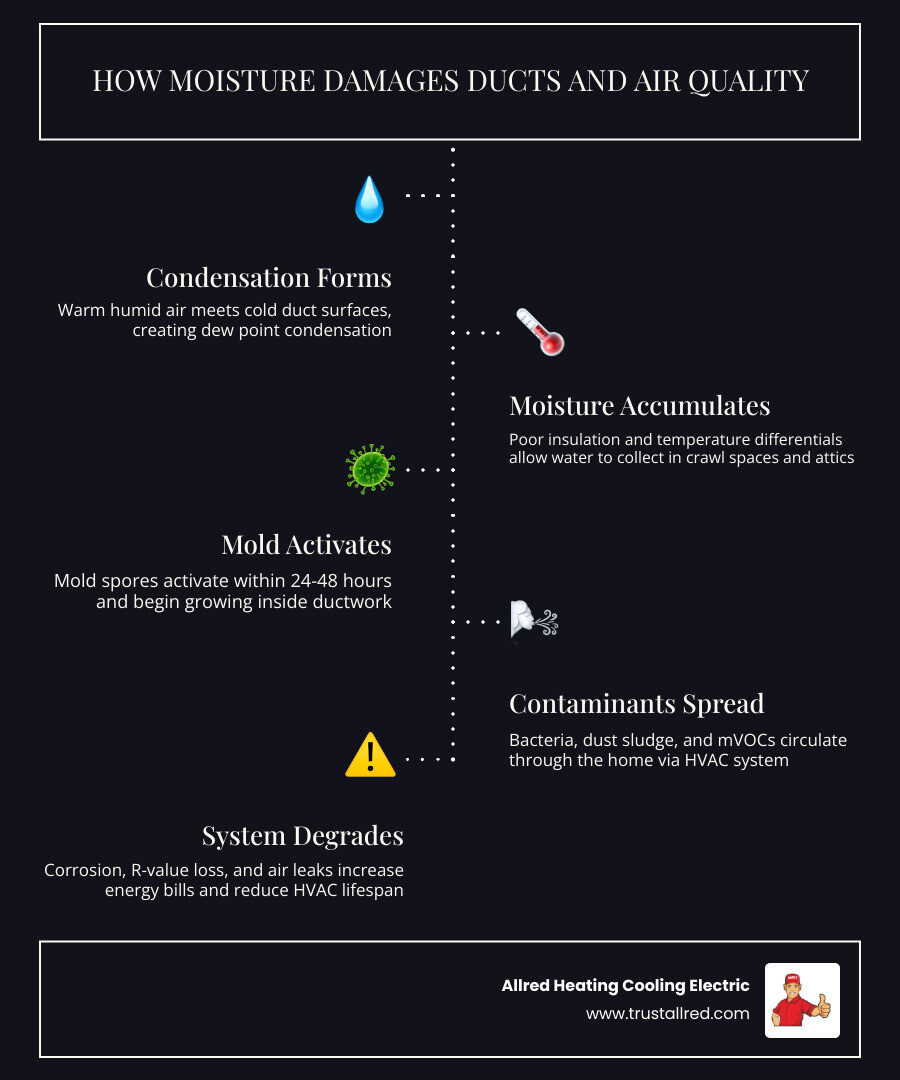
- Mold growth — Mold spores can activate within 24 to 48 hours of moisture exposure and spread through your entire duct system
- Bacteria and allergens — Damp ducts create ideal breeding conditions for biological contaminants that circulate through your home’s air
- Respiratory health risks — Breathing air from moisture-affected ducts can trigger asthma, worsen allergies, and cause chronic respiratory irritation
- Duct damage — Excess moisture causes metal ducts to rust and corrode, and causes insulation to lose its thermal resistance (R-value), reducing system efficiency
- Higher energy bills — Wet, degraded duct insulation forces your HVAC system to work harder, wasting energy and increasing wear
- Air leaks — Corrosion and structural damage from moisture leads to duct leaks, and the U.S. Department of Energy estimates these leaks account for 20 to 30 percent of energy loss in a typical HVAC system
The EPA has found that indoor air pollutants can be two to five times — and in some cases up to 100 times — higher than outdoor levels. When your ductwork is consistently damp, your home becomes one of those cases.
In the Pacific Northwest, where cool outdoor temperatures meet humid indoor air during heating and cooling seasons, duct moisture isn’t just possible — it’s common. The temperature differential between cold metal duct surfaces and warm, humid surrounding air is often enough to trigger condensation, especially in crawl spaces, attics, and basements where many ducts run uninsulated and unprotected.
The good news is that moisture problems in ductwork are preventable and fixable — if you know what to look for and when to act.
I’m Daniel Allred, co-founder of Allred Heating, Cooling & Electric, and after years of servicing HVAC systems across the Puget Sound region, I’ve seen how constant moisture affects ductwork and air quality in Pacific Northwest homes — from corroded metal ducts in waterlogged crawl spaces to mold colonies hidden inside flex duct liners. In the sections below, I’ll walk you through exactly what causes moisture to build up in your ducts, what damage it does over time, and what you can do to protect your home and the air your family breathes.
What Causes Constant Moisture to Form on HVAC Ductwork?
To solve a moisture problem, we first have to understand the “why.” In places like Auburn, Kent, and Bellevue, moisture in ductwork is rarely the result of a single issue; it is usually a combination of physics and system performance.
The Science of Condensation and Dew Point
The most common culprit is “duct sweating.” This happens when the temperature of the metal duct surface drops below the dew point of the surrounding air. Think of a cold can of soda on a humid July afternoon in Tacoma; the water droplets that form on the outside of the can are exactly what happens to your ducts. If your air conditioner is pumping 55-degree air through metal ducts located in a 75-degree crawl space with 70% humidity, condensation is inevitable.
Temperature Differentials and Poor Insulation
Ducts located in unconditioned spaces — like attics, basements, or crawl spaces — are highly susceptible. If these ducts lack proper insulation or if the insulation has gaps, the warm, moist air of the crawl space hits the cold metal, creating a constant drip. This is why we often emphasize checking your HVAC System FAQ to understand how insulation acts as a vapor barrier.

Air Leaks and Vapor Pressure
When ducts have holes or poorly sealed joints, they don’t just lose conditioned air; they pull in humid air from the outside. Vapor pressure naturally moves moisture from areas of high concentration to low concentration. If your return ducts are leaky, they can suck in damp air from a wet basement, which then condenses inside the system.
Oversized AC Units and Short-Cycling
This is a technical issue we see often in newer builds. If an AC unit is too large for the home, it cools the air very quickly and then shuts off. This is called “short-cycling.” Because the unit doesn’t run long enough to properly dehumidify the air, the indoor humidity remains high, while the ducts get cold enough to sweat.
How Constant Moisture Affects Ductwork and Air Quality Long-Term
When moisture becomes a permanent resident in your ventilation system, it transforms your home’s “arteries” into a breeding ground for biological hazards.
The 24-48 Hour Window
Mold is not patient. Research shows that mold spores can activate and begin releasing spores within a mere 24 to 48 hours after moisture exposure. Once established, these colonies can spread through your entire ductwork network in less than two weeks.
Bacteria and “Dust Sludge”
Moisture doesn’t just invite mold; it turns the normal household dust inside your ducts into a sticky, organic sludge. This “dust sludge” acts as a buffet for bacteria and dust mites. As the air blows over this damp debris, it picks up microbial volatile organic compounds (mVOCs). These are the gases responsible for that “dirty sock” or musty mildew smell that wafts through the home when the AC kicks on.
Health Risks: From Allergies to Asthma
Breathing air from moisture-affected ductwork is a significant health concern. For residents in Puyallup or Issaquah with seasonal allergies, damp ducts can turn a seasonal struggle into a year-round battle. The biological contaminants can cause:
- Persistent coughing and wheezing
- Frequent headaches and fatigue
- Skin irritation
- Severe asthma triggers, especially in children and the elderly
Using Ductless AC Services Improve Air Quality can sometimes mitigate these risks by removing the ductwork variable entirely, but for traditional systems, filtration is key. You can learn more about how to capture these particles in our guide on Air Purifier Benefits.
The Impact of Moisture on Duct Integrity and Efficiency
Beyond your health, moisture is a “system killer.” It attacks the physical components of your HVAC setup in several ways:
- Corrosion and Rust: Metal ducts are prone to oxidation. Constant moisture leads to rust, which eventually eats holes through the metal, creating massive air leaks.
- Insulation Failure: Most ductwork is wrapped in fiberglass insulation. When fiberglass gets wet, it compresses. Once compressed, it loses its R-value (thermal resistance). A wet 1-inch thick wrap has almost zero insulating power.
- Static Pressure Issues: As dust sludge builds up on coils and inside ducts, it increases the resistance the blower motor has to fight against. A 30% increase in static pressure across a coil can result in significantly higher operating costs and premature motor failure.
| Feature | Dry Duct Insulation | Wet/Damaged Duct Insulation |
|---|---|---|
| Thermal Resistance | High (Maintains Temp) | Low (Loses Conditioned Air) |
| Energy Efficiency | Optimal | 20-30% Energy Loss |
| Mold Risk | Low | Extremely High |
| System Lifespan | 15-20 Years | 10-12 Years |
Regular HVAC Upkeep is the only way to catch these efficiency drains before they lead to a total system breakdown.
Warning Signs of Moisture Problems in Your Ventilation System
You don’t always need to crawl into your attic to know you have a problem. Your home will usually give you several “tells”:
- Musty Smells: If you notice a damp, earthy odor only when the air is blowing, you likely have mold or bacteria in the ducts or on the evaporator coil.
- Water Stains: Yellow or brown rings on your ceiling near air registers are a “smoking gun” for duct condensation.
- Foggy Windows: Excessive indoor humidity often shows up as condensation on window glass, which is a sign that your HVAC system isn’t dehumidifying properly.
- Rusted Registers: Look at your floor or wall vents. If the metal is bubbling or showing orange rust, moisture is present.
- Increased Dust: If your furniture is “extra dusty” shortly after cleaning, your ducts may be pulling in debris through moisture-corroded holes in the attic or crawl space.
Don’t ignore these signs. Often, homeowners find that The High Cost of Dirty Filters and What Happens When You Forget Them plays a role; a clogged filter restricts airflow, making the coils and ducts even colder and more prone to sweating.
How to Prevent and Fix Moisture Issues in Your Ducts
Prevention is always more affordable than mold remediation, which can cost anywhere from $500 to over $6,000 depending on the severity. Here is how we recommend tackling the issue:
Step 1: Control Indoor Humidity
The EPA recommends keeping indoor relative humidity between 30% and 50%. We suggest every homeowner in the Pacific Northwest keep a $15 digital hygrometer in their home to monitor this. If your home consistently stays above 55%, you are in the “mold danger zone.”
Step 2: Professional Duct Sealing
Using standard “duct tape” won’t work — it actually dries out and falls off. Professionals use mastic sealant (a thick, gooey paste) or UL-rated foil tape. Sealing the joints prevents humid air from entering the system and stops conditioned air from escaping.
Step 3: Improve Insulation and Vapor Barriers
If your ducts are in a crawl space, ensure the ground is covered with a high-quality vapor barrier. In places like Klahanie or Sammamish, where ground moisture is high, crawl space encapsulation can reduce the humidity surrounding your ducts by 50% or more. For those looking for a modern solution, learning How to Keep Your Klahanie Home Cool with Ductless Magic can offer a way to bypass traditional duct issues entirely.
Why Controlling Humidity is Critical for Air Quality
Managing the “Goldilocks zone” of 30-50% humidity stops moisture migration. When you cook or shower, always run your exhaust fans for at least 20 minutes afterward to vent that moisture outside. In basements, sealing cracks in the foundation can prevent the “stack effect” from pulling damp air up into your living spaces.
Many homeowners find that the Benefits Ductless AC Systems Home include much better localized humidity control. If you stick with a central system, a whole-home dehumidifier integrated into your HVAC is often the best defense, ensuring your Ductless Mini Split for Optimal Performance or central unit isn’t overwhelmed.
Professional Maintenance Strategies
The best way to manage how constant moisture affects ductwork and air quality is through a Professional HVAC Maintenance Plan Available in Snoqualmie WA. Our technicians perform several critical tasks:
- Condensate Drain Clearing: We flush the lines to prevent water from backing up into the ducts.
- Coil Cleaning: Removing the “food source” (dust) from the wet evaporator coil prevents mold.
- Airflow Calibration: Ensuring your system has the right static pressure to prevent over-cooling of the duct surfaces.
Frequently Asked Questions about Duct Moisture
Why is my ductwork “sweating” in the summer?
It’s all about the temperature differential. When cold air (often 20 degrees cooler than the room) moves through metal ducts in a warm, humid space, the surface of the metal reaches the dew point, causing water to condense. This is usually a sign of poor insulation or high humidity in the attic/crawl space.
Can mold in air ducts be cleaned or should I replace them?
It depends on the material. Metal ducts can usually be cleaned and sanitized by a professional. However, porous materials like fiberglass duct board or flexible ducts with mold inside generally cannot be fully cleaned because the mold roots into the fibers. In those cases, replacement is the only way to ensure the mold doesn’t return.
How does moisture affect the lifespan of my HVAC system?
Moisture accelerates the aging process. It causes rust on the heat exchanger, shorts out electrical components, and forces the blower motor to work harder against damp, heavy insulation and clogged coils. A moisture-affected system may only last 10 years, whereas a dry, well-maintained system can easily go 20.
Conclusion
Understanding how constant moisture affects ductwork and air quality is the first step toward a healthier, more efficient home. Whether you’re dealing with “sweating” ducts in Auburn or a musty smell in your Tacoma basement, the key is to act quickly before mold takes hold and your energy bills skyrocket.
At Allred Heating Cooling Electric, we pride ourselves on being your local Seattle HVAC experts. As a family-oriented business founded on trust and superior customer service, we are here for you 24/7. Whether you need a simple tune-up or a complex ductwork repair, our expert technicians ensure your year-round comfort.
Don’t let moisture compromise the air your family breathes. Schedule your professional maintenance to protect your air quality with the team that treats your home like our own.
