


How to Apply for Energy Rebates in Washington (And Actually Get Paid)
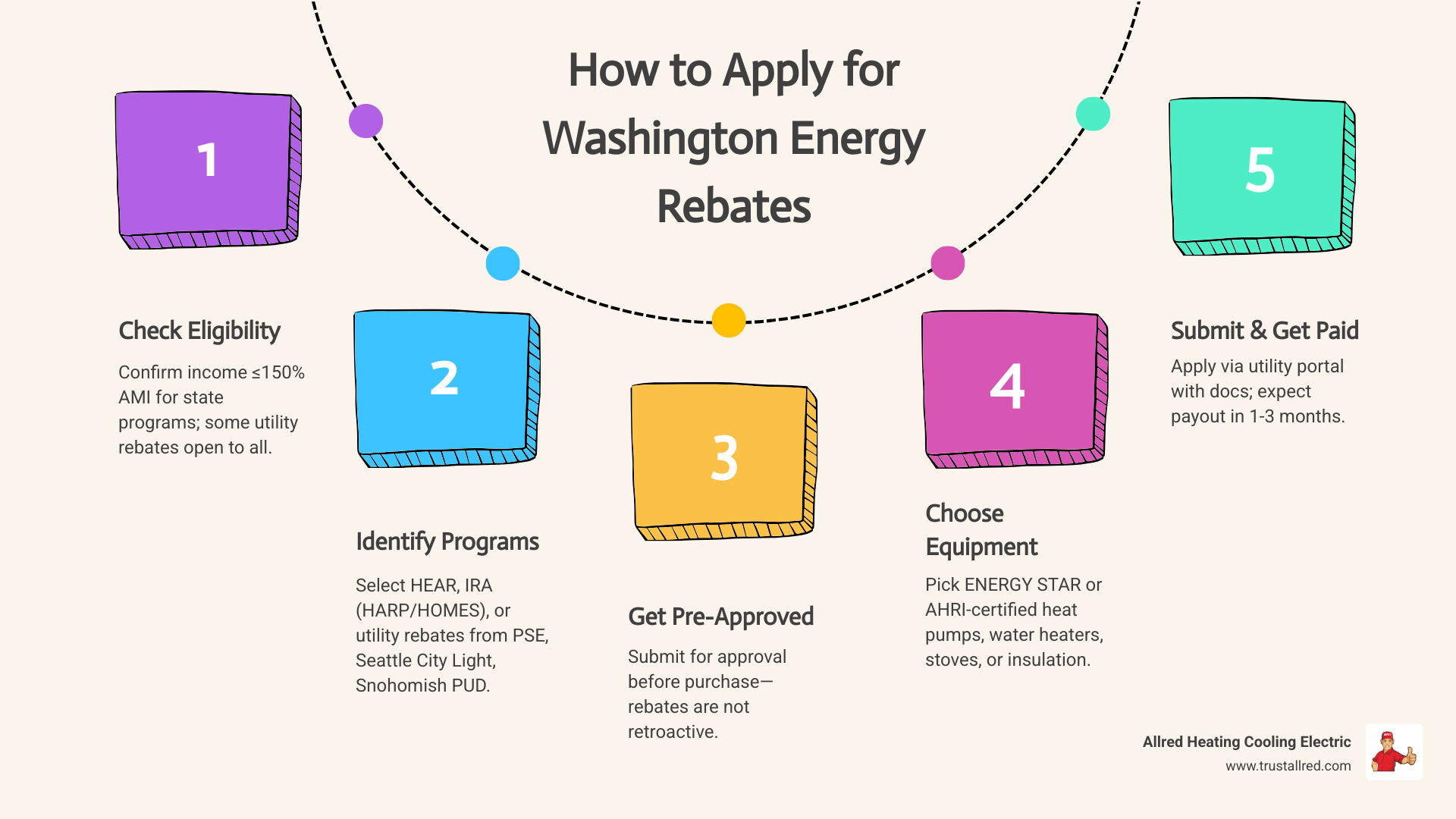
Knowing how to apply for energy rebates in Washington can save your household thousands of dollars on energy-efficient upgrades — here’s a quick overview of how it works:
- Check eligibility — Most programs require income at or below 150% of your county’s Area Median Income (AMI), though some utility rebates are open to all customers.
- Identify your program — Washington offers three main rebate layers: the state HEAR program, federal IRA programs (HARP and HOMES), and utility rebates from providers like PSE, Seattle City Light, and Snohomish PUD.
- Get pre-approved before you buy — IRA rebates are not retroactive. Work started before approval will not be reimbursed.
- Choose qualifying equipment — Look for ENERGY STAR or AHRI-certified heat pumps, heat pump water heaters, induction stoves, insulation, and electric panel upgrades.
- Find your local administrator — Email [email protected] with “State Home Electrification and Appliance Rebates (HEAR) Program” in the subject line to locate the program serving your area.
- Submit your application — Apply online through your utility’s portal or via your contractor, with receipts, photos, permits, and proof of installation.
- Wait for payout — Most rebates take one to three months from purchase to payment.
Washington homeowners right now are sitting on a significant — and time-sensitive — opportunity. The state has invested approximately $73.5 million across 55 rebate and incentive programs since 2024, with an additional $30.1 million anticipated for the 2025–2027 funding cycle. On top of that, Washington applied for over $165 million in federal Inflation Reduction Act funding to help low- and moderate-income households electrify their homes. That’s a lot of money on the table. But here’s the catch: these programs have deadlines, income thresholds, pre-approval requirements, and documentation rules that can trip up even the most organized homeowners. Miss a step and you could lose out on hundreds — or thousands — of dollars in savings.
I’m Daniel Allred, co-founder of Allred Heating, Cooling & Electric, and I’ve spent years helping Seattle-area homeowners navigate the overlapping layers of utility, state, and federal rebates when upgrading their HVAC and electrical systems — so I know exactly where people get stuck when figuring out how to apply for energy rebates in Washington. In this guide, I’ll walk you through every step clearly so you can claim what you’re owed without the headache.
Understanding How to Apply for Energy Rebates in Washington
Navigating the landscape of energy incentives in 2026 can feel like trying to solve a puzzle while the pieces are still being printed. However, the rewards are well worth the effort. In Washington, the primary driver for these incentives is the Climate Commitment Act (CCA), which funds state-level grants to reduce carbon emissions.
When you look at how to apply for energy rebates in Washington, you are essentially looking at three distinct “buckets” of money:
- State HEAR Program: The Home Electrification and Appliance Rebates (HEAR) program is state-funded. It doesn’t give money directly to you; instead, it funds local “administrators”—like community action agencies or specific utilities—who then distribute the rebates to residents and small businesses.
- Federal IRA Programs (HOMES and HARP): These come from the federal Inflation Reduction Act. The HARP (Home Appliance Rebate Program) focuses on point-of-sale rebates for equipment like heat pumps, while the HOMES program focuses on whole-home energy performance.
- Utility Rebates: These are offered directly by providers like Puget Sound Energy (PSE), Seattle City Light (SCL), and Snohomish PUD.
While these programs are designed to help you save, they often require different application paths. For some, you might need a professional assessment first, while others might require a specific type of backup power system. If you are considering a backup power solution alongside your energy upgrades, check out our Covington Generator Installation: Everything You Need to Know guide to see how it fits into your home’s electrical plan.

Eligibility and Income Requirements for 2026
One of the most common questions we hear is: “Do I actually qualify?” For many of the largest rebates, eligibility is tied to your Area Median Income (AMI).
In 2026, the magic number is 150% of the AMI. If your household earns at or below this threshold, you are likely eligible for the most significant rebates under the HEAR and IRA programs. This includes not just homeowners, but also renters and those living in multifamily properties.
If you are a PSE customer, you might be among the 50% of residents who qualify for the Efficiency Boost program. This program offers significantly higher rebate amounts for income-qualified customers. For example, a three-person household in certain counties might qualify with a monthly income of $6,000, while a higher income would move them to the “standard” rebate tier.
Why go through the trouble? Because the benefits of switching to high-efficiency systems go beyond just the rebate check. For instance, there are Five Reasons You Need to Get a Heat Pump that range from superior comfort to long-term energy savings that far outweigh the initial effort of the application.
Qualifying Equipment and Home Improvements
Not every “new” appliance qualifies for a rebate. To ensure you get paid, the equipment usually must meet strict efficiency standards, such as being ENERGY STAR certified or having specific AHRI (Air-Conditioning, Heating, and Refrigeration Institute) ratings.
In 2026, the most common qualifying upgrades include:
- Air-Source Heat Pumps: Both ducted and ductless systems.
- Heat Pump Water Heaters: A massive energy saver for most Washington homes.
- Induction Cooktops: Higher-tier rebates often apply when switching from gas to electric.
- Weatherization: This includes attic, wall, and floor insulation, as well as duct sealing.
- Electrical Infrastructure: Upgrading your electric panel or wiring to support new appliances often qualifies for its own set of rebates (up to $4,000 in some cases).
- EV Chargers: Many local utilities offer incentives for installing Level 2 chargers. For those in our service area, we have a detailed EV Charger Installation Auburn WA Guide to help you get started.
Step-by-Step Guide: How to Apply for Energy Rebates in Washington
The secret to a successful rebate application is preparation. You cannot simply buy a unit, install it yourself, and hope for a check. Most professional rebates in Washington explicitly exclude DIY installations.
Here is the professional roadmap for how to apply for energy rebates in Washington:
- The Pre-Purchase Check: Before you sign a contract, use the ENERGY STAR Rebate Finder or your utility’s “Quick Product Lookup” tool. Verify that the specific model number is on the approved list.
- The Contractor Connection: Ensure your contractor is a “Trade Ally” or part of the utility’s authorized network (like PSE’s Contractor Alliance Network). This is often required for the highest rebate tiers.
- The Energy Audit: For the HOMES program, a professional energy assessment is mandatory to model your home’s energy savings.
- The Installation: Ensure the system is installed according to local codes. This is particularly important for heat pumps, which are precision instruments. If you’re curious about why these systems are so popular here, read about Singing in the Rain: Why Heat Pumps Thrive in Mild Wet Climates.
Gathering Required Documentation for Submission
Missing paperwork is the #1 reason rebate applications are delayed or denied. You should create a dedicated folder (digital or physical) to hold the following:
- Detailed Receipts: These must show the model number, serial number, purchase date, and proof that the item was paid in full.
- AHRI Certificates: Your contractor should provide this; it proves the system’s efficiency rating.
- Photos: Many “fuel switching” rebates (moving from gas/oil to electric) require pre-installation photos of the old unit and post-installation photos of the new one.
- Permits: Proof that the work was performed legally and inspected by the city or county.
- Utility Bills: A recent copy of your PSE, Seattle City Light, or Snohomish PUD bill to prove you are a customer in good standing.
If you ever run into trouble with your system after installation, keeping these documents handy also makes it much easier to schedule a Heat Pump Repair Kent WA Guide visit, as the technician will have all the specs ready.
Navigating Utility-Specific Portals
Each utility has its own “flavor” of the application process.
- Puget Sound Energy (PSE): They offer an “Efficiency Boost” portal where you can check your income eligibility first. Many PSE rebates can be processed as “Instant Rebates,” where the contractor deducts the amount directly from your invoice.
- Seattle City Light (SCL): SCL focuses heavily on electrification. Their portal is generally user-friendly for appliance rebates, but larger HVAC projects often require contractor submission.
- Snohomish PUD: They offer a mix of mail-in coupons for smaller items (like water heaters) and professional portals for heat pump installations.
Always check if your utility offers “Trade Ally” portals. When a contractor submits the paperwork through these portals, the approval process is often much faster than a manual homeowner submission.
Maximizing Your Savings with Rebate Stacking
“Stacking” is the pro move of energy savings. It means combining multiple incentives to cover as much of the project cost as possible. In 2026, you can often combine:
- Utility Rebates (e.g., $2,400 from PSE)
- Federal Tax Credits (The 25C credit allows you to deduct 30% of the cost, up to $2,000 annually, from your federal taxes)
- Manufacturer Incentives (Companies like Mitsubishi or Trane often offer seasonal rebates of $500–$1,350)
- State HEAR Rebates (Additional grants for low-income households)
When you look at the Furnace vs Heat Pump debate, the ability to stack these incentives often makes the heat pump the clear financial winner over the long term.
How to Apply for Energy Rebates in Washington for Fuel Switching
Washington is aggressively pushing to move homes away from fossil fuels like oil, propane, and natural gas. Because of this, “fuel switching” rebates are some of the most lucrative available.
For example, residents in the Seattle area switching from oil to a heat pump can sometimes access “bonus” rebates totaling $4,000 to $6,000. These programs often require specific proof that the old fossil-fuel system was decommissioned or removed. If you are in Bellevue, Kirkland, or Redmond, look for local campaigns like “Energy Smart Eastside,” which offer massive instant rebates specifically for these transitions.
Timelines and Payout Expectations
Patience is a virtue when it comes to government and utility money.
- Processing Time: Expect to wait 1 to 3 months from the time you submit your final documentation to the time you receive a check or see the credit on your bill.
- Deadlines: Many programs have a “postmark” or “submission” deadline. For the 2026 fiscal year, many applications must be submitted by September 30, 2026.
- First-Come, First-Served: Most of these programs are funded by specific grants (like the $165 million in IRA funds). Once that money is gone for the year, the program may pause until the next funding cycle. This is why we always recommend applying as soon as your installation is complete.
Frequently Asked Questions about Washington Energy Rebates
Are energy rebates in Washington retroactive for 2026?
Generally, no. One of the biggest mistakes homeowners make is buying equipment and then looking for a rebate. Federal IRA rebates (HARP and HOMES) specifically state that work performed before approval will not be compensated. Always verify eligibility and, if required, obtain pre-approval before spending a dime.
Can renters apply for Washington energy rebates?
Yes! Programs like HEAR and the IRA incentives are designed to be inclusive. Renters can often apply for rebates on “portable” upgrades like window-unit heat pumps or induction cooktop inserts. For larger upgrades like whole-home insulation or a central heat pump, the renter and landlord usually need to cooperate on the application, especially since income qualification is based on the resident’s income, not the property owner’s.
How do I find a qualified contractor to handle my rebate?
The best way is to look for contractors who are members of “Alliance Networks” for utilities like PSE or Snohomish PUD. These contractors are vetted for quality and have direct access to the portals needed to process your rebates. At Allred, we handle the heavy lifting of documentation for our customers because we know how valuable your time is.
Conclusion
Understanding how to apply for energy rebates in Washington is the key to unlocking a more comfortable, efficient, and affordable home. With millions of dollars available through the Climate Commitment Act and the Inflation Reduction Act, 2026 is the perfect year to make those upgrades you’ve been considering.
At Allred Heating Cooling Electric, we aren’t just technicians; we’re your neighbors. As a family-oriented company, we take pride in helping our community in Auburn, Bellevue, Tacoma, and across the Puget Sound region navigate these complex programs. Whether you need a high-efficiency heat pump or a complete electrical panel upgrade, our expert team is here to ensure the job is done right—and that you get every penny of the rebates you deserve.
Ready to claim your cash and upgrade your comfort? Start your energy-efficient upgrade today and let us help you maximize your savings.
