


Why the benefits of regular HVAC maintenance in wet climates Matter More Than You Think
The benefits of regular HVAC maintenance in wet climates are significant — and in a region like the Pacific Northwest, they can mean the difference between a system that lasts 20+ years and one that breaks down before its time. Here’s a quick summary:
- Lower energy bills — Regular maintenance can cut energy costs by up to 30%
- Extended system lifespan — Well-maintained systems last 20–30 years; neglected ones may fail in under a decade
- Better indoor air quality — Prevents mold, mildew, and allergen buildup in ducts and coils
- Fewer costly breakdowns — Catches small issues before they become expensive repairs
- Improved moisture control — Keeps indoor humidity in the EPA-recommended 30–50% range
- Reduced corrosion damage — Protects metal components from rust caused by 164+ rainy days per year
- Consistent comfort — Ensures your system handles both damp winters and sudden summer heat waves
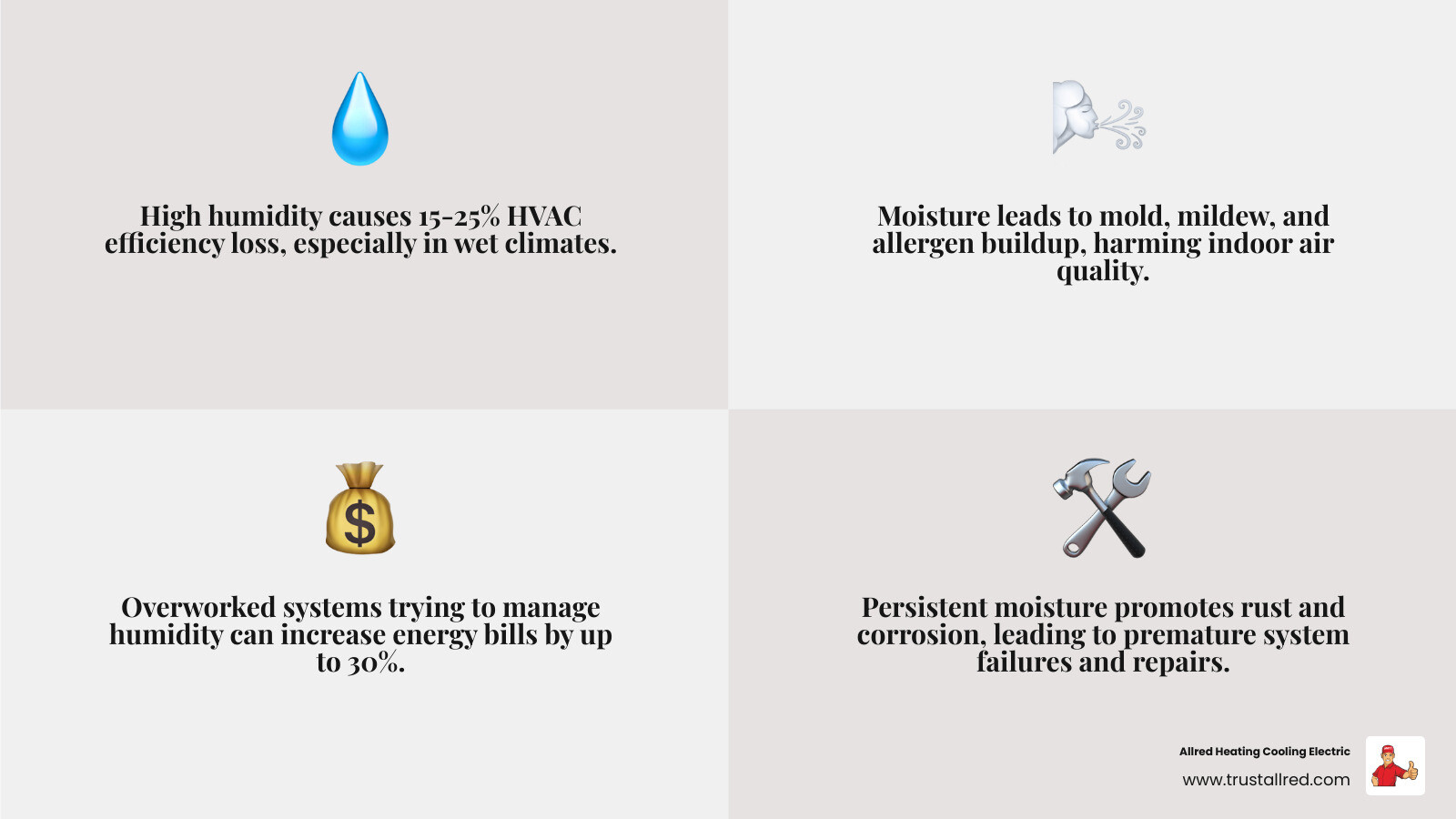
Seattle-area homeowners know the Pacific Northwest doesn’t do anything halfway when it comes to rain. From October through May, humidity regularly climbs above 75%, and the combination of persistent moisture, daily temperature swings of up to 30°F, and salty coastal air puts your heating and cooling system under a kind of slow, steady pressure that most homeowners don’t notice — until something stops working. What looks like a mild climate on a weather app can quietly push your HVAC to its limits, season after season. The result? Rust on coils, clogged drain lines, mold in ductwork, and an overworked compressor running at 15–25% below peak efficiency.
This isn’t just an inconvenience. It’s a pattern that plays out in homes all across the Puget Sound region, and it’s almost entirely preventable with the right maintenance routine.
I’m Daniel Allred, co-founder of Allred Heating, Cooling & Electric, and after years of servicing systems throughout the Puget Sound region, I’ve seen how the PNW’s relentless moisture quietly erodes HVAC performance in ways that catch even diligent homeowners off guard — which is exactly why understanding the benefits of regular HVAC maintenance in wet climates is something I’m passionate about sharing. Let’s walk through what’s really happening to your system, and what you can do about it.
The Core Benefits of Regular HVAC Maintenance in Wet Climates
In our corner of the world—stretching from the shores of Northeast Tacoma to the foothills of North Bend—the air is rarely “dry.” While we love our lush green scenery, that same moisture is looking for any excuse to settle into your HVAC system. When we talk about the benefits of regular HVAC maintenance in wet climates, we aren’t just talking about a quick dusting. We’re talking about a comprehensive strategy to keep your home comfortable and your wallet full.
One of the most immediate perks is the impact on your bank account. According to the Department of Energy, regular maintenance can help you save up to 30% on your energy bill. In a wet climate, this is even more pronounced. Without proper care, systems in our area often see efficiency losses of 15-20% during our wettest months. By ensuring your system is tuned up, you’re reclaiming that lost money every single month.
Longevity is the other major player. A well-maintained HVAC system in the PNW can last 20 to 30 years. However, a neglected one might not even see its tenth birthday. The constant moisture accelerates wear and tear, meaning that without HVAC Service, you’re looking at a full system replacement much sooner than necessary.
As of April 2026, efficiency standards have become even more stringent. Modern systems are designed to be incredibly efficient, but they are also more complex. Our Annual HVAC Maintenance Plans are specifically designed to meet these 2026 standards, ensuring that your high-tech equipment isn’t being sidelined by low-tech problems like moss or rust. Whether you need Residential HVAC Service in Bellevue or Puyallup, preventative care is the only way to stay ahead of the rain.

Maximizing Efficiency: Benefits of Regular HVAC Maintenance in Wet Climates
Have you ever noticed that a 45-degree day in Seattle feels much colder than a 45-degree day in a dry climate? That’s the “latent heat” challenge. Humid air holds more thermal energy, and your HVAC system has to work significantly harder to move that damp air around. When humidity levels spike above 75%—which happens frequently in places like Auburn and Kent—it can force your system to work harder just to heat or cool the air, leading to a 15–25% efficiency loss.
To fight back, modern systems often use smart thermostats with humidity sensors and variable-speed blowers. These blowers are a game-changer for wet climates because they can run at lower speeds for longer periods, which is much more effective at pulling moisture out of the air than a standard “on/off” blower. If you have a ductless system, a Ductless Mini-Split Needs Tune-Up just as much as a central furnace. These units are world-class at moisture removal, but only if their coils are clean and their drainage cycles are unobstructed.
Long-Term Savings: Benefits of Regular HVAC Maintenance in Wet Climates
If we told you that a simple service visit could extend your equipment’s life by 5 to 7 years, you’d probably take it, right? In wet environments, specialized coatings that resist rust and corrosion are essential. During a professional visit, we check these coatings and can even apply protective treatments to vulnerable metal parts.
The Importance of Regular Furnace Tune-Ups cannot be overstated, especially when it comes to avoiding those dreaded midnight emergency calls. Most major breakdowns happen because a small, moisture-related issue (like a corroded sensor or a damp electrical connection) was ignored. Furthermore, many manufacturers require proof of annual maintenance to keep your warranty valid. In the wet PNW, skipping a tune-up doesn’t just risk a breakdown; it risks losing your financial safety net.
How Rain and Moisture Attack Your System
It’s easy to think of an outdoor HVAC unit as a tank—built to stand outside and take whatever the sky throws at it. While they are rugged, they aren’t invincible. The 164+ rainy days we experience annually in the Puget Sound region create a constant state of “wet” that leads to several specific types of damage.
First, there’s the issue of salt air. For our friends in Browns Point, Northeast Tacoma, and coastal Kirkland, salt particles hitch a ride on the moisture. When salt combines with water, it accelerates corrosion on aluminum fins and steel components far faster than inland. This corrosion weakens refrigerant circuits, leading to micro-leaks that stress your compressor and drive up your bills.
Then there’s the debris. Our “Evergreen State” is beautiful, but it drops a lot of needles, leaves, and seeds. When these get wet, they clump together and stick to your outdoor coils, creating a “mat” that blocks airflow. This causes the unit to overheat. In some cases, we even see moss and algae growth directly on the coils, which acts as an insulator, preventing the unit from effectively releasing heat.
Electrical components are also at risk. While units are sealed, the high humidity can lead to internal condensation. Moisture-induced electrical shorts are more common in wet climates because dampness can degrade wire insulation over time. If you notice your system tripping a breaker after a heavy storm, it’s a sign that moisture has found its way into the electrical heart of your unit. This is why AC Repair: Trusting Our Technicians is so important—we know exactly where to look for these hidden damp spots. Following our Fall HVAC Tips can help you prepare before the heaviest rains arrive.
Protecting Your Home from Mold and Mildew
The air inside your home is a direct reflection of the health of your HVAC system. In a damp climate, the system’s primary job isn’t just changing the temperature—it’s managing moisture. If your system is neglected, it stops being a climate controller and starts being a mold incubator.
When warm, moist air hits a cold evaporator coil, water condenses. This is normal. However, if the coils are dirty, that water mixes with dust to create a “biofilm.” This slimy buildup is the perfect breeding ground for mold and bacteria. Once mold starts growing on your coils or in your drain pan, your blower motor sends those spores through your vents and into your living room.
To truly Clear the Air, you have to address the ductwork as well. In unconditioned spaces like crawl spaces or attics—common in older homes in Tacoma and Puyallup—ductwork is highly susceptible to condensation. If your ducts aren’t properly sealed, they pull in damp, dirty air from the “envelope” of your home. This is why the Importance of Regular Ductwork Maintenance is a cornerstone of PNW home health.
| Humidity Factor | Outdoor Impact (Wet Climate) | Indoor Impact (HVAC Neglect) |
|---|---|---|
| Component Stress | High (Rust, Corrosion, Moss) | High (Blower motor strain, biofilm) |
| Air Quality | High Pollen/Spore count | Mold spores, musty odors, allergens |
| Efficiency | 15-25% loss due to latent heat | 10-15% loss due to clogged filters/coils |
| Health Risks | Seasonal Allergies | Respiratory issues, asthma triggers |
| Comfort Level | “Clammy” or “Sticky” feeling | Uneven temps, damp feeling indoors |
By keeping indoor humidity in the 30–50% range, you protect your home’s structure (no warped wood floors!) and your family’s health.
What a Professional Tune-Up Looks Like in the PNW
When one of our expert technicians arrives at your home in Issaquah or Sammamish, they aren’t just there to change a filter. A PNW-specific tune-up is a detailed inspection designed to combat the unique challenges of our wet environment. We focus on the areas where moisture does the most damage.
Here is what a professional maintenance visit from Allred includes:
- Drain Line Flushing: We don’t just check the drain; we flush it. We often use a distilled vinegar treatment to kill algae and prevent the thick “sludge” that leads to backups and water damage.
- Coil Cleaning: We remove the moss, pollen, and debris that act as an unwanted blanket on your outdoor unit.
- Refrigerant Monitoring: We check for micro-leaks caused by corrosion. Even a tiny leak can reduce efficiency by 20% and eventually kill your compressor.
- Electrical Tightening: We inspect all connections for signs of moisture-induced corrosion or “pitting” and ensure everything is tight and dry.
- Thermostat Calibration: We verify that your sensors are accurately reading the humidity levels, not just the temperature.
- Airflow Testing: We check for blockages or leaks in your ductwork that might be letting damp air in.
- Component Lubrication: Moving parts work harder in high humidity; we ensure they are properly lubricated to reduce friction and heat.
These HVAC Services to Keep Home Comfortable are the most effective way to ensure your system is ready for whatever the Washington sky decides to do next.
Frequently Asked Questions
We get a lot of questions about how to handle the rain, and we love answering them! Here are the most common concerns we hear from homeowners in King and Pierce Counties.
Is it safe to run my HVAC during a rainstorm?
Generally, yes! HVAC systems are designed with a sealed cabinet that protects the electrical components from falling rain. However, there is one major exception: flooding. If your outdoor unit is sitting in standing water that reaches the internal wiring, you must shut it off at the breaker immediately.
Another risk during storms is power surges. Lightning strikes can cause surges that fry sensitive circuit boards. We highly recommend installing a dedicated HVAC surge protector to safeguard your investment. If a storm is particularly severe with frequent lightning, it’s always safer to turn the system off at the thermostat until the worst has passed.
Should I cover my outdoor AC unit during the wet season?
This is a common mistake! Most homeowners think they are helping by wrapping their unit in a plastic tarp or a heavy cover. In reality, this does more harm than good. A solid cover traps moisture inside the unit, creating a “greenhouse effect” that promotes rapid rust and mold growth.
If you want to protect your unit from falling debris (like pine needles), use a breathable mesh cover designed specifically for HVAC units. These allow airflow so moisture can evaporate while still keeping the big stuff out. Better yet, just ensure you have at least two feet of clearance around the unit and check it periodically for debris.
How often is maintenance needed in high-humidity regions?
In a dry climate, you might get away with once a year. In the Pacific Northwest, we strongly recommend a biannual (twice a year) schedule.
- Spring Prep: Get your AC or heat pump ready for the summer humidity and potential heat waves.
- Fall Tune-Up: Ensure your furnace or heat pump is ready for the long, damp heating season.
Additionally, homeowners should check their air filters every 30 days. In high-humidity environments, filters can become “heavy” with moisture and clog faster. If you have pets or allergies, a 30–45 day replacement cycle is the gold standard for our region.
Conclusion
The benefits of regular HVAC maintenance in wet climates are clear: you save money, you breathe cleaner air, and your system stays in the game for decades instead of years. In the Puget Sound, our homes are our sanctuaries from the rain, and a healthy HVAC system is the heart of that sanctuary.
At Allred Heating, Cooling & Electric, we take this personally. As a family-founded company, we treat your home like our own. Our expert technicians are available 24/7 for emergencies, but our goal is to help you avoid those emergencies altogether through proactive, expert care. Whether you’re in Maple Valley, Snoqualmie, or Federal Way, we’re here to ensure your comfort doesn’t wash away with the next rainstorm.
Don’t wait for the next atmospheric river to test your system’s limits. Schedule your HVAC Maintenance with our team today and experience the peace of mind that comes with a truly well-maintained home.
