


How to Decide Between HVAC Repair and Replacement (And Get It Right)
How to decide between HVAC repair and replacement comes down to a few key factors: your system’s age, the cost of the repair, how often it’s been breaking down, and how efficiently it’s running. Here’s a quick framework to guide your decision:
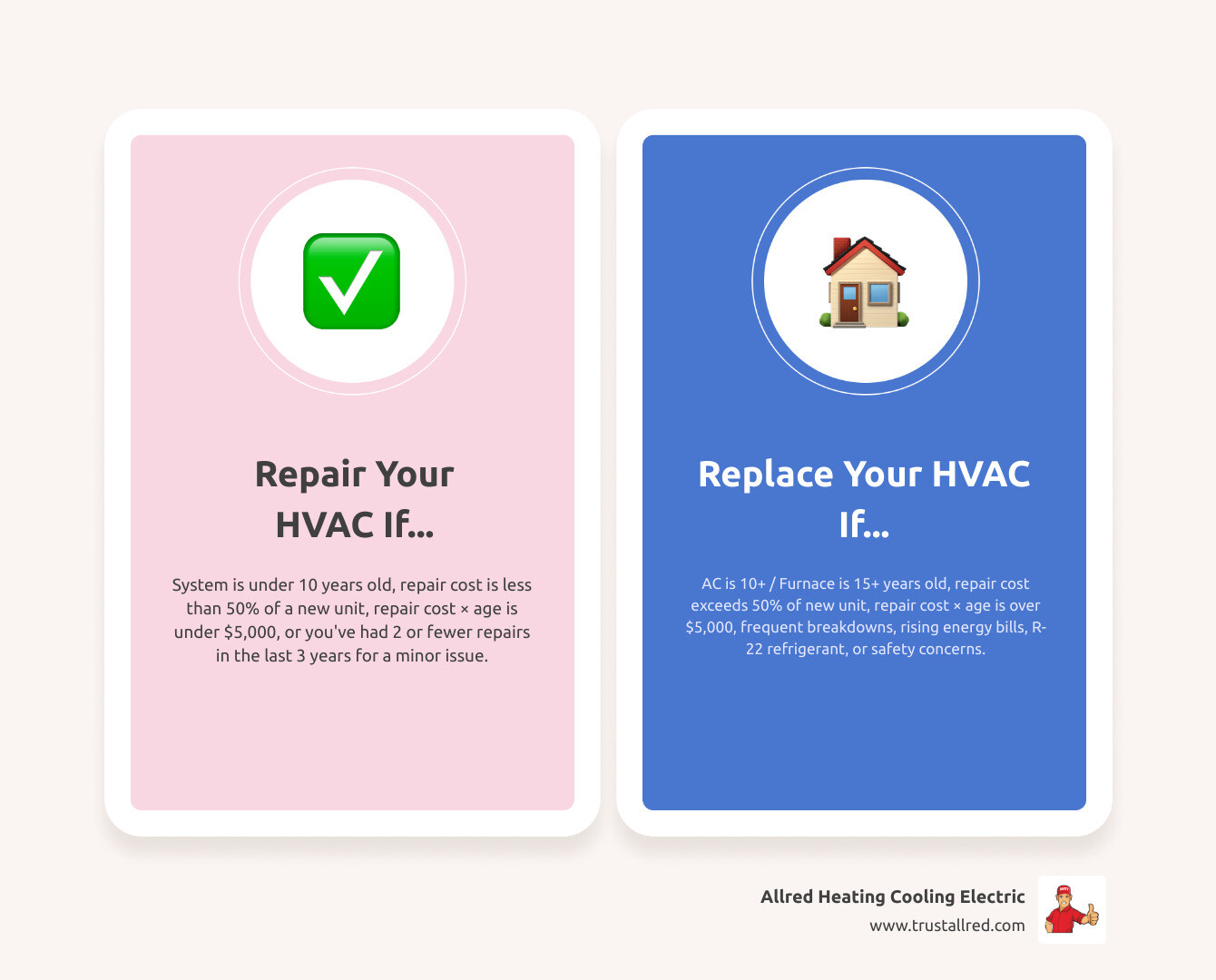
Repair your HVAC system if:
- The system is under 10 years old
- The repair cost multiplied by the system’s age is under $5,000 (the $5,000 Rule)
- The repair cost is less than 50% of the cost of a new system
- You’ve had 2 or fewer repairs in the last 3 years
- The issue is minor and isolated
Replace your HVAC system if:
- Your AC is 10+ years old or your furnace is 15+ years old (per ENERGY STAR)
- The repair cost multiplied by the system’s age exceeds $5,000
- The repair would cost more than half the price of a new system
- You’ve called for repairs 3 or more times in the last 3 years
- Your energy bills keep climbing without explanation
- Your system uses R-22 refrigerant (now phased out and costly to service)
- There are safety concerns like carbon monoxide or gas leaks
Most homeowners face this decision without a clear framework — and that uncertainty can lead to pouring money into a system that’s already past its prime, or replacing one that still had years of reliable service left. With unpredictable Pacific Northwest weather putting real demand on your home’s heating and cooling system year-round, making the right call matters more than ever.
I’m Daniel Allred, co-founder of Allred Heating, Cooling & Electric, and after years of helping Seattle-area homeowners navigate exactly this question, I know that understanding how to decide between HVAC repair and replacement can save you thousands of dollars and years of frustration. Let’s walk through everything you need to make a confident, informed decision.
Understanding the Lifespan of Your Heating and Cooling System
In our years serving communities from Federal Way to Snoqualmie, we’ve seen systems that lasted 25 years and others that gave up the ghost at 8. While individual results vary based on brand and usage, the industry averages provide a solid baseline for your expectations.
Generally, an air conditioner has a lifespan of 12 to 15 years. Furnaces and heat pumps typically last a bit longer, often reaching the 15 to 20-year mark. However, in our damp Pacific Northwest climate, outdoor units can face extra wear from moisture and debris. If you are currently seeking Shoreline HVAC Repair, the first question we’ll likely ask is: “How old is the unit?”
Age isn’t just a number; it’s a measure of technological relevance. A furnace built in 2006 simply cannot match the efficiency or safety features of a model built in 2026. Understanding Your Home’s Heating & Cooling System is the first step in realizing that as components age, they don’t just break—they become more expensive to operate every single month. When a system enters the final third of its expected life, every repair should be viewed as a “patch” rather than a long-term solution.
How to Decide Between HVAC Repair and Replacement Using Industry Rules
When you’re standing in a cold living room in North Bend or a sweltering kitchen in Kent, it’s easy to make an emotional decision. You want comfort now. But we encourage our neighbors to use a structured financial logic to ensure they aren’t throwing good money after bad.
Choosing to invest in Professional HVAC Replacement Services is often a better long-term financial move than a series of expensive repairs. As a King County HVAC Contractor, we look at the Return on Investment (ROI). A new system might have a higher upfront cost, but when you factor in lower monthly bills, fewer service calls, and the peace of mind of a new warranty, the “expensive” replacement often pays for itself faster than you’d think.
Applying the $5,000 Rule: How to Decide Between HVAC Repair and Replacement
The “$5,000 Rule” is a favorite among technicians because it takes the guesswork out of the math. Here is how it works: Multiply the age of your unit by the cost of the repair quote.
- If the total is less than $5,000: Repairing the unit is usually a safe bet.
- If the total is more than $5,000: It’s time to consider a replacement.
For example, if you need a Tacoma HVAC Repair on a 12-year-old AC unit and the quote is $600, your math looks like this: 12 x 600 = $7,200. Since $7,200 is well over the $5,000 threshold, that $600 is better spent as a down payment on a new, efficient unit.
While there are Proven Benefits of Timely HVAC Repair Services—such as restoring comfort quickly—this rule helps you see the “hidden” cost of keeping an old machine on life support.
The 50% Rule for Major Component Failures
Another industry standard we use is the 50% Rule. This is straightforward: If the cost of a single repair exceeds 50% of the value of a brand-new system, you should almost always replace it.
Major component failures, such as a cracked heat exchanger or a seized compressor, are the “engine failures” of the HVAC world. If you’re looking at a Tacoma Furnace Repair and the heat exchanger is gone, you’re looking at one of the most expensive parts of the system.
Moreover, when you replace a major component in an old system, you still have an old system. If you install Wilkeson New AC Units, every single part—from the fan motor to the coils—is brand new and covered by a manufacturer’s warranty. Patching a 15-year-old system with a new compressor still leaves you with 15-year-old electronics and 15-year-old coils that could leak next week.
Critical Signs Your System is Failing
Sometimes, the signs aren’t as obvious as a total breakdown. Your system might be “running,” but it’s no longer doing its job effectively. Here are the red flags we tell our customers in Auburn and Puyallup to watch for:
- Frequent Breakdowns: If we’ve seen you three times in the last two years, your system is telling you it’s tired.
- Rising Energy Bills: If your usage hasn’t changed but your bills in April 2026 are significantly higher than April 2025, your system is losing its efficiency.
- Uneven Temperatures: Is the upstairs in your Sammamish home a sauna while the downstairs is an icebox? This often indicates a struggling blower motor or failing ductwork.
- Strange Noises: Grinding, squealing, or banging are the sounds of mechanical parts reaching their breaking point.
- Humidity Issues: In the Pacific Northwest, your HVAC system is your primary defense against indoor mold. If your home feels clammy or smells musty, the system is no longer dehumidifying properly.
If you notice these Signs Your Air Conditioner Needs Repair, don’t ignore them. Small problems caught early can be repaired, but chronic issues usually point toward the exit.
Efficiency, Safety, and Modern Technology
In 2026, HVAC technology has leaped forward. Older systems are not just inefficient; they can sometimes be dangerous.
Safety is our number one priority. A cracked heat exchanger in a furnace can leak carbon monoxide into your home—a colorless, odorless gas that can be fatal. Similarly, gas leaks or frayed electrical wiring in old units pose significant fire risks. If a safety hazard is detected, we will always recommend immediate replacement over a risky repair.
Then there is the issue of R-22 refrigerant (often called Freon). If your AC was built before 2010, it likely uses R-22. Because this substance depletes the ozone layer, it has been phased out by federal law. It is no longer manufactured or imported. If your old unit has a leak, the cost of finding “reclaimed” R-22 is astronomical. In these cases, our Residential HVAC Service experts will explain that a new unit using modern, eco-friendly refrigerants is the only logical path forward. For more on this, check out our Guide to HVAC Services.
Energy Efficiency: How to Decide Between HVAC Repair and Replacement for Long-Term Savings
Modern systems are rated by SEER2 (Seasonal Energy Efficiency Ratio). While older units might have a SEER rating of 8 or 10, modern units are often 16, 18, or even 22+.
According to the Department of Energy, replacing a 10-year-old AC with an ENERGY STAR certified model can cut your cooling costs by 20% to 40%. For our neighbors considering a Lakeland Hills Heat Pump Installation, the savings are even more dramatic. Heat pumps provide both heating and cooling using variable-speed technology, which allows the system to “sip” electricity rather than gulping it down in loud, inefficient bursts. Whether it’s a Summit AC Installation or a new furnace, the technology of today is designed to keep your money in your pocket, not the utility company’s.
Maximizing Your Investment with Maintenance and Incentives
One of the best ways to delay the repair vs. replace dilemma is through consistent care. We offer Annual HVAC Maintenance Plans that help catch those small $100 problems before they turn into $2,000 disasters.
There are also significant HVAC Maintenance Tips for Long-Lasting Systems you can do yourself, like changing your filters every 90 days. However, nothing replaces the Importance of Regular Furnace Tune-Ups performed by a pro who can check for those hidden safety risks.
| System Feature | Older Systems (10+ Years) | Modern Systems (2026) |
|---|---|---|
| Efficiency Rating | 8 – 12 SEER | 15 – 22+ SEER2 |
| Refrigerant | R-22 (Phased out/Expensive) | R-410A or R-454B (Eco-friendly) |
| Technology | Single-stage (On/Off) | Variable-speed (Precise) |
| Monthly Cost | High and Rising | 20-40% Lower |
| Sound Level | Loud/Clunky | Whisper-Quiet |
Beyond energy savings, the federal government and local utilities often offer incentives to help you upgrade. Under the Inflation Reduction Act, homeowners can often claim tax credits up to $2,000 for high-efficiency heat pumps. Local utility rebates in areas like Bellevue and Issaquah can further reduce the net cost of your investment.
Frequently Asked Questions
How many repairs are too many for an older system?
If you’ve had three or more significant repairs in the last three years, your system is likely in a “spiral of failure.” At this point, you are essentially paying for a new system one repair bill at a time, but without the benefits of a new warranty or lower energy bills.
Is it better to replace the furnace and AC at the same time?
Generally, yes. Your furnace and AC often share the same blower motor and ductwork. When you replace them together, you ensure that the components are perfectly matched for maximum efficiency. It also saves you money on labor costs, as our team only has to make one trip to perform the full installation.
Does a new HVAC system increase home resale value?
Absolutely. In the Seattle real estate market, a new, energy-efficient HVAC system is a major selling point. It gives potential buyers confidence that they won’t face a massive emergency expense shortly after moving in. Most home inspections flag systems over 15 years old as a “near-term replacement” item, which can lead to buyers asking for price concessions.
Conclusion
At Allred Heating, Cooling & Electric, we don’t just see ourselves as technicians; we see ourselves as your neighbors. Whether you’re in Covington, Maple Valley, or Browns Point, our family-oriented approach means we give you the same advice we’d give our own parents.
Deciding how to decide between HVAC repair and replacement doesn’t have to be a headache. If your system is old, inefficient, or becoming a safety risk, patching it up is often just delaying the inevitable. Our expert technicians are available 24/7 to provide an honest evaluation of your system’s health and help you find a solution that fits your home and your budget.
If you’re tired of “patching it up” and are ready for the reliability and comfort of a modern system, reach out to us today. We proudly serve Auburn, Tacoma, Redmond, and the surrounding areas with the expertise you deserve.
