


Why Homeowners Are Rethinking Traditional HVAC in 2026
Heat pump advantages over traditional HVAC are hard to ignore — especially when energy bills keep climbing and Pacific Northwest weather keeps getting less predictable. In short, heat pumps beat traditional systems in nearly every major category that matters to homeowners:
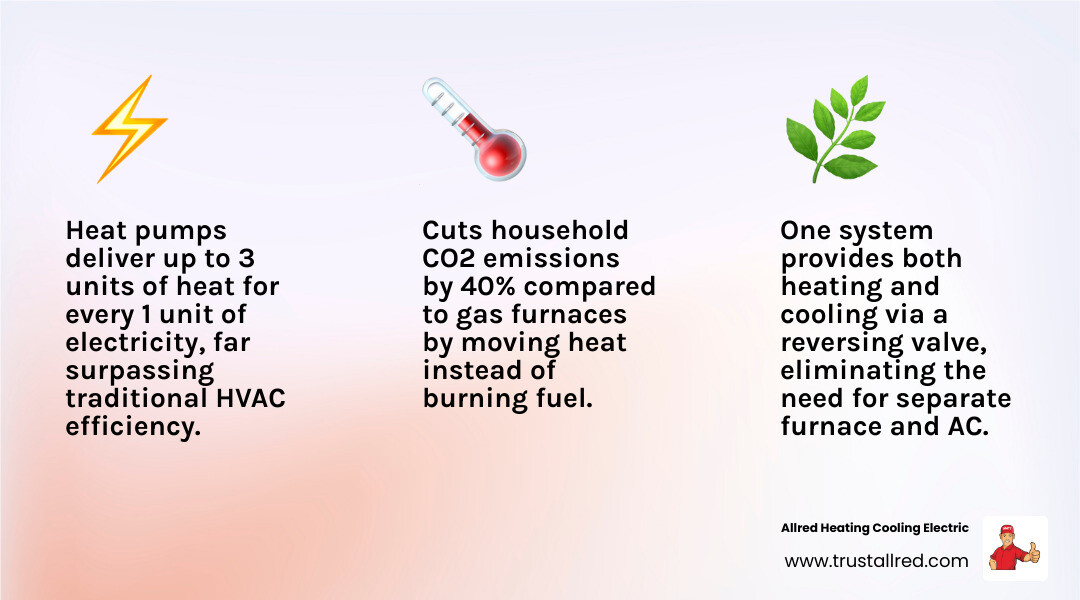
- Energy efficiency — Heat pumps move heat instead of generating it, delivering up to 3 units of heat for every 1 unit of electricity consumed
- Year-round comfort — One system handles both heating and cooling, replacing your furnace and AC
- Lower carbon footprint — Air-source heat pumps cut household CO2 emissions by roughly 40% compared to gas furnaces
- Better indoor air quality — No combustion means no carbon monoxide risk, plus built-in humidity control and advanced filtration
- Long-term savings — Between 62% and 95% of U.S. households see lower energy bills after switching, according to NREL research
- Cold-climate reliability — Modern cold-climate models operate efficiently down to -22°F, making them a strong fit for Seattle winters
- Longer lifespan — Heat pumps can last 15 to 25 years with proper maintenance, often outlasting traditional systems
That said, the right choice still depends on your home, your climate, and your existing setup — and this guide walks you through all of it.
I’m Daniel Allred, co-founder of Allred Heating, Cooling & Electric, and after more than a decade of installing and servicing both heat pumps and traditional HVAC systems across the Puget Sound region, I’ve seen how understanding heat pump advantages over traditional HVAC can transform a homeowner’s comfort and energy costs. Let’s break down exactly what makes these systems so different — and how to decide which one is right for your home.
Understanding Heat Pump Advantages Over Traditional HVAC
To understand why so many people in places like Issaquah and Kent are switching, we first have to look at how these systems actually work. A traditional HVAC setup usually involves two separate machines: a furnace (which burns gas or uses electric coils to create heat) and an air conditioner (which uses electricity to remove heat from your home).
A heat pump is a bit of a magician. It doesn’t “create” heat; it moves it. Using a specialized refrigerant cycle, it absorbs heat from the outside air—even when it feels cold to us—and pumps it into your home. In the summer, a reversing valve flips the process, pulling heat out of your house and dumping it outside, exactly like an air conditioner. This dual functionality is one of the biggest heat pump systems benefits, as it streamlines your home’s mechanical needs into one unit.
| Feature | Heat Pump | Traditional Furnace + AC |
|---|---|---|
| Operation | Moves heat (Heat Transfer) | Creates heat (Combustion/Resistance) |
| Fuel Source | Electricity | Gas, Propane, or Electricity |
| Functions | Heating & Cooling in one | Separate units for each |
| Efficiency | Up to 300-400% | Max 95-98% (Gas) or 100% (Electric) |
| Safety | No combustion/CO risk | Possible carbon monoxide risk |
Efficiency and Energy Savings
When we talk about efficiency, the numbers for heat pumps are staggering. Because they transfer heat rather than generating it, they can achieve efficiencies well over 100%. In fact, an air-source heat pump (ASHP) can deliver up to three times more heat energy than the electrical energy it consumes.
Compared to electric resistance heating—like baseboard heaters or electric furnaces—heat pumps can reduce electricity use for heating by up to 75%. For our neighbors in Auburn or Federal Way, this translates to massive monthly savings. Statistics show that an ENERGY STAR certified heat pump provides heating for approximately 1/3 the cost of traditional electric heating and 1/2 the cost of oil heat. There are five reasons you need to get a heat pump, but “keeping more money in your pocket” is usually the one that gets people the most excited.
Environmental Impact and Indoor Air Quality
Sustainability is a huge priority for many families in the Pacific Northwest. Switching from a gas furnace to an air-source heat pump trims household carbon dioxide emissions by about 40%. In regions with “cleaner” electrical grids like ours, that reduction can be even more significant.
Beyond the planet, consider the air inside your living room. Traditional furnaces rely on combustion, which always carries a non-zero risk of carbon monoxide leaks. Heat pumps are entirely electric, eliminating that worry. They also excel at humidity control. Because they run in longer, more consistent cycles, they are better at pulling moisture out of the air during our damp King County winters and muggy summer days. Pair that with advanced filtration, and you’ve got a home that breathes easier.
Performance in Cold Climates and the Pacific Northwest
A common myth we hear is that heat pumps don’t work when it gets cold. While that might have been true in the 1980s, the technology in 2026 is lightyears ahead. Modern heat pumps are designed specifically for climates like Snoqualmie and North Bend, where temperatures can dip, but rarely stay at sub-zero levels for weeks on end.
The secret lies in variable-speed compressors (also known as inverter technology). Unlike older systems that are either “all the way on” or “all the way off,” these units can ramp up or down to match the exact heating needs of the home. This prevents the “blast of hot air followed by a cold chill” cycle common with traditional furnaces.
Heat Pump Advantages Over Traditional HVAC in Winter
For those living in higher elevations or colder pockets like Tacoma, “cold-climate” heat pumps are the gold standard. These specialized models can maintain high efficiency even when the mercury hits -22°F.
Even if we hit a rare Seattle “Snowpocalypse,” most systems are installed with an auxiliary heat source—either electric heat strips or a backup furnace in a dual-fuel setup. This ensures that even if the heat pump reaches its limit, your family stays toasty. However, because our winters are generally moderate, a heat pump will do 95% of the heavy lifting, saving you a fortune compared to running a gas furnace full-time.
Long-Term Reliability and Maintenance Requirements
When you invest in a home comfort system, you want to know it’s going to last. A well-maintained heat pump typically has a lifespan of 15 to 25 years. Because they have fewer moving parts than a combustion-based furnace, there are fewer things that can go “clunk” in the night.
However, the “bi-annual service” rule is non-negotiable. Since a heat pump works year-round (heating in winter, cooling in summer), it doesn’t get a “season off” like a furnace does. We recommend a check-up in the spring for cooling and in the fall for heating. This ensures the refrigerant levels are perfect and the coils are clean, which is essential for maintaining those Seattle efficiency standards.
Maximizing Heat Pump Advantages Over Traditional HVAC
To truly get the most out of your system, you can look into zoning control. Heat pumps, especially ductless mini-split versions, allow you to heat or cool specific rooms independently. Why pay to heat the guest room and the basement if you’re spending all day in the home office?
Smart thermostats also play a huge role. Modern heat pumps work best when they maintain a steady temperature rather than being turned way down at night and cranked up in the morning. A smart controller can manage this “steady-state” operation for you, ensuring you maximize every bit of that heat pump advantages over traditional HVAC efficiency. Whether you are in University Place or Maple Valley, these technological tweaks can shave even more off your utility bills.
Choosing the Right System for Your Home
Deciding to switch isn’t just about the equipment; it’s about your home’s “envelope.” Before we install a system in Sammamish or Des Moines, we always look at a few key factors:
- Insulation: A heat pump works most efficiently in a well-sealed home. If your attic insulation is thin, the heat pump has to work harder to keep up.
- Existing Ductwork: If you already have ducts from an old furnace, a “ducted” heat pump can often slide right in. If your home uses baseboard heat and has no ducts, a “ductless” system is usually the way to go.
- Home Size: We perform a “load calculation” to ensure the unit is sized perfectly. An oversized unit will cycle on and off too much, while an undersized unit won’t keep you warm on the coldest nights.
Frequently Asked Questions about Heat Pumps
Can a heat pump replace both my furnace and air conditioner?
Absolutely. This is one of the primary reasons homeowners in Tukwila make the switch. Instead of maintaining two separate machines, you have one high-performance unit that handles everything. In some cases, homeowners choose a “dual-fuel” system where the heat pump handles most of the year, and an existing gas furnace kicks in only during extreme cold snaps.
Do heat pumps work during Seattle’s coldest days?
Yes! With 2026 technology, “cold-climate” models are more than capable of handling our local weather. Even in places like Mercer Island, where it can get breezy and damp, these systems extract heat from the air with incredible efficiency. On the rare occasion that temperatures drop below the unit’s optimal range, the backup heat source ensures your comfort is never compromised.
Are there tax credits or rebates available in 2026?
There has never been a better time to upgrade. Thanks to the Inflation Reduction Act and various local utility programs in areas like Lacey, you can often claim significant tax credits (up to $2,000 in many cases) for installing ENERGY STAR certified heat pumps. Many local PUDs and utility companies also offer instant rebates because they want to reduce the strain on the electrical grid.
Conclusion
The debate between heat pumps and traditional HVAC is quickly settling in favor of the heat pump. With superior efficiency, lower emissions, and the convenience of all-in-one heating and cooling, it’s the smart choice for the modern Washington home.
At Allred Heating Cooling Electric, we’re more than just technicians; we’re a family-oriented team dedicated to keeping our neighbors comfortable. Whether you need an emergency repair or a brand-new installation, our expert technicians are available 24/7 to ensure your home stays exactly the temperature you want it to be.
Ready to experience the future of home comfort? Schedule your Yelm Heat Pump installation today and let us help you start saving.
