


Your Home Is Sending You Signals — Here’s When to Listen
When should you call an electrician is one of the most important safety questions a homeowner can ask — and the answer could prevent a house fire, serious injury, or thousands of dollars in damage.
Here’s a quick reference for the most common situations that require a licensed electrician:
| Situation | Call an Electrician? |
|---|---|
| Burning smell or scorch marks near outlets | Yes — immediately |
| Flickering lights in multiple rooms | Yes — schedule soon |
| Circuit breaker trips repeatedly | Yes — don’t keep resetting it |
| Electrical shocks or tingling from appliances | Yes — immediately |
| Buzzing, humming, or crackling from outlets or walls | Yes — immediately |
| Warm or discolored outlet covers | Yes — urgently |
| Visible sparks from outlets or panel | Yes — immediately |
| Home is over 25 years old, never inspected | Yes — schedule an inspection |
| Heavy reliance on extension cords | Yes — schedule soon |
| Planning a remodel, EV charger, or smart home upgrade | Yes — before starting |
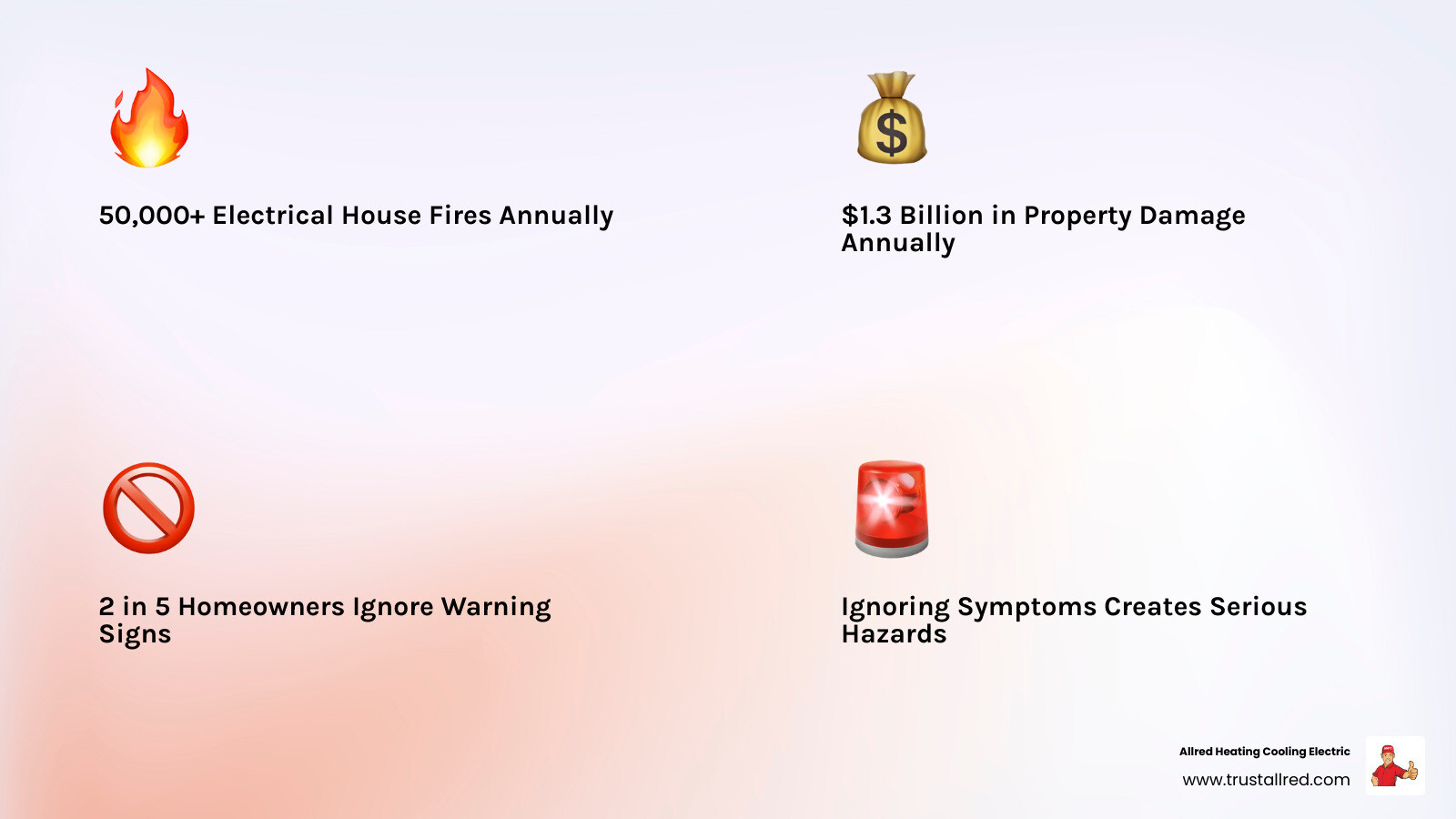
The stakes are real. More than 50,000 house fires occur every year due to electrical malfunctions, causing an estimated $1.3 billion in property damage. Yet two out of five property owners in North America have never called an electrician — even after noticing warning signs. That gap between “I noticed something” and “I called a pro” is exactly where danger lives.
I’m Daniel Allred, a Washington State licensed electrician and co-founder of Allred Heating Cooling & Electric, and I’ve spent years helping Puget Sound homeowners understand when should you call an electrician before a small issue becomes a serious hazard. In the sections below, I’ll walk you through every major warning sign, so you can make a confident, informed decision.
Critical Warning Signs: When Should You Call an Electrician Immediately?
In home maintenance, some things can wait until the weekend. Electrical red flags are not among them. When your home starts displaying “active” symptoms—things you can smell, hear, or feel—it is often a sign that a fire is already in its localized beginning stages or that a life-threatening shock hazard is present.
If you encounter any of the following, don’t wait for the morning. We provide Emergency Electrical Repairs in Kent WA precisely because these issues don’t follow a 9-to-5 schedule.
What do burning smells or scorch marks indicate?
If you detect an odor that smells like burning plastic, sulfur, or ozone near an outlet, switch, or your electrical panel, your home is in immediate danger. This scent usually indicates that wire insulation is melting due to extreme heat. When insulation fails, the raw electricity can arc (jump) between wires, creating temperatures hot enough to ignite the wooden studs inside your walls.
Similarly, scorch marks or discoloration on an outlet cover are not just “old age.” They are physical evidence of a short circuit or a dangerously loose connection that is generating heat. This is a primary reason to seek Electrical Panel Repair Covington WA, as the heat from a failing breaker can spread through the entire bus bar, compromising your home’s main power hub.
Why am I receiving electrical shocks from appliances?
You should never feel a “tingle” or a sharp zap when touching a toaster, a metal faucet, or a light switch. If you do, it means the electricity has found a path to the outer casing of the device rather than staying within the circuit.
This usually points to a significant grounding issue. In a healthy system, the ground wire safely directs stray current into the earth. If that path is broken or was never installed correctly, you become the path to the ground. This is a critical safety failure. Whether you need a Tukwila Electrical Contractor or Spanaway Residential Electrical support, getting a pro to test your grounding system is the only way to ensure your family’s safety.
Persistent Performance Issues in Your Home’s Circuitry
Sometimes the signs are less dramatic than a spark, but just as telling. If your home’s electrical system feels like it’s “struggling” to keep up with your daily routine, you are likely dealing with circuit overloads or internal component failure.
When should you call an electrician for flickering or dimming lights?
We have all seen a light flicker during a major windstorm in the Pacific Northwest. However, if your lights dim every time the microwave starts or the vacuum runs, you have a localized overload. This happens when a single circuit is being asked to provide more amperage than it was designed to handle.
If the flickering happens across multiple rooms or involves the whole house, the issue could be a loose neutral wire in your main panel or an issue with the utility drop. Our West Seattle Electrician team often finds that these “minor” flickers are actually symptoms of a failing main lug that could lead to a total power loss. If you’re in an area prone to grid instability, discussing Kent Backup Power Solutions can also help protect your sensitive electronics from the voltage fluctuations that cause these flickers.
When should you call an electrician for frequent breaker trips?
A circuit breaker’s job is to shut off power when it detects a “fault”—either an overload, a short circuit, or a ground fault. If a breaker trips once, you might have just plugged in too many things. But if it happens repeatedly, stop resetting it.
Repeatedly forcing a breaker back on when there is an underlying fault is like ignoring a smoke alarm. The breaker is trying to prevent a fire. Frequent trips can indicate:
- Ground Faults: Electricity escaping the path and hitting a ground source.
- Arc Faults: Electricity “sparking” between damaged wires.
- Worn Breakers: The mechanical components inside the panel have weakened and can no longer hold a load.
For those using specialized systems, such as an Orting Transfer Switch Installation for a generator, ensuring that your breakers are sized correctly for your loads is essential for the system to work when you need it most.
Identifying Outdated or Unsafe Electrical Infrastructure
If your home was built before April 2026—specifically if it dates back to the mid-20th century—it may be sitting on a ticking time bomb of outdated materials. Electrical codes change every three years for a reason: we find safer ways to power our lives.
Signs of insufficient electrical capacity
Modern families use significantly more power than families did in the 1970s. We have air conditioners, high-end computers, and multiple kitchen gadgets running simultaneously. If you find yourself relying on a “snake farm” of extension cords or “octopus” plug adapters, your home has insufficient capacity.
Extension cords are designed for temporary use only. Using them as permanent wiring can lead to overheating under rugs or behind furniture. This is why many homeowners opt for Central District Kitchen Electrical Updates to add dedicated 20-amp circuits for modern appliances.
Risks of aging wiring and panels
Older homes in the Puget Sound area often contain specific hazards that a Woodinville Electricians inspection can uncover:
- Aluminum Wiring: Common in homes built between 1965 and 1975, aluminum expands and contracts more than copper, leading to loose connections and fire risks at the outlets.
- Knob and Tube or Cloth Wiring: These antiquated insulation types become brittle over decades and can crumble away, leaving bare wires exposed inside your walls.
- Lack of GFCIs: If your kitchen or bathroom doesn’t have Ground Fault Circuit Interrupter outlets (the ones with the “test” and “reset” buttons), you are at a high risk for electrocution in “wet” zones. A Clyde Hill Bathroom Electrical Update often focuses on bringing these safety features up to modern code.
| Feature | Grounded (3-Prong) | Ungrounded (2-Prong) |
|---|---|---|
| Safety Path | Provides a path for stray current | No safety path for surges |
| Shock Risk | Low | High |
| Code Status | Required for modern homes | Outdated; should be replaced |
| Best Use | All electronics and appliances | Lamps only (not recommended) |
Planning for Modern Upgrades and Home Improvements
You don’t always have to wait for a “problem” to call us. In fact, calling an electrician before you start a major project is the smartest way to avoid future headaches.
If you are purchasing a new electric vehicle, a standard wall outlet won’t cut it. You’ll need a Federal Way Home EV Charger or a Seattle Vehicle Charging Station installation that includes a dedicated 240V circuit. Attempting to DIY this can lead to melted panels and voided vehicle warranties.
Similarly, as we move into 2026, more homeowners are looking for Summit Home Automation and King County Home Automation solutions. Smart switches, integrated security, and automated East Hill Outdoor Lighting all require a stable, modern electrical backbone to function correctly.
The Dangers of DIY and the Golden Rule of Safety
We get it—the “Do It Yourself” spirit is strong in Washington. But while you can probably handle painting a room or fixing a leaky faucet, electrical work is in a different category.
“When in doubt, don’t.” This is the golden rule of electrical safety.
The risks of DIY electrical work include:
- Electrocution: Household current is more than enough to be fatal.
- Hidden Hazards: A DIY connection might work today but slowly overheat over the next six months, eventually starting a fire while you’re asleep.
- Insurance Issues: If a fire is traced back to unpermitted, non-professional electrical work, your insurance company may deny your claim entirely.
- Code Violations: When you go to sell your home, an inspector will flag unpermitted work, which can delay or kill a sale.
Professional diagnostics from a licensed Woodinville Electricians team ensure that the root cause—not just the symptom—is fixed. We use thermal imaging and advanced circuit analyzers to see what’s happening behind your drywall.
Frequently Asked Questions about Electrical Safety
How often should I have my home electrical system inspected?
Most experts recommend a professional electrical inspection every 3 to 5 years. However, if you have just moved into a home older than 25 years, or if you have completed a major renovation, you should have an inspection immediately to ensure everything is up to the current 2026 safety standards.
Are flickering lights always a sign of a major problem?
Not always. A single flickering lamp might just need a new bulb. But if the flickering is consistent, involves multiple fixtures, or happens when an appliance turns on, it is a sign of a “voltage drop” or a loose connection in your panel, both of which require professional attention.
What is the difference between a fuse and a circuit breaker?
Both serve the same purpose: stopping the flow of electricity during an overload. A fuse melts a small wire to break the circuit and must be replaced once it “blows.” A circuit breaker is a mechanical switch that “trips” and can be reset. If your home still uses a fuse box, it is highly recommended to upgrade to a modern breaker panel for better safety and capacity.
Conclusion: Your Local Seattle Electrical Experts
At Allred Heating Cooling Electric, we aren’t just technicians; we’re your neighbors. As a family-oriented company founded by twin brothers, we understand that your home is your sanctuary. Whether you’re in Auburn, Federal Way, or Tacoma, our 24/7 availability means you never have to guess about your family’s safety.
Stop wondering when should you call an electrician and get the peace of mind you deserve. From emergency repairs to EV charger installations, our expert Kent Electricians are ready to ensure your home remains safe, efficient, and comfortable all year long.
Ready to secure your home? Contact Allred Heating Cooling Electric today for a professional safety inspection or repair.
