


Is Your HVAC System Living on Borrowed Time?
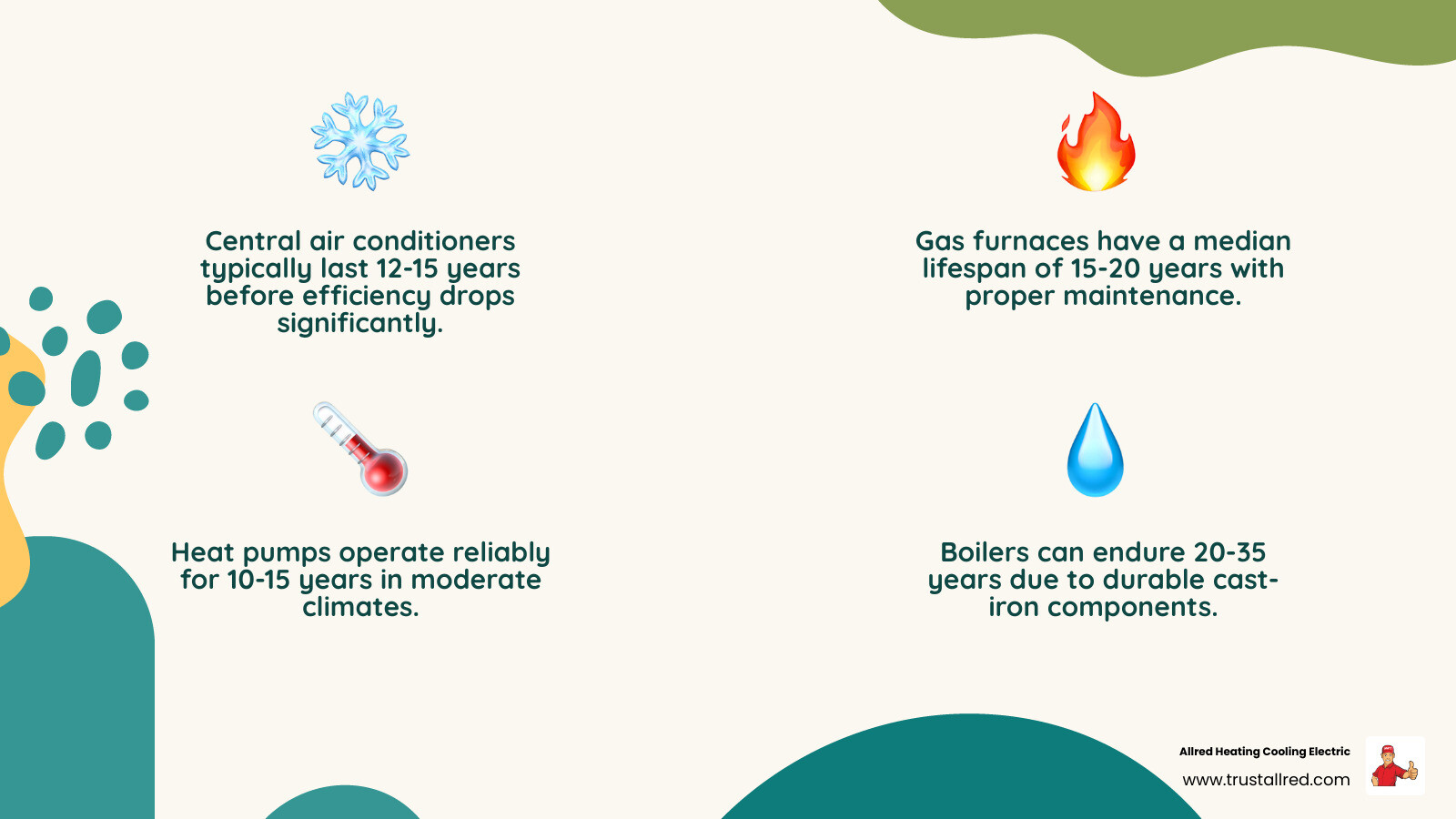
How old is too old for an HVAC system is one of the most common questions Seattle-area homeowners face — and the answer depends on your equipment type. Here’s a quick reference:
| Equipment Type | Typical Lifespan | Action Threshold |
|---|---|---|
| Central Air Conditioner | 12-15 years | Evaluate at 10-12 years |
| Heat Pump | 10-15 years | Evaluate at 10 years |
| Gas Furnace | 15-20 years | Evaluate at 15 years |
| Boiler | 20-35 years | Evaluate at 20 years |
The short answer: If your air conditioner or heat pump is over 10-12 years old, or your furnace or boiler is past 15 years, your system is entering the zone where efficiency drops, repair costs climb, and breakdown risk rises significantly.
That said, age alone doesn’t tell the whole story. A well-maintained 14-year-old furnace may have years left in it. A neglected 10-year-old AC unit could already be costing you real money every month. The full picture involves efficiency loss, repair frequency, safety risks, and how your Pacific Northwest climate is working your system.
Here in the Seattle area, our relatively mild summers may give cooling equipment a slightly longer runway — but our damp, unpredictable winters put consistent pressure on heating systems year-round. Knowing exactly when your system crosses from “aging but functional” to “costing you more than it’s worth” is what this guide is all about.
I’m Daniel Allred, co-founder of Allred Heating, Cooling & Electric, and I’ve spent years in the field diagnosing aging HVAC systems across the Puget Sound region — helping homeowners understand how old is too old for an HVAC system before a breakdown forces the decision for them. Read on for a complete breakdown of what the numbers, warning signs, and real-world factors actually mean for your home.
Understanding the Average Lifespan of Modern Heating and Cooling Units
When we talk about the lifespan of an HVAC system, we aren’t just guessing. Organizations like the National Association of Home Builders (NAHB) have conducted extensive studies on the life expectancy of home components. In HVAC, “lifespan” refers to the operating period where a unit remains reliable, safe, and efficient. Once a system passes its median service life, it doesn’t necessarily explode, but it does become a financial liability.
| System Type | Median Service Life (Years) |
|---|---|
| Central Air Conditioner | 12–15 |
| Gas Furnace | 15–30 |
| Air-Source Heat Pump | 10–15 |
| Boiler (Cast Iron) | 20–35 |
| Ductless Mini-Split | 15–20 |
As of April 2026, many homeowners in areas like Auburn and Puyallup are finding that systems installed in the early 2010s are hitting a “wall.” While a high-quality unit might technically run for two decades, the gap between “it still turns on” and “it actually works well” widens every year. For more specific answers on your unique setup, our HVAC FAQs cover many of the common quirks we see in Washington homes.
Lifespan Expectations for Air Conditioners and Heat Pumps
Air conditioners and heat pumps generally have the shortest lifespans in the HVAC family, typically ranging from 12 to 15 years. Heat pumps often lean toward the lower end of that range (10–12 years) because they work double duty, providing both heating in the winter and cooling in the summer.
By the time an AC unit hits the 10-year mark, it has likely completed over 4,000 full cooling cycles. This constant mechanical stress leads to compressor fatigue and fan motor wear. In places like Redmond, where summers are becoming increasingly warm, a decade-old unit might struggle to keep up. If you’re noticing your home isn’t as crisp as it used to be, it might be time to look into Redmond AC Installation options rather than sinking more money into a fading unit.
Why Furnaces and Boilers Often Outlast Cooling Units
You might wonder why your furnace seems like a tank compared to your AC. Furnaces and boilers are generally protected from the elements, residing in your garage, basement, or utility closet. A well-maintained gas furnace can last 15 to 30 years, while cast-iron boilers are the marathon runners of the industry, sometimes lasting 35 years or more.
However, the “heart” of the furnace—the heat exchanger—is the limiting factor. Once that component cracks or rusts through, the system is officially “too old” because the repair is rarely cost-effective or safe. If your heating system is acting up in Medina, it’s worth getting a professional opinion on Medina Furnace Repair to see if you’re dealing with a simple fix or a total system expiration.
How Old Is Too Old for an HVAC System in 2026?
As we move through April 2026, the definition of “old” is shifting. It’s no longer just about mechanical failure; it’s about technological and efficiency obsolescence. We often refer to the “12-year wall” for cooling systems. This is the point where efficiency slippage becomes undeniable. A unit that was rated for high efficiency in 2014 might only be operating at 70% of that capacity today due to internal wear and scale buildup on coils.
When asking how old is too old for an hvac system, you have to look at the current standards. Modern units are designed to meet much stricter Department of Energy (DOE) requirements than those built 15 years ago. If your system is old enough to have its own driver’s license, it is likely consuming 20–40% more electricity than a new model would. Choosing Right HVAC System involves balancing the age of your current unit against the immediate energy savings of a 2026-standard model.
Why 12 Years Is Often the Tipping Point for Air Conditioners
By year 12, most central air systems are operating at only 80–85% of their original efficiency. This isn’t just a number on a page; it translates to 25–30% higher energy costs on your monthly bill. Component fatigue in the compressor—the most expensive part of the system—reaches a critical point around this age.
In Sumner and surrounding areas, we see many homeowners trying to “nurse” a 12-year-old system through one more summer. However, the risk of a catastrophic failure during a July heatwave is high. Proactively looking at Sumner New AC Units allows you to choose a system calmly, rather than making an emergency purchase when your house is 85 degrees inside.
Determining if Your Furnace Is Too Old for an HVAC System Upgrade
In reliability engineering, we use something called the “bathtub curve.” This describes how machines have high failure rates right at the start (infant mortality), a long period of stable operation, and then a sharp increase in failures as they reach the end of their life. For a furnace, that sharp upward curve usually starts around the 15-to-18-year mark.
If your furnace has reached 80% of its median lifespan (about 16 years), it is officially “old.” At this stage, the risk of a cracked heat exchanger—a major safety hazard—increases significantly. Before you invest in another mid-winter fix, it’s helpful to understand How Much Does Furnace Replacement Cost so you can weigh that investment against the diminishing returns of your current unit.
The $5,000 Rule and Other Signs It’s Time to Replace
Deciding between a repair and a full replacement doesn’t have to be a guessing game. The HVAC industry uses a handy heuristic called the $5,000 Rule.
The Formula: Multiply the age of the system (in years) by the cost of the repair. If the total is $5,000 or more, you should replace the system.
- Example A: A 12-year-old AC needs a $500 repair. (12 x 500 = 6,000). Replace.
- Example B: A 5-year-old furnace needs a $400 repair. (5 x 400 = 2,000). Repair.
This rule helps homeowners in Tacoma and Bellevue see the economic logic behind the decision. Sinking a large sum into an old unit is often “throwing good money after bad.” If you’re currently facing a breakdown, our Repair services can help you run these numbers to see what makes the most sense for your wallet.
Critical Warning Signs Beyond the Calendar
While age is a primary factor in determining how old is too old for an hvac system, your home will often give you physical clues that the end is near. Keep an eye out for these red flags:
- Uneven Temperatures: Does the master bedroom feel like a sauna while the kitchen is a walk-in freezer? This often means the system can no longer push air effectively.
- Strange Noises: Banging, screeching, or rattling sounds usually indicate a failing motor or a loose belt.
- Excessive Dust: Older systems struggle to filter air, and leaky ducts can pull in dust from attics or crawlspaces.
- Humidity Issues: If your home feels “clammy” in the summer, your AC is likely failing to dehumidify the air properly.
If you notice these Signs Air Conditioner Repair is needed, don’t wait for the system to stop entirely. Early diagnosis can prevent a small issue from turning into a total system failure.
The Impact of Frequent Repairs on Long-Term Value
There is a point where “frequent repairs” become a pattern of cascading failures. This is when one part fails, putting stress on another, which then fails shortly after. Additionally, as systems age, part obsolescence becomes a real problem. For a 20-year-old unit, finding a specific control board or motor can be nearly impossible, leading to long wait times in the dead of winter.
Another common guideline is the 50% Rule: if a single repair costs 50% or more of the price of a new unit, replacement is almost always the better long-term investment. This is especially true for heat pumps, which are complex machines. Recognizing the Signs You Need Immediate Heat Pump Repair can help you decide if your unit is just having a bad day or if it’s ready to retire.
Safety Risks and Regulatory Factors in Aging Systems
As HVAC systems age, they don’t just become less efficient—they can become dangerous. The most significant risk with an old furnace is carbon monoxide (CO) leaks. Over decades of heating and cooling, the metal in a heat exchanger expands and contracts. Eventually, this can lead to stress cracks. According to NFPA 54 (the National Fuel Gas Code), a cracked heat exchanger is a critical failure that requires the system to be shut down immediately to prevent CO poisoning.
If your Furnace Blowing Cold, it could be a simple pilot light issue, or it could be a safety sensor shutting the system down because of a dangerous internal fault. Never ignore a furnace that isn’t behaving normally, especially if it’s over 15 years old.
The Role of Refrigerant Phase-Outs in Replacement Decisions
One of the biggest “deal-breakers” for older air conditioners is the type of refrigerant they use. If your system was installed before 2010, it likely uses R-22 (Freon). The EPA officially banned the production and import of R-22 on January 1, 2020, because of its ozone-depleting properties.
Today, in 2026, the remaining supply of R-22 is extremely scarce and incredibly expensive. If an old R-22 system develops a leak, the cost to “recharge” it can often be over $1,000—and that doesn’t even fix the leak itself. This regulatory shift has made many 15-year-old units functionally obsolete. In these cases, Air Conditioning Replacement is often the only logical choice, as modern systems use environmentally friendly refrigerants that are much more affordable to service.
Maximizing Longevity Through Professional Maintenance
While we’ve spent a lot of time talking about when to replace, the best way to delay that day is through consistent, professional maintenance. We like to say that an HVAC system is like a car; you wouldn’t drive a vehicle for 100,000 miles without an oil change and expect it to last.
Annual tune-ups, typically performed in the spring for AC and the fall for heating, can significantly extend a system’s life. These visits include cleaning evaporator and condenser coils, checking refrigerant levels, and optimizing airflow. Following Must Know Maintenance Tips like changing your filters every 90 days can prevent the “suffocation” of your blower motor, which is a leading cause of premature aging.
Why Routine Inspections Prevent Premature Aging
Routine inspections allow us to catch those “infant” problems before they grow into “adult” disasters. By monitoring the system’s performance against the “bathtub curve,” we can spot early signs of wear in capacitors or contactors. Replacing a $150 part during a scheduled visit can save you from a $2,500 compressor failure later.
During an HVAC Check During Routine Maintenance, we also look for leaky ducts. Sealing these leaks not only improves comfort but also reduces the workload on your system, helping it last several years longer than a neglected unit.
Frequently Asked Questions About HVAC Longevity
Should I replace my HVAC system based on age alone?
Not necessarily. While age is a major indicator, it should be combined with other factors like performance decline, rising energy bills, and reliability. If you have a 15-year-old furnace that has been meticulously maintained, has a perfect heat exchanger, and hasn’t needed a repair in years, you might choose to keep it. However, you should still be prepared for a replacement soon, as efficiency gains from new models are significant. Working with the Best Home Heating Company ensures you get an honest assessment rather than just a sales pitch.
How does the Seattle climate affect my system’s lifespan?
The Pacific Northwest has a unique “temperate” workload. Our summers aren’t as brutal as Arizona’s, which can actually extend the life of an AC unit toward the 15-to-20-year mark. However, our high humidity and damp winters can lead to rust and corrosion on outdoor units. Systems in coastal areas or very wet parts of the Sound may age faster due to moisture. Our HVAC Services Seattle WA are specifically designed to handle these local conditions, ensuring your system is protected against the PNW’s specific environmental stressors.
What are the benefits of upgrading to an ENERGY STAR model?
Upgrading to an ENERGY STAR-certified unit can save you up to 20% on your annual heating and cooling costs. Modern systems feature variable-speed technology, which allows the unit to run at lower, quieter speeds most of the time, rather than just “full blast” or “off.” This reduces wear and tear and provides much more consistent comfort. Additionally, as of 2026, there are often federal tax credits and local utility rebates available for high-efficiency upgrades, helping to offset the initial investment.
Conclusion
Determining how old is too old for an hvac system is about more than just checking a date on a sticker. It’s about evaluating your home’s comfort, your family’s safety, and your long-term financial health. Whether you are in Kent, Issaquah, or Tacoma, the goal is the same: reliable, efficient air that doesn’t keep you up at night wondering if the furnace will make it through the next cold snap.
At Allred Heating Cooling Electric, we take a family-oriented approach to every home we visit. Our expert technicians are trained to give you the straight facts about your system’s health, helping you decide whether a repair will buy you five more years or if a replacement is the smarter move for 2026 and beyond. We are available 24/7 for emergencies, but we’d much rather help you plan a stress-free upgrade before the emergency happens.
Is your system starting to feel like “ancient history”? Don’t wait for a total breakdown to find out. Schedule your professional system evaluation today and let us help you ensure year-round comfort for your Puget Sound home.
