


Is Your Older Home’s Wiring Putting Your Family at Risk?
An electrical safety checklist for older homes is a structured inspection covering these key areas:
- Wiring type – Check for knob and tube, aluminum, or cloth-insulated wiring
- Electrical panel – Look for outdated fuse boxes or panels under 100 amps
- Outlets – Identify two-prong, ungrounded, or warm-to-the-touch outlets
- Switches and outlets – Listen for buzzing, crackling, or sizzling sounds
- Cords – Inspect for fraying, pinching, or furniture resting on cords
- GFCIs and AFCIs – Confirm they are installed and tested monthly
- Smoke alarms – Verify quantity, placement, and function
- Circuit breakers – Check for frequent trips and proper fuse sizing
- Extension cords – Avoid permanent use; replace with additional outlets
- Light bulbs – Match wattage to fixture ratings
Older homes in the Pacific Northwest are full of character — the craftsman details, the original hardwood floors, the charm you just can’t replicate. But beneath that charm, many homes are running on electrical systems never designed to handle a modern household. According to the U.S. Consumer Product Safety Commission, 31,000 home electrical fires happen every year in the United States, and faulty or damaged wiring is responsible for 69 percent of them. Homes more than 40 years old are especially vulnerable, often wired for just 60 amps at a time when today’s standard is 200 amps — and when everything from EV chargers to smart appliances is pushing those old systems to their limits. The risks are real, they’re hidden inside your walls, and most homeowners have no idea until something goes wrong.
I’m Daniel Allred, a licensed electrician and co-founder of Allred Heating Cooling & Electric, and I’ve spent years inspecting older homes across the Puget Sound region — which means I’ve seen just how dangerous outdated electrical systems can be. My goal with this electrical safety checklist for older homes is to give you a practical, room-by-room guide to spotting hazards before they become emergencies.
Identifying Outdated Wiring Systems
When we walk into a historic home in Auburn or Tacoma, the first thing we look at isn’t the light fixtures—it’s what’s behind the lath and plaster. Many vintage homes in our area still rely on wiring systems that were state-of-the-art during the Truman administration but are now major liabilities.

The most common “red flags” we find during Essential Home Electrical Inspections include:
- Knob and Tube (K&T): Identifiable by white ceramic “knobs” that anchor wires and “tubes” that protect them as they pass through wood joists.
- Aluminum Wiring: Popular in the late 1960s and early 70s, this silvery-colored wire is prone to loosening at connection points.
- Cloth Insulation: Before plastic (Romex) became the standard, wires were wrapped in rubber and cloth. After 50+ years, this cloth becomes brittle and flakes off, leaving bare “live” wires exposed.
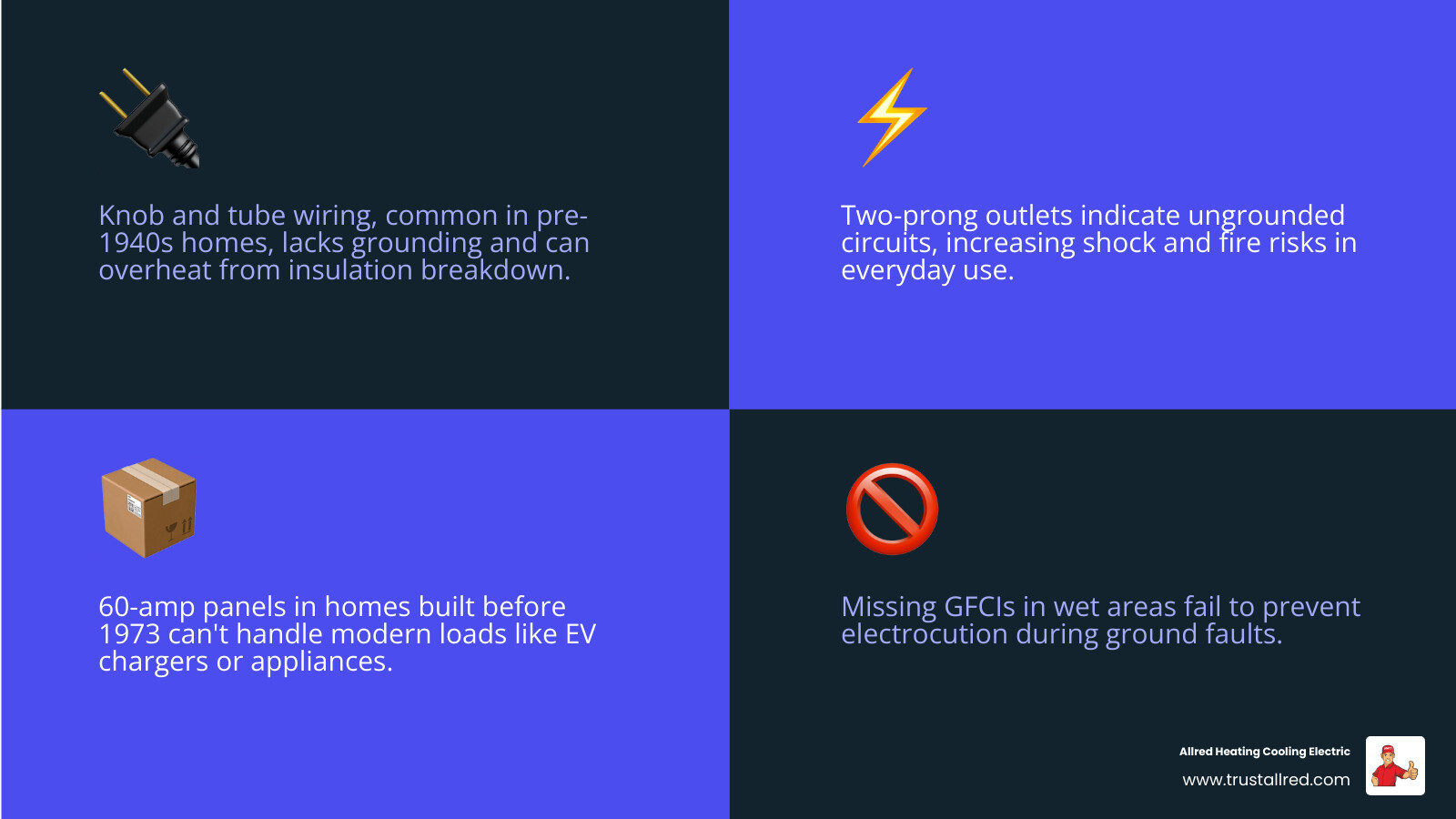
- Ungrounded Circuits: If your home only has two-prong outlets, your system lacks a dedicated path for excess electricity to travel safely to the ground, increasing the risk of shock and fire.
The Dangers of Knob and Tube (K&T)
If your home was built before 1940 and hasn’t had a major electrical overhaul, there is a high probability that K&T wiring is still lurking in your attic or crawlspace. The biggest issue with K&T isn’t just its age; it’s how it was designed. It is an “air-cooled” system, meaning the wires need space to dissipate heat.
When modern homeowners blow fiberglass or cellulose insulation over these wires to save on heating bills, they inadvertently create a fire trap. Furthermore, K&T has no ground wire. In an age of sensitive electronics and high-draw appliances, this lack of grounding is a recipe for disaster. From an insurance perspective, many companies in Washington will flat-out refuse to insure a home with active K&T wiring because the fire risk is simply too high.
Risks of 1960s-70s Aluminum Wiring
Between 1965 and 1973, copper prices spiked, leading many builders in the Pacific Northwest to use aluminum wiring. The problem? Aluminum expands and contracts much more than copper when it gets hot. Over time, this “creeping” causes connections at outlets and switches to wiggle loose.
Loose connections create electrical arcing—miniature lightning bolts that generate intense heat. This can lead to oxidation, which further increases resistance and heat, eventually melting the outlet or starting a structure fire. If you suspect you have aluminum wiring, we often recommend “pigtailing” with copper connectors or replacing the devices with CO/ALR rated outlets to mitigate the risk.
The Ultimate Electrical Safety Checklist for Older Homes
We recommend that every homeowner in the Kent or Federal Way area perform a basic DIY audit every six months. While you should never open your electrical panel or touch bare wires, there is a lot you can catch just by using your senses.
Essential Components of an Electrical Safety Checklist for Older Homes
Start with the basics. Walk through every room of your house and check the following:
- Outlet Temperature: Lightly touch your outlet faceplates. Are they warm? If so, you have a high-resistance connection or an overloaded circuit.
- The “Sizzle” Test: Listen closely to your switches. Do you hear crackling, buzzing, or sizzling? These are the sounds of electricity jumping through the air (arcing).
- Plug Fit: Does your vacuum cord fall out of the wall if you barely tug it? Loose “grips” inside an outlet create heat.
- Visual Cues: Look for discoloration or scorch marks around the plug slots. This is a sign of internal melting.
- Two-Prong Outlets: If you see two slots and no round grounding hole, that circuit is ungrounded.
If you notice any of these signs, it’s often a precursor to a larger failure. You can learn more about identifying these issues in our guide on Signs It’s Time to Schedule a Circuit Breaker Repair.
How to Use Your Electrical Safety Checklist for Older Homes
To be thorough, perform a room-by-room audit. In the kitchen and bathroom, check for GFCI (Ground Fault Circuit Interrupter) outlets—these are the ones with the “Test” and “Reset” buttons. They are designed to shut off power in milliseconds if they detect water contact.
In bedrooms, check your light fixtures. Many older fixtures have a maximum wattage rating (often 60W). If you’ve installed a 100W incandescent bulb in a 60W vintage fixture, you are literally baking the wire insulation inside the ceiling.
Finally, look at your floor. Are there extension cords running under rugs or stapled to baseboards? Extension cords are for temporary use only. Running them under a rug traps heat and allows the internal wires to be pinched or pierced by foot traffic, which is a leading cause of residential fires. If you find yourself relying on them, it’s a sign you need more permanent outlets. Understanding the Benefits of Hiring Professionals for Electrical Needs can help you plan these necessary upgrades safely.
Modern Upgrades for Vintage Systems
If your home still has a fuse box with those little screw-in glass circles, it’s time for an upgrade. While fuses aren’t inherently “evil,” they are easily bypassed. We’ve seen many cases where a homeowner got tired of a 15-amp fuse blowing and screwed in a 30-amp fuse instead. This allows the wire to carry twice the current it was designed for, which can turn the wiring inside your walls into a heating element.
| Feature | Old Fuse Box / 60-Amp Panel | Modern 200-Amp Breaker Panel |
|---|---|---|
| Capacity | 60 Amps (Inadequate for modern life) | 200 Amps (Standard for modern homes) |
| Safety | Fuses can be oversized/bypassed | Breakers are tamper-resistant |
| Protection | Basic overcurrent protection | Includes AFCI/GFCI options |
| EV Readiness | No | Supports Level 2 EV Charging |
| Insurance | Often rejected or penalized | Preferred by insurers |
Upgrading from 60-Amp to 200-Amp Service
In 2026, our homes are doing more than ever. Between high-efficiency heat pumps, electric ovens, and the growing need for home EV charging stations in places like Bellevue and Issaquah, a 60-amp or even a 100-amp service is often insufficient. Most insurance companies now require at least 100-amp service to even write a policy. Upgrading to 200-amp service provides the “headroom” your home needs to run multiple high-draw appliances without straining the system.
Essential Safety Devices: GFCIs and AFCIs
Modern electrical codes now require two specific types of protection that didn’t exist when your vintage home was built:
- GFCIs (Ground Fault Circuit Interrupters): Required in “wet” areas like kitchens, bathrooms, garages, and outdoors. If you drop a hair dryer in a sink, the GFCI cuts the power before you can be electrocuted.
- AFCIs (Arc Fault Circuit Interrupters): These are the “smart” breakers in your panel. They use a tiny computer to “listen” for the specific signature of an electrical arc (like a frayed cord or a loose wire in the wall). If an arc is detected, they trip the breaker before a fire can even start.
Retrofitting these into an older home is one of the single best investments you can make for your family’s safety.
Professional Maintenance and Warning Signs
While our electrical safety checklist for older homes is a great starting point, some things require a professional eye. The U.S. Consumer Product Safety Commission recommends a professional electrical inspection every six months for older homes. At a minimum, you should have a licensed electrician out every 1-2 years to torque down connections in your panel and check for signs of aging that are invisible to the naked eye.
Common warning signs that require immediate professional attention include:
- Burning Smells: A persistent “fishy” or “burnt plastic” smell that you can’t locate.
- Flickering Lights: Especially if they dim when the refrigerator or AC kicks on.
- Shock Sensations: If you feel a “tingle” when touching a metal appliance or faucet.
- Discolored Outlets: Any yellowing or browning of the plastic.
If you experience these, don’t wait for business hours. We provide Emergency Electrical Repairs in Kent, WA and surrounding areas to handle these high-risk situations 24/7.
When to Call an Emergency Electrician
Some situations are “drop everything and call” moments. If you see sparks flying from an outlet, hear loud buzzing from your breaker panel, or see smoke coming from a switch, turn off your main breaker immediately and call us. These are signs of an active electrical failure that could lead to a fire in minutes.
Frequently Asked Questions about Older Home Wiring
What is the most dangerous type of wiring in an old house?
While all outdated wiring has risks, Knob and Tube (K&T) is widely considered the most dangerous. This is due to its lack of a ground wire, its tendency to overheat when covered by modern insulation, and the fact that the rubberized cloth insulation becomes extremely brittle over time, often falling away and leaving bare wires exposed inside your walls.
How often should an older home’s electrical system be inspected?
The CPSC recommends a basic check every six months. For a professional, in-depth inspection, we suggest every 1 to 2 years for homes over 40 years old. Regular maintenance ensures that small issues—like a loosening wire in your panel—don’t turn into expensive repairs or fire hazards.
Can I replace two-prong outlets with three-prong outlets myself?
Technically, you can physically swap the device, but it is often unsafe and against code to do so without a proper ground wire. Simply installing a three-prong outlet on a two-wire system creates a “false ground,” which can destroy your electronics and poses a shock hazard. If you want three-prong convenience on an old system, you must either run a new ground wire or install a GFCI outlet (labeled “No Equipment Ground”) to provide some level of safety. It’s always best to consult a pro to ensure you’re meeting local April 2026 safety standards.
Conclusion
Owning a vintage home is a point of pride, but it comes with the responsibility of maintaining its hidden systems. By using this electrical safety checklist for older homes, you’re taking the first step toward protecting your investment and, more importantly, your family.
At Allred Heating Cooling & Electric, we’re more than just technicians; we’re your neighbors. As a family-oriented business founded by twin brothers, we bring a personal touch to every job, whether we’re in Puyallup, Redmond, or Kirkland. We specialize in bringing older homes up to modern safety standards while respecting the architectural integrity of your property.
Don’t let “hidden” problems become “visible” disasters. If you’re worried about your home’s wiring or if it’s been years since your last inspection, give us a call. Our highly-rated Kent Electricians are available 24/7 to ensure your vintage home stays safe, comfortable, and hazard-free.
