



How Washington Weather Affects Heat Pump Lifespan — What Every Homeowner Should Know
How washington weather affects heat pump lifespan is one of the most important questions you can ask before investing in home comfort — and the answer depends heavily on where you live in the state and how well your system is maintained.
Here’s a quick summary of the key ways Washington’s climate impacts your heat pump:
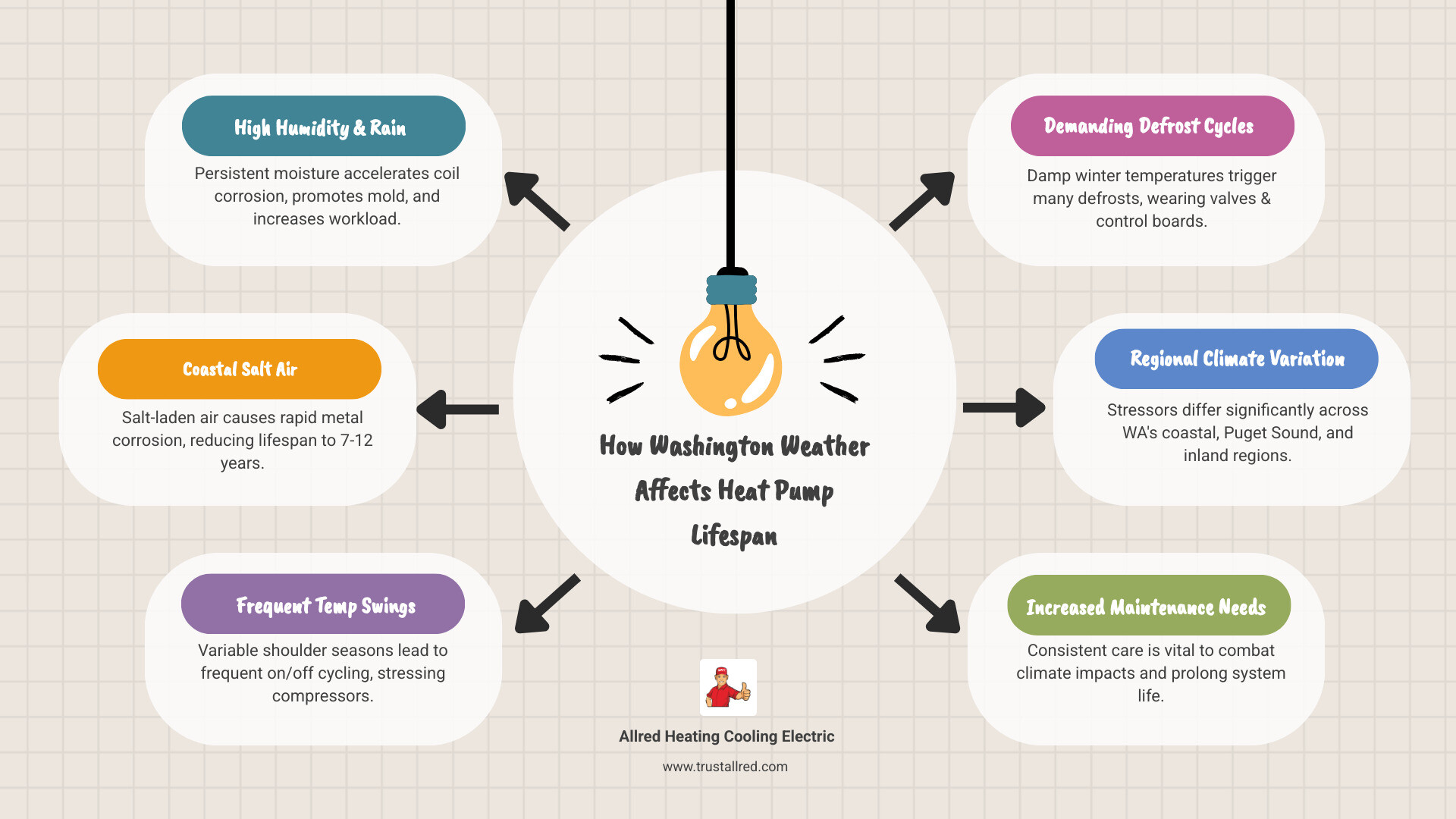
- High humidity and rainfall — Persistent moisture accelerates coil corrosion, promotes mold growth in ductwork, and forces your system to work harder to move heat through saturated air
- Salt air in coastal areas — Homes near Puget Sound shorelines or the coast can see heat pump lifespans cut to just 7–12 years, compared to the standard 14–16 years, due to rapid metal corrosion
- Temperature swings — Washington’s shoulder seasons push heat pumps through frequent on/off cycles, wearing down compressors, capacitors, and contactors faster than steady-state climates
- Defrost cycle demand — The damp 35–45°F range that dominates Western Washington winters triggers hundreds of defrost cycles per season, putting extra stress on reversing valves and control boards
- Regional differences — Coastal, Puget Sound, and inland areas each present a distinct set of climate stressors, meaning lifespan and maintenance needs vary significantly across the state
The bottom line: Washington’s marine climate is genuinely hard on heat pumps — but with the right system, proper installation, and consistent maintenance, most homeowners can reach or exceed the 15-year benchmark.
I’m Daniel Allred, co-founder of Allred Heating, Cooling & Electric, and after more than a decade of servicing heat pumps across the Puget Sound region, I’ve seen exactly how Washington weather affects heat pump lifespan — from salt-corroded coils on waterfront properties to worn reversing valves in inland homes hit by sudden cold snaps. That experience shapes everything we’ll cover in this guide, so you can make informed decisions about your system.
Understanding How Washington Weather Affects Heat Pump Lifespan

When we talk about the life expectancy of a heating and cooling system, we usually point to a 15-year benchmark. In a perfect world—one with moderate humidity and no salt in the air—a well-maintained unit might even stretch to 20 years. However, in our neck of the woods, the reality is a bit more complex.
Statistical data suggests that while the average lifespan sits between 14 and 16 years with professional care, certain Washington microclimates can shave years off that total. For example, if you have a Redmond Heat Pump, you’re dealing with a different set of environmental stressors than someone living right on the shores of the Pacific. Inland areas benefit from less salt but face more significant temperature fluctuations, while the Puget Sound basin traps moisture like a sponge.
The Impact of High Humidity and Rainfall on Longevity
Washington is famous for its “liquid sunshine,” but for your HVAC system, that constant dampness is a challenge. High humidity creates a “latent heat” problem. In the summer, your heat pump doesn’t just lower the temperature; it has to work overtime to wring moisture out of the air. This increases energy consumption and places a heavier load on the blower motor and compressor.
Furthermore, persistent rainfall leads to coil saturation. When outdoor coils stay wet for weeks at a time, they become magnets for dirt, pollen, and forest debris. This mixture can create a corrosive “sludge” that eats away at the delicate aluminum fins. If moisture finds its way into the ductwork or the air handler, you also face the risk of mold growth, which degrades air quality and can physically damage internal components over time. Homeowners looking for a Federal Way Heat Pump should be particularly mindful of how our 37+ inches of annual rainfall necessitates superior drainage around the outdoor unit.
How Salt Air and Coastal Conditions Accelerate Corrosion
If you live within five to ten miles of the ocean or the Sound, your heat pump is breathing in salt-laden air every single day. Salt is incredibly aggressive toward metal. It accelerates the oxidation process, leading to premature rust on the cabinet, base pan, and—most critically—the copper and aluminum heat exchanger coils.
In these coastal environments, the expected service life can drop significantly, often falling into the 7 to 12-year range. We often see “pitting” on the coils where the salt has literally eaten through the metal, leading to refrigerant leaks. For an Alki Heat Pump Installation, we strongly recommend units with specialized protective coatings (like “Seacoast” or “Gold Fin” technology) and a more aggressive rinsing schedule to wash away salt deposits before they can bond to the metal.
Temperature Swings and the Stress of Frequent Cycling
Washington is the king of “shoulder seasons.” It’s not uncommon to wake up to a crisp 38°F morning, enjoy a 65°F sunny afternoon, and be back down in the 40s by dinner. While this weather is pleasant for us, it’s exhausting for a heat pump.
These rapid changes cause frequent on/off cycling. Every time a single-stage compressor starts up, it experiences a surge of electrical and mechanical stress. Over thousands of cycles, this leads to “compressor fatigue.” It also wears out the capacitors (the “batteries” that start the motor) and the contactors (the switches that provide power). If you’re considering a Tacoma Heat Pump Installation, choosing a system that can handle these transitions smoothly is vital for long-term reliability.
Managing Ice Buildup and Defrost Cycles in Washington
One of the most misunderstood parts of how washington weather affects heat pump lifespan is the defrost cycle. When it’s 35°F and raining—a standard Tuesday in King County—the outdoor coil actually drops below freezing to pull heat from the air. This causes frost or ice to build up on the unit.
The heat pump is designed to “reverse” itself into cooling mode briefly to melt that ice. However, in our damp climate, a unit might have to do this hundreds of times a winter. This puts immense wear on the reversing valve, which has to physically shift positions under pressure. If a sensor malfunctions due to moisture or age, the unit might fail to defrost, becoming encased in a block of ice that can bend fan blades and crack coils. Regular King County Heat Pump Repair often involves calibrating these sensors to ensure the defrost logic is firing correctly.
Maximizing How Washington Weather Affects Heat Pump Lifespan Through Care
The good news is that you aren’t at the mercy of the clouds. You can fight back against climate-related wear by making smart choices during the installation phase.
- Proper Sizing: An oversized unit will “short-cycle,” turning on and off constantly and killing the compressor early. An undersized unit will run 24/7, wearing out the motor.
- Variable-Speed Technology: Unlike old-school units that are either “all on” or “all off,” variable-speed (inverter) compressors ramp up and down slowly. This reduces mechanical stress and handles Washington’s temperature swings with ease.
- Smart Thermostats: Modern thermostats can be programmed with “lockout temperatures” to prevent the system from overworking during extreme snaps. If you need Heat Pump Repair Klahanie WA, upgrading to a smart controller is often one of the best ways to extend your system’s life.
Regional Variations: Puget Sound vs. Inland Washington
Washington’s geography is diverse, and your heat pump knows it.
| Feature | Coastal Areas (e.g., Alki, Redondo) | Puget Sound Basin (e.g., Bellevue, Kent) | Inland/Higher Elevation (e.g., Enumclaw, Snoqualmie) |
|---|---|---|---|
| Primary Stressor | Salt Air Corrosion | High Humidity & Dampness | Temperature Extremes & Snow |
| Expected Lifespan | 7–12 Years | 13–15 Years | 14–16 Years |
| Defrost Frequency | Moderate | Very High | High (due to snow/ice) |
| Corrosion Risk | Severe | Moderate | Low |
For a Bellevue Heat Pump Installation, the focus is usually on moisture management and noise ordinances, whereas in the foothills, we have to worry about protecting the unit from heavy snow loads and falling debris.
Installation Quality and System Sizing in Variable Climates
A heat pump is only as good as the person who installs it. In Washington, this means performing a Manual J load calculation to ensure the system matches the home’s specific insulation and window types.
We also pay close attention to drainage design. If an outdoor unit sits in a puddle of rainwater, the base pan will rust out in half the time. We use specialized risers (often called “snow feet”) to keep the unit off the ground, allowing water to flow away and preventing ice from damming up under the fan. Vibration isolation is another key factor—as the unit cycles frequently during our swing seasons, we want to ensure it isn’t shaking itself to pieces. This is a standard part of any Medina Heat Pump Installation we perform.
Maintenance Strategies to Combat Local Climate Effects
If there is one “secret” to beating the Washington weather, it’s maintenance. Think of it like an oil change for your car—you wouldn’t drive 50,000 miles without one, yet many people expect their heat pump to run for 15 years without a checkup.
We recommend bi-annual tune-ups: once in the spring to prep for the cooling season and once in the fall to ensure the heating and defrost components are ready for the winter dampness. During these visits, we perform deep coil cleaning to remove the “PNW sludge” and check refrigerant levels. A system low on refrigerant has to work twice as hard to move heat, which is a leading cause of premature compressor failure. If you’re scheduling an Enumclaw Heat Pump Installation, make sure you have a plan for seasonal maintenance from day one.
Essential Maintenance Tips for Washington Homeowners
While we handle the technical stuff, there are several things you can do to protect your investment:
- Filter Changes: In our humid climate, air filters can get “heavy” with moisture and dust. Change them every 30–90 days to maintain airflow.
- Vegetation Trimming: Washington grows plants very well. Keep shrubs and grass at least 18 inches away from your outdoor unit to ensure it can “breathe.”
- Clear the Debris: After a typical PNW windstorm, check your unit for pine needles, leaves, and twigs. These can trap moisture against the coils and cause rust.
- Condensate Drain Clearing: Ensure the white PVC pipe coming from your indoor unit is dripping freely. If it clogs, water can back up into your home or damage the indoor electronics. This is a common issue we see during Mc Millin Heat Pump Installation follow-ups.
When to Consider Replacement Due to Climate Wear
Eventually, the weather wins. You should start thinking about a replacement if:
- The unit is over 12 years old (especially in coastal areas like Redondo).
- Efficiency loss is obvious: Your energy bills are climbing even though your habits haven’t changed.
- Frequent repairs: If you’ve had more than two significant repairs in the last three years, you’re likely “throwing good money after bad.”
- Strange Noises: Grinding or squealing often indicates a failing compressor or fan motor—the heart of the system.
If you’re noticing these signs at your Redondo Heat Pump Installation, it might be time to look at modern, high-efficiency models that are better equipped for our marine environment.
Frequently Asked Questions about Washington Heat Pumps
What is the typical lifespan of a heat pump in Washington?
In the inland areas of the Puget Sound (like Kent or Auburn), you can expect 14 to 16 years with regular maintenance. However, this can drop to 7 to 12 years if you are in a high-corrosion coastal zone or if the unit is neglected.
How does salt air affect heat pumps in coastal Washington towns?
Salt air acts as a corrosive catalyst. It reacts with the aluminum and copper in your heat pump’s coils, causing “formicary corrosion.” This leads to microscopic holes in the metal, causing refrigerant leaks and eventual system failure. Protective coatings and regular fresh-water rinsing are the best defenses.
Why does my heat pump cycle more often during Washington’s spring and fall?
This is usually due to the narrow “deadband” of our outdoor temperatures. When it’s 50°F outside, your home loses heat slowly. A standard single-stage heat pump will turn on, quickly satisfy the thermostat, and turn off. This “short-cycling” is common in our shoulder seasons and is best managed by upgrading to a variable-speed system.
Conclusion
Washington’s weather is beautiful, but it’s undeniably tough on mechanical equipment. From the salt spray of the coast to the persistent dampness of the Sound, your heat pump is constantly battling the elements. At Allred Heating Cooling Electric, we pride ourselves on being more than just technicians; we are local experts who understand the unique engineering requirements of the Pacific Northwest.
As a family-oriented business, we treat your home’s comfort as if it were our own. Whether you need a midnight emergency repair or a brand-new, climate-resilient installation, our expert technicians are available 24/7 to ensure your family stays cozy, no matter what the Washington sky throws at you.
Don’t let the climate cut your system’s life short. Schedule your Washington heat pump service today and let us help you get the most out of your home comfort investment.
