


Why Summer Cooling Tips for Pacific Northwest Homeowners Matter More Than Ever
Summer cooling tips for pacific northwest homeowners have never been more important than they are right now. Washington summers are no longer the mild, breezy seasons many residents grew up with. The 2021 “heat dome” pushed Seattle temperatures past 100°F for multiple days in a row — an event that caught thousands of households completely off guard. And that was just the beginning.
Here’s a quick look at the most effective ways to keep your home cool this summer in the Pacific Northwest:
- Block heat at the windows — Close blinds and curtains before 10 a.m.; up to 30% of unwanted heat enters through glass.
- Use natural ventilation strategically — Open windows in the evening and early morning when outside air is cooler than inside.
- Run ceiling fans counterclockwise — This pushes cool air downward and can let you raise your thermostat by up to 4°F without discomfort.
- Minimize indoor heat sources — Swap incandescent bulbs for LEDs, grill outside, and run appliances at night.
- Maintain your cooling system — Replace filters every one to three months and schedule a pre-season tune-up before summer peaks.
- Upgrade insulation and air sealing — A well-insulated home can cut summer cooling costs by as much as 20%.
- Consider a ductless mini-split or heat pump — These systems are well-suited to the PNW’s climate and may qualify for local utility rebates.
Temperatures in the region have already risen 1.5°F over the past century, and climate models project an additional 2.5°F rise in the coming decades. Every year in the U.S., extreme heat events send nearly 10,000 people to the hospital and contribute to around 600 deaths — a sobering reminder that staying cool is a health issue, not just a comfort one. For Seattle-area homeowners, that reality is hitting closer to home with each passing summer.
I’m Daniel Allred, co-founder of Allred Heating, Cooling & Electric, and after years of helping Puget Sound homeowners navigate increasingly unpredictable summers, I’ve seen which summer cooling tips for Pacific Northwest homeowners actually make a difference — and which ones fall short. In this guide, I’ll walk you through everything from no-cost quick fixes to smart long-term upgrades that keep your home comfortable without driving up your energy bill.
Immediate Summer Cooling Tips for Pacific Northwest Homeowners
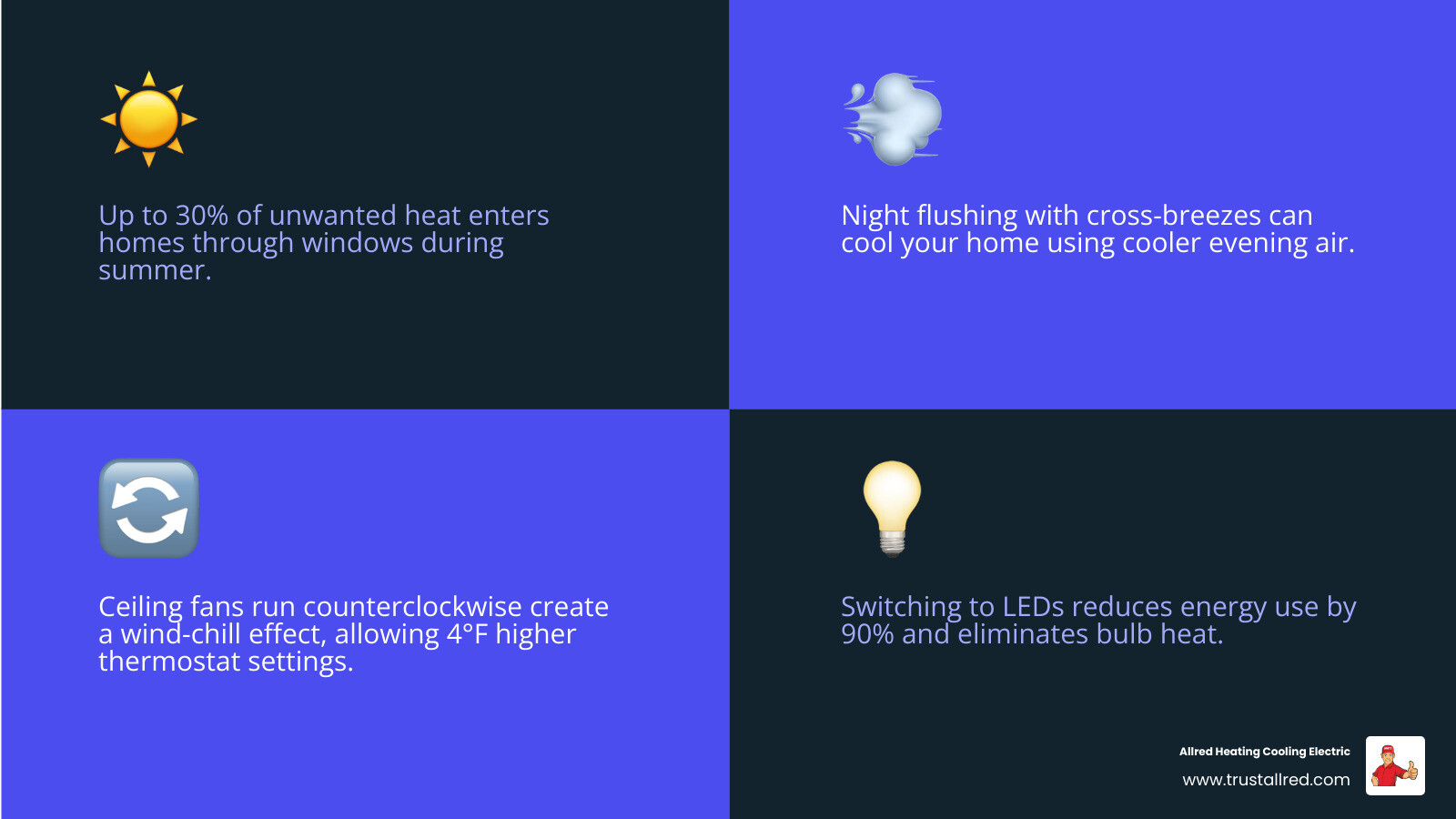
When the mercury starts climbing in King or Pierce County, you don’t always have time for a full renovation. You need relief now. One of the most effective immediate strategies is “night flushing.” In our region, nights are typically much cooler than days. By opening windows on opposite sides of the house after the sun goes down, you create a cross-breeze that pulls out the stagnant, hot air and replaces it with refreshing night air.
Another quick win involves your ceiling fans. Ensure they are rotating counterclockwise during the summer. This direction creates a “wind-chill effect” by pushing a breeze directly downward. While fans don’t actually lower the room’s temperature, they make the people in the room feel about 4°F cooler, allowing you to nudge your thermostat up and save on energy.
Internal heat gain is a silent comfort killer. Did you know that traditional incandescent light bulbs release 90% of their energy as heat? By upgrading to LEDs, you achieve a 90% energy reduction and stop your light fixtures from acting like mini-heaters. If your system is struggling despite these changes, it might be time for HVAC Services Seattle WA or a quick Des Moines HVAC Repair to ensure your equipment is actually up to the task.
Low-Cost Ventilation and Summer Cooling Tips for Pacific Northwest Homeowners
If you want to take ventilation to the next level, try creating an “airflow vacuum.” Place a box fan in a window on the hot, sunny side of the house (usually south or west) facing outward to blow hot air out. On the shady, cooler side of the house, open a window to draw fresh air in. This active exchange is far more effective than just letting a fan oscillate in the middle of a room.
Here are some essential no-cost cooling habits to start today:
- Close windows by 10 a.m.: Trap the cool morning air inside before the outdoor temperature surpasses the indoor temperature.
- Shut interior doors: If you have rooms that get direct afternoon sun, keep those doors closed to prevent that heat from migrating to the rest of the house.
- Use the “Ice Bucket” trick: Place a bowl of ice or a frozen gallon jug directly in front of a portable fan for a DIY swamp cooler effect.
Strategic Appliance Use to Minimize Indoor Heat
Your kitchen and laundry room are the primary “heat factories” in your home. During a Washington heat wave, small changes in how you use appliances can prevent your AC from working overtime.
- Laundry: Wash clothes in cold water and air-dry them outside. Dryers not only generate heat but also exhaust conditioned air out of your home.
- Cooking: This is the best time to fire up the BBQ! Avoid the oven and stove, which can linger at high temperatures for hours. If you must cook indoors, stick to the microwave or a slow cooker.
- Timing: Run your dishwasher late at night or early in the morning when the house is at its coolest.
- Unplugging: Electronics like gaming consoles and large TVs generate heat even when they are in “standby” mode. Unplug what you aren’t using.
Maximizing Window Efficiency and Shading
Up to 30% of unwanted heat in your home comes directly through the windows. In the Pacific Northwest, where we love our large windows for natural light during the gray winters, those same glass panes become massive heat conductors in July. Controlling “solar heat gain” is perhaps the single most impactful of all summer cooling tips for pacific northwest homeowners.
Insulated cellular shades are a fantastic investment. They can cut AC use by 13% compared to vinyl blinds and up to 25% compared to having no window coverings at all. If you are in a particularly sun-drenched area, you might need more robust Ashburn WA Air Conditioning support to keep up with the load.
| Feature | Interior Vinyl Blinds | Insulated Cellular Shades | Exterior Solar Screens |
|---|---|---|---|
| Heat Reduction | Minimal | Up to 25% | Over 20% vs none |
| Cost | Low | Moderate | Moderate to High |
| Best For | Privacy | Insulation | Maximum Heat Block |
Shading Devices and Summer Cooling Tips for Pacific Northwest Homeowners
If you want to stop the heat before it even touches the glass, exterior shading is the way to go. Awnings installed on the outside of your windows can reduce solar heat gain by a staggering 77%. For a less permanent solution, window films can be applied directly to the glass to block up to 78% of the sun’s heat while still allowing you to see the beautiful Washington landscape.
Homeowners in sunny areas like Bellevue often find that a combination of blackout curtains and reflective shades provides the best defense. If your home still feels like an oven even with the shades drawn, it may be time to consult with Bellevue WA HVAC experts to see if your cooling system is properly sized for your home’s window load.
Optimizing HVAC Performance and Smart Technology
Even the best AC system will struggle if it isn’t maintained. We recommend replacing your air filters every one to three months—especially during the summer when pollen and dust are high. A clogged filter restricts airflow, forcing the system to work harder and increasing the risk of a breakdown.
Annual coil cleaning is another essential step. When the outdoor condenser coils are covered in dirt or cottonwood fluff, they can’t release heat effectively. We suggest keeping your thermostat between 75°F and 78°F when you are home. While it might be tempting to “blast” it at 65°F, most systems aren’t designed to maintain a 30-degree difference from the outdoor air. For more details on what we look for, check out our guide on HVAC Check During Routine Maintenance. If your current unit is over 10-15 years old, it might be time to look at Bellevue New AC Units that offer significantly better efficiency.
Smart Thermostats and Energy Management
Smart thermostats are a game-changer for managing cooling costs. These devices allow for remote access and automation, meaning you can raise the temperature while you’re at work in Kent and cool the house down just before you arrive home. Many Washington utilities offer rebates for smart thermostats, and some even have “Time-of-Use” plans where you can save money by shifting your heavy cooling to off-peak hours. If you’re considering a more efficient system altogether, a Renton Heat Pump Installation paired with a smart thermostat is one of the best ways to future-proof your home.
Long-Term Upgrades for Climate Resilience
If you’re tired of “getting by” every summer, it’s time to look at structural upgrades. Insulation acts as a thermal barrier, keeping the heat out in the summer and the warmth in during the winter. Upgrading your attic insulation can save you up to 15% on cooling costs alone.
Spray foam insulation is particularly effective in the PNW because it provides both a high R-value and superior air sealing. By sealing the gaps in your attic and crawl spaces, you prevent hot air from seeping into your living areas. If your home is older and lacks modern cooling, you might consider a Seattle WA AC Replacement or a Seattle WA Heat Pump Installation to handle the increasing summer loads.
Choosing the Best Cooling System for the PNW
Not every home in Washington was built for central air. For homes with existing ductwork, a central AC or a ducted heat pump is often the most straightforward choice. However, for many of the classic homes in our area, Daikin Heat Pumps and ductless mini-splits are the gold standard.
Ductless systems allow for room-by-room control, which is incredibly efficient. You only cool the rooms you are actually using. If you’re curious about the tech, read more about What You Should Know About Mini-Split Heat Pumps. Whether you need an Edgewood Mini-Split Installation, a Federal Way WA Ductless AC setup, or a standard Shoreline AC Installation, there is a modern, high-efficiency solution that fits your home’s layout.
Landscaping and Structural Efficiency
Your yard can be a powerful tool for cooling. Planting deciduous trees (trees that lose their leaves in winter) on the south and west sides of your home provides natural shade during the summer. In the winter, the leaves fall, allowing the sun to help heat your home. This natural “evaporative cooling” from plants can significantly lower the ambient temperature around your house.
Structural choices matter, too. If you’re replacing your roof, look for materials with a high Solar Reflectance Index (SRI), often called “cool roofs.” These reflect more sunlight and absorb less heat. When weighing your options for total home comfort, it’s also worth comparing a Furnace vs Heat Pump to see which provides the best year-round efficiency for your specific microclimate.
Frequently Asked Questions about PNW Cooling
Why is air conditioning becoming a necessity in Washington?
The climate in the Pacific Northwest is shifting. Seattle saw its warmest summer on record in 2022, and the “heat dome” of 2021 proved that triple-digit temperatures are no longer a “once-in-a-century” fluke. With a projected 2.5-degree rise in temperatures over the next few decades, the “urban heat island” effect in cities like Tacoma and Kent is making it harder for homes to cool down naturally at night.
Are there local rebates for energy-efficient cooling upgrades?
Yes! Many local utility providers in Washington offer significant cash-back programs for installing Energy Star-certified heat pumps, smart thermostats, and even high-efficiency central AC units. Additionally, federal tax credits are often available for substantial energy-efficiency upgrades like insulation and heat pump installations.
How should I manage cooling during wildfire smoke events?
This is a unique challenge for the PNW. During smoke events, you must keep windows closed, which makes natural ventilation impossible. This is where central AC or a heat pump with a high-quality filter (MERV 13 or higher) becomes vital. These systems can cool your home while in “recirculation” mode, using HEPA-level filtration to keep your indoor air clean. Avoid using window AC units or portable units with a single hose during smoke events, as they can actually pull smoky air into your home through gaps and vents.
Conclusion
At Allred Heating Cooling Electric, we believe every Washington family deserves a cool, safe sanctuary to retreat to when the summer heat hits. As a family-oriented company, we take pride in our expert technicians who are available 24/7 for emergencies. Whether you need a simple tune-up or a brand-new high-efficiency system, our team is dedicated to ensuring your year-round comfort.
Don’t wait until the next heat wave to find out if your home can handle the heat. Schedule your professional cooling assessment today and stay ahead of the summer sun!
