


Why HVAC Maintenance Tips for Pacific Northwest Homeowners Are Essential for Year-Round Comfort
The best hvac maintenance tips for pacific northwest homeowners to follow are:
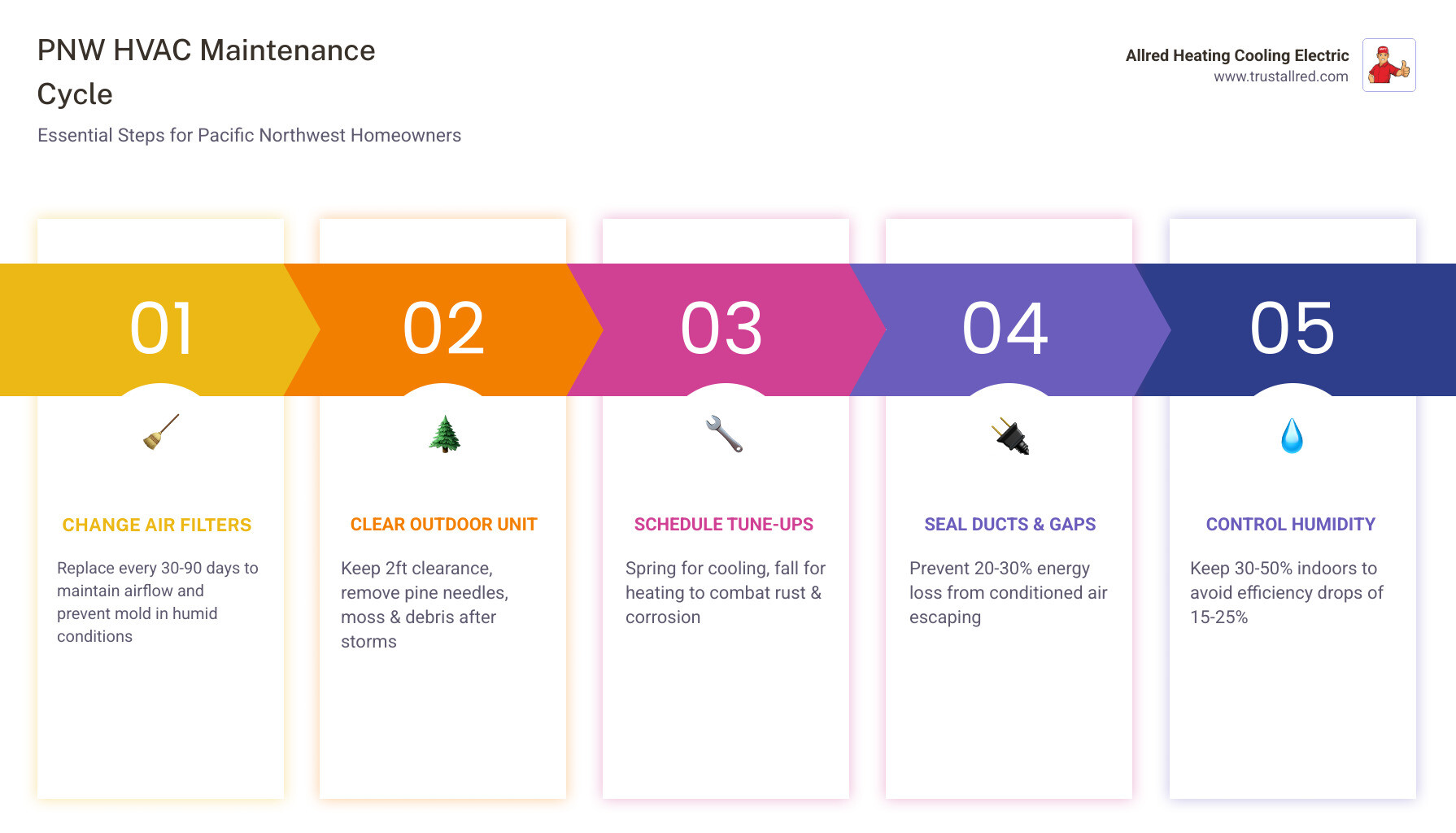
- Change air filters every 30–90 days (more often with pets or allergies)
- Schedule professional tune-ups twice a year — spring for cooling, fall for heating
- Keep 2 feet of clearance around your outdoor unit to prevent debris buildup
- Seal ducts, windows, and doors to stop 20–30% of conditioned air from escaping
- Control indoor humidity to stay between 30–50% and prevent mold growth
- Use a programmable thermostat to save up to $180 per year on energy costs
- Watch for warning signs like strange noises, short cycling, or rising energy bills
- Clean condensate drain lines regularly to prevent water damage from algae clogs
- Heat pumps are your best friend in the PNW marine climate — maintain them biannually
- Clear moss, pine needles, and debris from outdoor coils after every major storm
Your HVAC system works hard year-round in the Pacific Northwest — and the region’s climate makes that job uniquely demanding. Seattle sees an average of 164 rainy days per year, and indoor humidity regularly climbs above 75%, which can quietly reduce your system’s efficiency by 15–25% while accelerating rust, corrosion, and mold growth on critical components. The result? Higher energy bills, shorter system lifespans, and the kind of breakdown that always seems to happen on the coldest or hottest day of the year.
The good news is that most of those problems are preventable. A little consistent attention goes a long way — and this guide walks you through exactly what to do and when to do it.
I’m Daniel Allred, co-founder of Allred Heating, Cooling & Electric, and alongside my brother Matt, I’ve spent years helping Puget Sound homeowners navigate the specific challenges that the PNW climate puts on their heating and cooling systems. Our hands-on experience in HVAC service and operations across the region is the foundation for every hvac maintenance tip for pacific northwest homeowners you’ll find in this guide.
Why HVAC Maintenance Tips for Pacific Northwest Homeowners Matter
Living in areas like Auburn, Bellevue, or Tacoma means dealing with a “marine climate.” While our temperatures are often moderate, the air is heavy with moisture. This high humidity creates what we call a “latent heat” challenge. Your air conditioner or heat pump has to work twice as hard—not just to lower the temperature, but to wring the water out of the air. When humidity levels stay above 75%, your system’s efficiency can drop by as much as 25%.

This constant dampness is a silent enemy. It accelerates rust and corrosion on metal components and creates a breeding ground for mold within your ductwork. In fact, if not properly maintained, your ducts can develop a “biological paste”—a mix of dust, moisture, and pollen—that recirculates through your home. By following HVAC Maintenance Tips for Long-Lasting Systems, you can combat these regional issues.
Regular maintenance isn’t just about comfort; it’s about survival for your equipment. A neglected system might only last 10 years, while a well-cared-for unit can easily reach 15 to 20 years. In a region where we rely on our heating for a long portion of the year, that extra decade of service is a massive return on investment.
Seasonal Checklists and Warning Signs
In the Pacific Northwest, we don’t just have “on” and “off” seasons. We have long transitions where your system might switch from heating to cooling in the same day. This makes seasonal tune-ups vital.
The Seasonal Breakdown
| Task | Spring (Cooling Prep) | Fall (Heating Prep) |
|---|---|---|
| Primary Focus | Air Conditioning / Heat Pump Cooling | Furnace / Heat Pump Heating |
| Outdoor Unit | Clear winter debris, rinse coils | Clear fallen leaves, check for moss |
| Indoor Unit | Check condensate drain for clogs | Inspect heat exchanger and burners |
| Thermostat | Test cooling cycle and batteries | Test heating cycle and calibration |
| Safety | Check electrical connections | Test Carbon Monoxide detectors |
Preparing for the wet months requires specific Fall HVAC Tips to ensure your home stays cozy. If you have a furnace, the Importance of Regular Furnace Tune-Ups cannot be overstated, as a cracked heat exchanger can lead to dangerous carbon monoxide leaks. For our neighbors in the south end, following Don’t Get Left in the Cold: The Essential Auburn WA Furnace Tune-Up Checklist is the best way to avoid a mid-January emergency.
Warning Signs You Can’t Ignore
Your HVAC system usually tries to tell you it’s struggling before it completely quits. Keep your ears and eyes open for:
- Unusual Noises: Banging, screeching, or buzzing often indicates a failing motor or loose belt.
- Short Cycling: If your system turns on and off every few minutes, it’s likely overheating or has a sensor issue.
- Rising Energy Bills: A sudden spike in your utility bill without a change in weather usually means the system is losing efficiency.
- Poor Airflow: If some rooms are cold while others are warm, your blower or ducts may be the culprit.
If you notice these, check out these guides on Signs You Need Immediate Heat Pump Repair or local resources like the Heat Pump Tune-Up Auburn WA Guide and the Heating Tune-Up Tacoma WA Guide to troubleshoot the issue early.
Maximizing Efficiency and Indoor Air Quality
Efficiency in the PNW is about more than just a high SEER rating; it’s about keeping the conditioned air inside and the moisture out.
The Power of Control and Sealing
ENERGY STAR estimates that the average home loses 20% to 30% of its air through leaks, holes, and poorly connected ducts. In our damp climate, leaky ducts don’t just lose heat—they suck in moisture and allergens from crawlspaces and attics. Sealing these gaps and using weatherstripping on doors and windows can reduce heat loss by up to 40%.
Upgrading to a programmable or smart thermostat is another easy win. Setting your home to 75°F in the summer and 68°F in the winter (with adjustments when you’re away) can save you roughly $180 a year. Also, don’t forget your ceiling fans! Running them counterclockwise in the summer creates a wind-chill effect that allows you to raise the thermostat a few degrees without losing comfort.
Specialized Systems
Many homes in Issaquah, Sammamish, and Kirkland are moving toward ductless systems. If you have one, a Ductless Mini-Split Needs Tune-Up just as much as a central system. These units are excellent at moisture removal and zoning, but their filters and indoor coils need regular cleaning to prevent that “dirty sock” smell common in humid areas.
Frequently Asked Questions
How often should I apply HVAC maintenance tips for Pacific Northwest homeowners to my filters?
In our region, you should check your air filter every 30 days. While some high-efficiency filters claim to last six months, our heavy pollen seasons and winter dampness can clog them much faster. If you have pets or suffer from allergies, you’ll likely need to replace them every 30 to 60 days. A clogged filter is the #1 cause of system failure—it restricts airflow, forcing the motor to work harder and eventually burn out. Using a MERV 8 to MERV 13 filter provides a great balance between air filtration and system protection. For more details, see our Must-Know Maintenance Tips.
Why are heat pumps the focus of HVAC maintenance tips for Pacific Northwest homeowners?
Heat pumps are the “gold standard” for the Puget Sound area because they are incredibly efficient in our moderate temperature range. However, because they provide both heating and cooling, they run year-round, meaning they experience twice the wear and tear of a standard AC. During PNW winters, they go through thousands of “defrost cycles” to melt ice off the outdoor coils. This mechanical fatigue makes biannual professional checks critical to ensure components like the reversing valve don’t get stuck.
What are the best steps for outdoor unit care in the PNW?
Our environment is beautiful, but it’s messy. Pine needles, falling leaves, and moss love to settle inside your outdoor condenser.
- Maintain Clearance: Keep at least 2 feet of clear space around the unit. Trim back bushes and rhododendrons.
- Clear Debris: After a windstorm, check for “yard missiles”—branches or needles stuck in the fins.
- Gently Rinse: Use a garden hose (not a pressure washer!) to rinse away dirt and salt spray from the coils.
- Level the Pad: Heavy rains can cause the soil to shift. Ensure your unit is still sitting level to prevent oil from pooling in the compressor.
Conclusion
Taking care of your HVAC system doesn’t have to be a chore, but in the Pacific Northwest, it is a necessity. By following these hvac maintenance tips for pacific northwest homeowners, you aren’t just saving money on your monthly energy bill—you’re protecting one of the biggest investments in your home.
At Allred Heating Cooling Electric, we take a family-oriented approach to every home we visit. Whether you’re in Auburn, Kent, or Bellevue, our expert technicians are available 24/7 for emergencies and are dedicated to ensuring your system runs at peak efficiency. Ready to stop worrying about your furnace or heat pump? Explore our Annual HVAC Maintenance Plans or reach out for HVAC Maintenance Auburn WA to keep your home comfortable through every rainy day and surprise heatwave.
Book your service today and let us help you stay cool (or warm) without losing your cool!
