



Why Adding Cooling Without Ductwork Options Compared Matters for Older Homes
Adding cooling without ductwork options compared is one of the most common questions homeowners in older Seattle-area homes ask — and for good reason. If your home was built before the 1970s, there is a strong chance it has no ductwork at all. Installing traditional central air conditioning would mean cutting through plaster walls, running ducts through tight crawl spaces, and potentially disrupting the very character that makes your home worth loving.
The good news is that you have real, effective choices. Here is a quick look at the main options:
| Option | Best For | Efficiency | Installation Disruption |
|---|---|---|---|
| Ductless mini-split | Whole-home or multi-room cooling | Very high (up to 35 SEER2) | Minimal (3-inch hole) |
| Window AC unit | Single room, renters, temporary use | Moderate (10-15 EER) | None |
| Portable AC | Renters, windowless rooms, short-term | Low (8-12 EER) | None |
| Through-the-wall unit | Permanent single-room solution | Moderate (10-13 EER) | Requires wall cutout |
| Evaporative cooler | Dry climates, supplemental cooling | High in low humidity | Low |
| Whole-house fan | Homes with cool evenings, ventilation | Very high for ventilation | Moderate (attic install) |
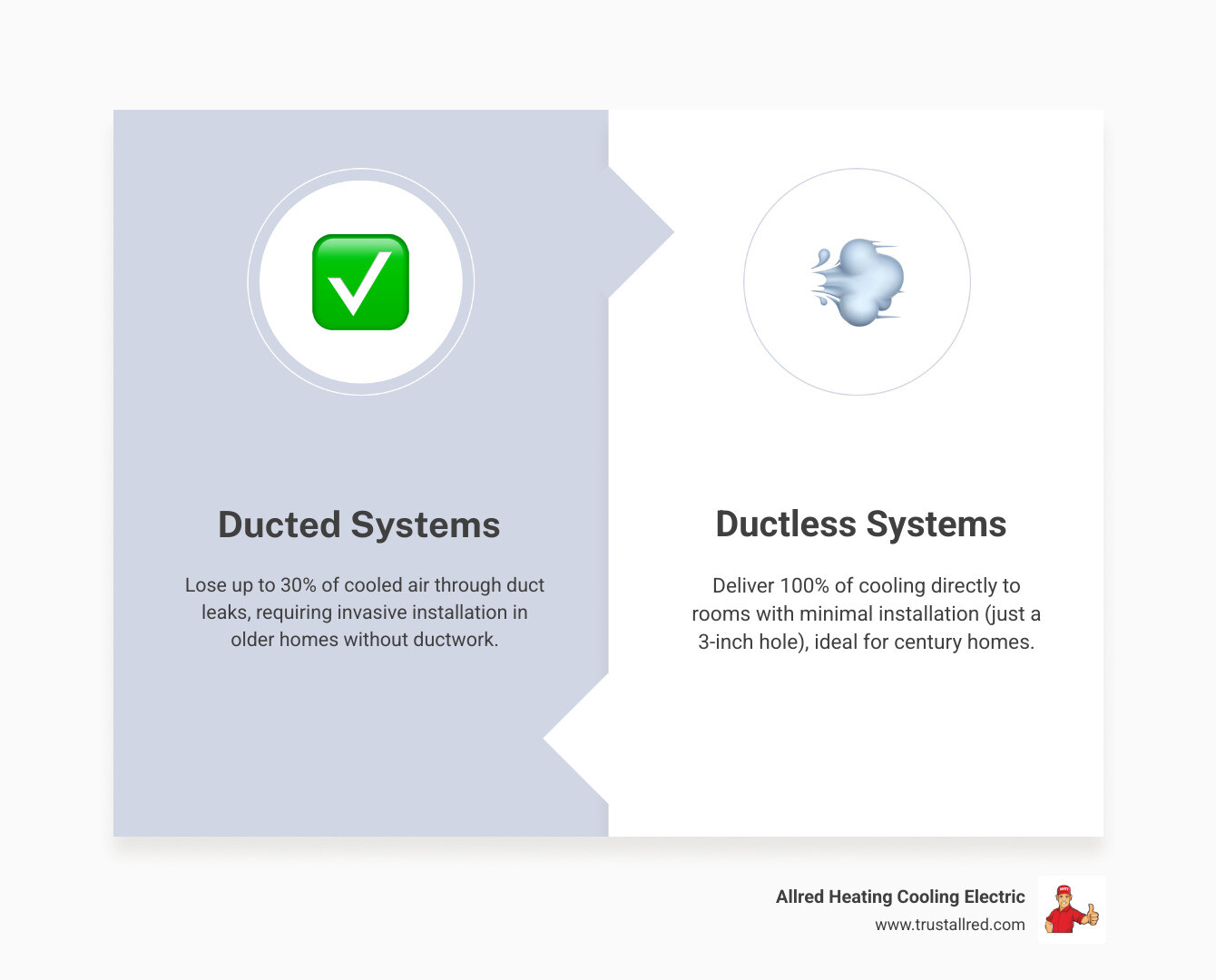
The biggest factor separating these options is not just upfront cost — it is long-term efficiency, comfort, and how well each fits a home without existing ductwork. Traditional ducted systems can lose up to 30% of cooled air through leaks alone. Ductless systems sidestep that problem entirely.
I am Daniel Allred, co-founder of Allred Heating, Cooling & Electric, and I have spent years helping Puget Sound homeowners navigate exactly this challenge of adding cooling without ductwork options compared — from century homes in Seattle’s historic neighborhoods to modern additions and converted garages. In the sections below, I will walk you through every realistic option so you can make a confident, informed decision for your home.
Adding Cooling Without Ductwork Options Compared: The Top Contenders
When we sit down with families in Auburn or Kent, we start by looking at the three heavy hitters of ductless cooling: mini-splits, window units, and portable ACs. While all three will lower the temperature, the experience of using them is night and day.
Mini-Split Air Conditioning has quickly become the gold standard for Pacific Northwest homes. Unlike a window unit that rattles your nerves and blocks your view, a mini-split is a permanent, whisper-quiet system. In fact, most indoor units run at 19 to 32 decibels—that is literally quieter than a whisper.
When adding cooling without ductwork options compared, efficiency is where the mini-split really pulls ahead. Traditional ductwork can lose up to 40% of its cooling power if it isn’t perfectly sealed and cleaned. Because mini-splits deliver air directly into the room, they lose less than 5% efficiency over their entire lifespan. This is why Ductless Mini-Split for Optimal Performance is often the best long-term investment. While a window unit might last 5 to 7 years, a well-maintained mini-split can keep your home comfortable for 15 to 20 years.
Adding Cooling Without Ductwork Options Compared: Efficiency and Performance
The secret sauce behind modern ductless systems is inverter technology. Traditional AC units are either “on” or “off”—like a light switch. This creates those annoying temperature swings where you’re freezing one minute and sweating the next. Modern systems, like the Daikin Fit, use variable-speed compressors that act more like a dimmer switch. They adjust their speed to maintain a perfectly steady temperature, using up to 60% less energy than standard heating and cooling systems.
Proper BTU sizing is critical here. If you undersize a unit for a sun-drenched living room in Federal Way, it will run constantly and wear out early. If you oversize it, it will “short-cycle,” turning on and off so fast that it never has a chance to dehumidify the air. Our team specializes in Seattle Mini-Split Heat Pumps and performs precise load calculations to ensure your system is a perfect match for your home’s square footage and insulation levels.
Adding Cooling Without Ductwork Options Compared: Installation and Aesthetics
One of the biggest fears homeowners have with century homes is the “renovation nightmare.” We get it—you don’t want us ripping open your lath-and-plaster walls. The beauty of Efficient Ductless Mini-Split Installation is its non-invasive nature. We only need to drill a small, 3-inch hole to connect the indoor air handler to the outdoor condenser using a slender conduit of refrigerant lines and power cables.
For those in historic districts needing Tacoma Ductless AC, this is a game-changer. We can preserve the architectural integrity of your home while bringing it into the 21st century. No bulky metal ducts dropped from the ceiling, and no lost closet space.
The Versatility of Ductless Mini-Split Systems
A Mini-Split System consists of two main parts: an outdoor condenser and one or more indoor air handlers. The real magic happens with multi-zone capabilities. A single outdoor unit can often support up to six indoor handlers. This means you can have a unit in the master bedroom, one in the kitchen, and another in that upstairs bonus room that always feels like a sauna in July.
With systems like Daikin VRV, each room gets its own independent thermostat. If you like your bedroom at 68 degrees but want the guest room at 72, everyone stays happy. This “zoned cooling” is one of the most effective ways to save money, as you aren’t wasting energy cooling rooms that nobody is using.
Indoor Unit Styles for Every Room
Gone are the days when a “white box on the wall” was your only option. While wall-mounted units are the most common and cost-effective, we offer several styles to fit your decor:
- Ceiling Cassettes: These sit flush with the ceiling, with only a small decorative grille visible. They are perfect for open-concept living areas.
- Floor-Mounted Units: Ideal for rooms with sloped ceilings (like attics) or where wall space is limited. They look similar to a modern radiator.
- Concealed Units: For the ultimate “invisible” look, these units can be tucked away in a crawl space or attic, with only a small vent showing in the room.
Whether you need South Hill Ductless AC or a solution for a home in Issaquah, there is a mounting style that will blend seamlessly with your interior design.
Improving Indoor Air Quality
Older homes in the Puget Sound area often struggle with dust and allergens. Traditional ducts are notorious for trapping pet dander, pollen, and dust, then blowing it back into your face every time the AC kicks on. Ductless AC Services Improve Air Quality by using multi-stage filtration right at the source.
These filters are designed to catch microscopic particles before they enter your lungs. Furthermore, because there are no ducts for moisture to sit in, you significantly reduce the risk of mold growth within your HVAC system. For our neighbors looking for Kent Mini-Split Heat Pumps, this improved air quality is often just as important as the cooling itself.
Alternative Cooling Solutions for Targeted Spaces
While we believe mini-splits are the best permanent solution, we know that sometimes you just need a quick fix for a single room or a rental property.
- Window Air Conditioners: These are the most common temporary fix. They are relatively inexpensive but come with downsides: they block your light, compromise home security, and are quite noisy. They also tend to be much less efficient, with SEER ratings often half that of a modern mini-split.
- Portable AC Units: These sit on the floor and vent through a hose. They are convenient because you can move them from room to room, but they are generally the least efficient option. Single-hose models actually create “negative pressure,” pulling hot outdoor air into your home through cracks in doors and windows.
- Evaporative Coolers (Swamp Coolers): These use the evaporation of water to cool the air. While very energy-efficient, they only work well in dry climates. In the humid summers of Puyallup or Sumner, they often just make the air feel “sticky” without actually lowering the temperature much.
- Whole-House Fans: These are installed in the attic and pull cool evening air through open windows while pushing hot air out through attic vents. They use only 10 to 15 percent of the electricity of an AC system. They are a fantastic supplement to Daikin Heat Pumps on those rare Seattle nights when the temperature drops into the 60s.
Critical Factors for Homeowners in 2026
As we move through 2026, several new factors are influencing how we choose cooling systems. First is the “Home Envelope.” Pre-1940 homes use roughly 40% more energy per square foot than modern homes. Before you even pick a system, we often recommend improving insulation and sealing air leaks, which can reduce your cooling load by 15 to 30%.
When we evaluate South Hill Mini-Split Heat Pumps, we also look at:
- Window Orientation: West-facing windows in places like Browns Point can turn a living room into an oven in the afternoon.
- Local Climate Patterns: Our summers are getting longer and hotter, making reliable AC a necessity rather than a luxury.
- Electrical Capacity: Older homes may need a small panel upgrade to handle the dedicated circuit for a new outdoor condenser.
What You Should Know About Mini-Split Heat Pumps is that they aren’t just for cooling. They are year-round comfort machines. And thanks to the Inflation Reduction Act of 2026, there are significant federal tax credits and utility rebates available for Energy Star-certified systems that can make these premium upgrades much more accessible.
Frequently Asked Questions about Ductless Cooling
Do ductless systems provide both heating and cooling?
Absolutely. Most ductless systems are actually “heat pumps.” In the summer, they pull heat out of your house and dump it outside. In the winter, they reverse the process, pulling heat from the outdoor air (even when it’s cold!) and moving it inside. Modern cold-climate models can maintain full heating capacity even when temperatures drop well below freezing, making them a perfect primary heat source for homes in Snoqualmie or North Bend.
How much maintenance do ductless systems require?
Maintenance is surprisingly simple, but it is non-negotiable if you want your system to last.
- Monthly: You should pop open the front panel of your indoor units and rinse the reusable mesh filters. It takes about five minutes.
- Annually: We recommend a professional inspection. We check refrigerant levels, clean the outdoor coils, and ensure the condensate drain lines are clear. This prevents water leaks and keeps your efficiency at its peak.
Proper maintenance ensures that your system loses less than 5% efficiency over years of operation.
Are there government incentives available in 2026?
Yes, 2026 is a great year for HVAC upgrades. Federal tax credits can cover up to 30% of the cost of qualifying heat pump installations, capped at $2,000 annually. Many local utilities in the Puget Sound area also offer instant rebates ranging from $500 to $1,500 because these systems take so much strain off the electrical grid compared to old-fashioned baseboard heaters or window units.
Conclusion
Keeping a century home cool doesn’t have to mean sacrificing its history or your life savings. By adding cooling without ductwork options compared, it becomes clear that the ductless mini-split offers the best balance of quiet operation, incredible efficiency, and zoned comfort.
At Allred Heating Cooling Electric, we aren’t just technicians; we’re your neighbors. Whether you’re in Bellevue, Redmond, or Spanaway, we bring a family-oriented approach to every home assessment. We pride ourselves on expert installations that respect your home’s unique architecture and 24/7 emergency support to ensure you’re never left in the heat.
Ready to transform your home’s comfort? Schedule your consultation for a customized cooling solution with our team today and experience the Allred difference.
