



How a Heat Pump Works — And Why It Matters for Seattle Homeowners
How does a heat pump work is one of the most searched questions in home comfort — and for good reason. Here is a quick answer:
A heat pump moves heat from one place to another instead of generating it from scratch. In winter, it pulls heat from outdoor air and moves it inside. In summer, it reverses and pushes indoor heat outside. It does both jobs using a small amount of electricity and a continuous refrigerant cycle.
How a heat pump works — at a glance:
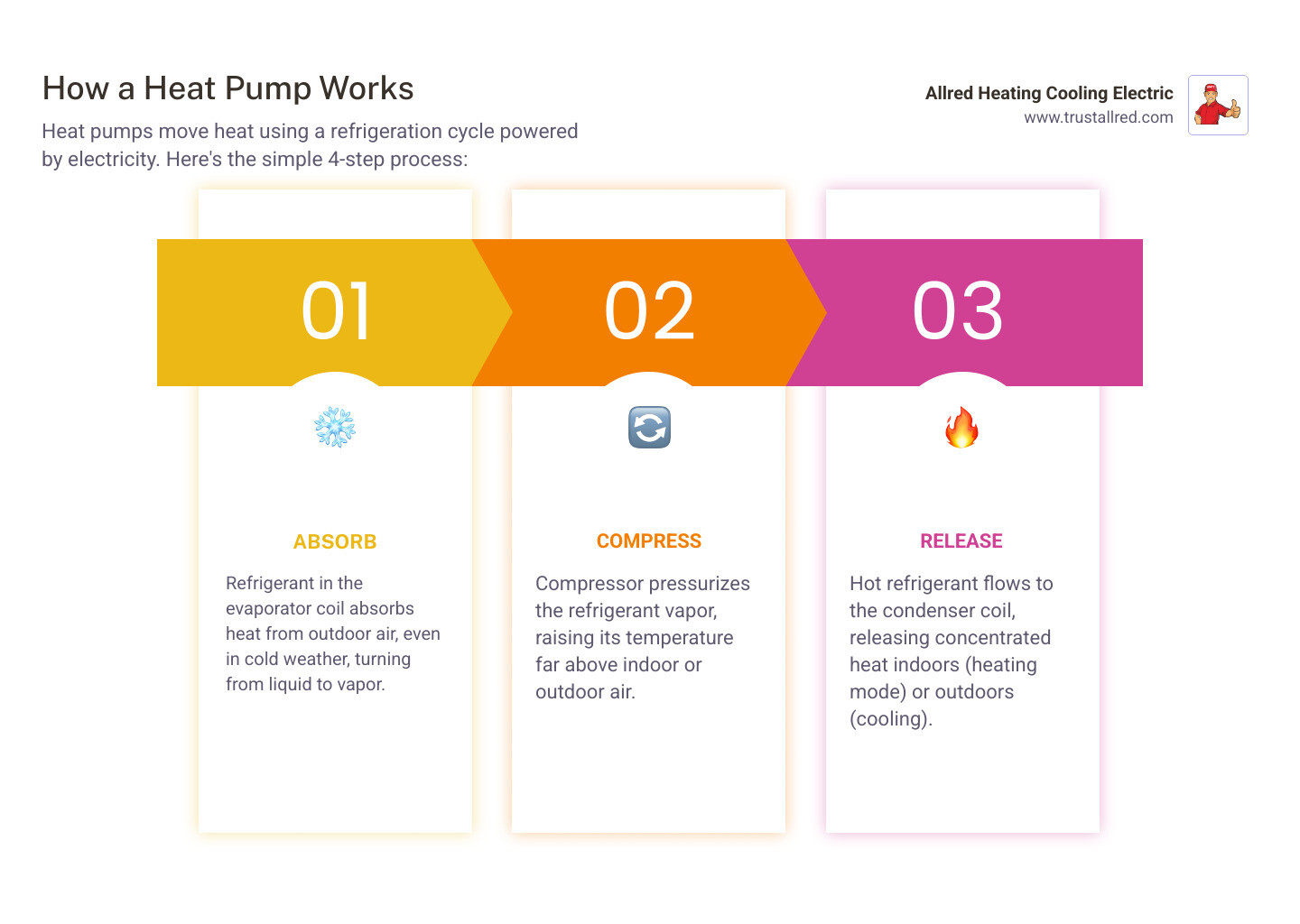
- Absorb — Refrigerant absorbs heat from outdoor air (even cold air)
- Compress — The compressor raises the refrigerant’s temperature and pressure
- Release — Heat transfers indoors through the indoor coil
- Expand — The refrigerant cools back down and the cycle repeats
Because a heat pump moves heat rather than burns fuel to create it, a single unit of electricity can deliver three to four units of heat energy into your home. That is why heat pumps can be three to five times more energy efficient than a gas boiler or electric furnace.
For Seattle-area homeowners dealing with unpredictable Pacific Northwest winters, rising energy bills, and the need for year-round comfort, understanding how this technology works is the first step toward making a smart decision for your home.
I’m Daniel Allred, co-founder of Allred Heating, Cooling & Electric, and over more than a decade of hands-on HVAC work across the Puget Sound region, I’ve helped hundreds of families understand exactly how does a heat pump work and whether it’s the right fit for their home. In the sections below, I’ll walk you through the full picture — from the basic refrigeration cycle to cold-climate performance — so you can make a confident, informed choice.
What is a Heat Pump and How Does It Work?
At its core, a heat pump is an electrical device that extracts heat from one place and transfers it to another. To understand how does a heat pump work, it helps to think of it as a “heat transporter” rather than a “heat creator.”
Traditional systems like furnaces create heat by burning fossil fuels or using electric resistance. This is inherently limited; you can never get more than 100% efficiency because you cannot create more energy than you consume. A heat pump, however, breaks this “rule” of physics by simply moving existing thermal energy. Even when it feels freezing outside in Auburn or Kent, there is still a massive amount of heat energy in the air. In fact, the heat content of air at -18°C (-0.4°F) still contains roughly 85% of the heat energy found at 21°C (70°F).
The magic happens through the refrigeration cycle. By using a special fluid called refrigerant, the system can become colder than the outdoor air to soak up heat, then become hotter than the indoor air to release it. This process is very similar to how your kitchen refrigerator works—it pulls heat from inside the fridge and vents it out the back (which is why the back of a fridge feels warm).
When comparing a Furnace vs Heat Pump Difference, the biggest takeaway is that the heat pump provides both heating and cooling in one system.
Main Types of Heat Pumps
Depending on your home’s structure in places like Bellevue or Sammamish, we typically install one of three main types:
- Air-Source Heat Pumps: The most common residential type. These extract heat from the outdoor air. They are versatile, easier to install, and can provide up to 75% of a home’s annual heating needs.
- Ground-Source (Geothermal) Heat Pumps: These use the stable temperature of the earth (usually 50-60°F below the frost line) to exchange heat. While they have higher upfront costs, they are incredibly efficient and can last over 50 years.
- Ductless Mini-Splits: Perfect for homes in Seattle or North Bend that don’t have existing ductwork. These use an outdoor compressor connected to small, wall-mounted indoor units to provide zoned comfort.
The Science of the Refrigeration Cycle
To truly grasp how does a heat pump work, we have to look under the hood at the four “heart” components of the system. The entire process relies on the relationship between pressure, temperature, and phase changes (turning a liquid into a gas and back again).
- The Evaporator Coil: This is where the magic starts. Cold, low-pressure liquid refrigerant flows through these coils. Because the refrigerant is colder than the air passing over it, it absorbs heat and evaporates into a gas.
- The Compressor: This is the “engine” of the system. It takes that cool gas and squeezes it tightly. Just like a bike pump gets hot when you use it, compressing the gas causes its temperature to skyrocket.
- The Condenser Coil: Now a hot, high-pressure gas, the refrigerant moves to the condenser coils. As air blows over the coils, the refrigerant releases its heat to the air and condenses back into a liquid.
- The Expansion Valve: Before the liquid refrigerant can go back to the start, it passes through this valve, which suddenly drops the pressure. This causes the temperature to plummet, preparing it to absorb heat all over again.
Refrigerant States: Heating vs. Cooling
| Component | Heating Mode (Indoor) | Cooling Mode (Indoor) |
|---|---|---|
| Indoor Coil | Acting as Condenser (Releases Heat) | Acting as Evaporator (Absorbs Heat) |
| Outdoor Coil | Acting as Evaporator (Absorbs Heat) | Acting as Condenser (Releases Heat) |
| Refrigerant State | Hot Gas to Warm Liquid | Cold Liquid to Cool Gas |
How does a heat pump work in heating mode?
In the winter, the outdoor unit acts as the “evaporator.” Even in a chilly Snoqualmie morning, the system makes the refrigerant so cold that it can still pull “warmth” from the 35°F air. Once that heat is captured, the compressor concentrates it until it’s hot enough to warm your home to a cozy 72°F. This follows the Second Law of Thermodynamics: heat naturally flows from a warmer object to a cooler one. By making the refrigerant the “coolest” thing around, we force the outdoor heat to jump into our system.
How does a heat pump work in cooling mode?
When summer hits the Puget Sound, a component called the reversing valve flips the direction of the refrigerant. Now, the indoor coil becomes the evaporator. It soaks up the heat inside your living room, carries it outside, and the outdoor coil (now the condenser) vents it into the backyard. This process also provides excellent dehumidification, making those humid July days much more bearable. If your system ever struggles to make this switch, you might need Heat Pump Repair Klahanie WA to check the reversing valve.
Efficiency and Performance in Cold Climates
One of the biggest myths we hear in Tacoma and Puyallup is that heat pumps don’t work in the cold. While it’s true that older models struggled when temperatures dropped below freezing, modern technology has changed the game.
The Coefficient of Performance (COP) is the metric we use to measure this. A typical heat pump has a COP of about 4.0, meaning for every 1 unit of electricity you pay for, you get 4 units of heat. For comparison, an electric furnace has a COP of 1.0. Even at -8°C (17°F), many air-source heat pumps maintain a COP between 1.1 and 3.7, which is still more efficient than traditional electric heat.
Cold Weather Features:
- Variable-Speed Compressors: Unlike older “on/off” systems, these can ramp up or down like a dimmer switch, providing exactly the amount of heat needed and maintaining efficiency in extreme cold.
- The Defrost Cycle: In freezing weather, frost can build up on the outdoor coils. The heat pump is smart enough to temporarily reverse itself, sending a bit of heat to the outdoor coil to melt the ice so it can keep breathing.
- Supplemental Heat: For those rare Seattle nights when it drops into the teens, many systems include a backup “heat strip” or are paired with a furnace in a “dual-fuel” configuration. You can learn more about these setups in our guide on Furnace vs Heat Pump.
Frequently Asked Questions about Heat Pumps
Can heat pumps work in freezing temperatures?
Absolutely. Modern “cold-climate” heat pumps are designed to operate effectively down to -22°F. While their efficiency (COP) does drop as it gets colder, they are still capable of extracting heat from the air. In our region—from Federal Way to Redmond—temperatures rarely stay low enough to challenge a well-installed, modern heat pump. Even at -18°C, the air still holds 85% of the heat energy it had at room temperature!
Why are heat pumps more energy efficient than furnaces?
It comes down to the difference between moving and making. A furnace has to burn gas or use a red-hot electric element to create heat. A heat pump just uses a little electricity to run a fan and a compressor to move heat that already exists outside. This allows them to reach 300% to 400% efficiency. Switching to a heat pump can reduce your electricity use for heating by approximately 50% compared to furnaces or baseboard heaters.
Do heat pumps require backup heating?
In the Pacific Northwest, most of our customers find that a high-performance heat pump handles 100% of their needs. However, in “hybrid” or “dual-fuel” systems, we pair a heat pump with a gas furnace. The heat pump handles the vast majority of the year, and the furnace only kicks in during the absolute coldest “Arctic blasts.” This gives you the best of both worlds: extreme efficiency most of the time and high-intensity heat when you really need it.
Conclusion
Understanding how does a heat pump work reveals why this technology has become the gold standard for home comfort in April 2026. By leveraging the laws of physics to move heat rather than create it, these systems offer a level of efficiency and versatility that traditional furnaces simply can’t match. Whether you are in Issaquah, Kirkland, or Spanaway, a heat pump is an investment in year-round comfort and lower energy bills.
At Allred Heating Cooling Electric, we aren’t just technicians; we are a family-owned team dedicated to keeping our neighbors comfortable. From Auburn to Snoqualmie, our expert technicians ensure your system is sized correctly and installed with the precision required for maximum efficiency. If you’re ready to stop “burning” money and start “moving” heat, we are here to help.
Upgrade to an efficient heat pump today and experience the Allred difference.
